Graphene Oxide Nanotech
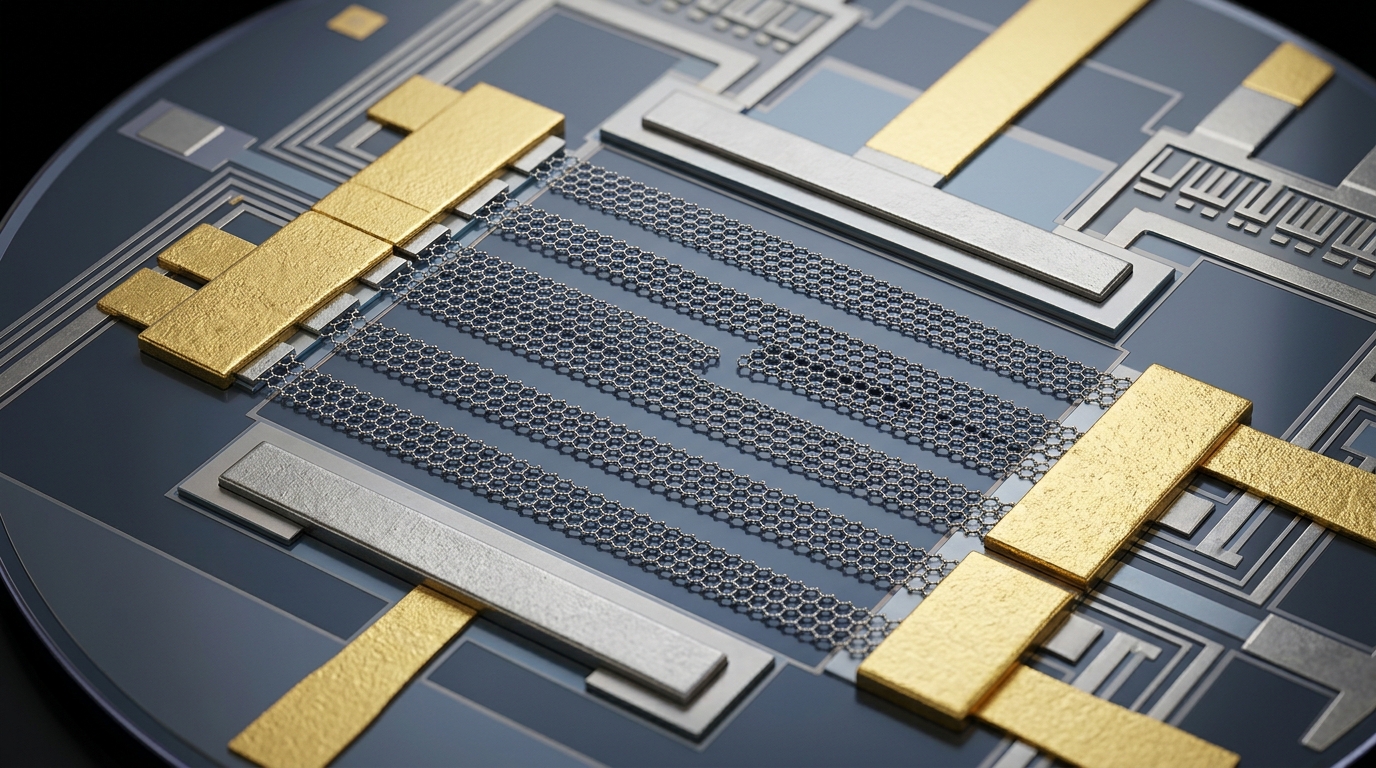
Graphene oxide nanotech occupies a foundational position in advanced materials science, bridging the atomic precision of two-dimensional carbon lattices with the versatile processing capabilities of wet-chemical engineering. While pristine graphene consists of a flawless, single-atom-thick sheet of sp2-hybridized carbon atoms arranged in a honeycomb lattice, graphene oxide (GO) is a heavily oxygenated derivative. This chemical modification disrupts the conjugated π-electron network, converting a portion of the planar lattice into sp3-hybridized carbon centers decorated with oxygen-bearing functional groups.
This structural departure transforms the physical, electrical, and chemical properties of the material. Whereas pristine graphene is electrically conductive, chemically inert, and hydrophobic, graphene oxide behaves as an electrical insulator with pronounced hydrophilicity, chemical reactivity, and mechanical resilience. These attributes allow researchers to synthesize, disperse, and manipulate two-dimensional carbon sheets in aqueous solutions at industrial volumes, establishing graphene oxide nanotech as a primary platform for membranes, nanocomposites, energy devices, and biotechnology.
Atomic Structure and Surface Chemistry of Graphene Oxide
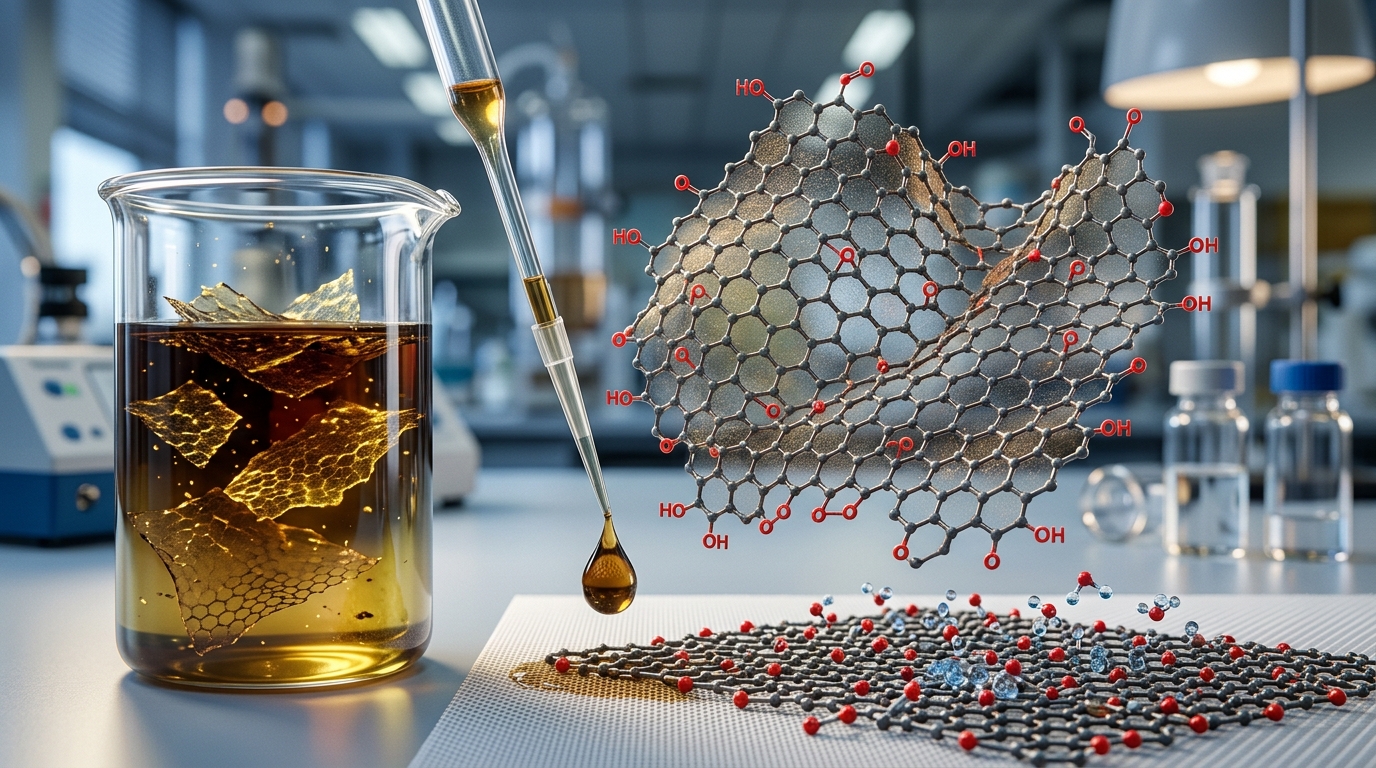
Understanding graphene oxide requires mapping its non-stoichiometric, structurally heterogeneous atomic landscape. Unlike pristine crystals with uniform unit cells, GO features a disordered carbon skeleton described predominantly by the Lerf-Klinowski model. This structural model posits that the basal plane consists of intact, aromatic sp2 carbon domains interspersed with oxidized, tetrahedral sp3 carbon networks.
The disruption of the pristine carbon plane is driven by specific oxygen-containing functional groups distributed across the sheet:
- Basal Plane Groups: Hydroxyl (-OH) and epoxide (-O-) groups dominate the interior flat surfaces of the sheets. Epoxide bridges span adjacent carbon atoms, inducing local steric strain and buckling the historically planar monolayer.
- Edge Terminations: Carboxyl (-COOH), carbonyl (=O), and minor lactone groups congregate almost exclusively at sheet peripheries and defect-induced tear points, where carbon valencies remain accessible for deeper oxidation.
The abundance of these polar functional groups imparts strong hydrophilicity to the material. When introduced to water or polar organic solvents, the hydroxyl and carboxyl groups readily deprotonate, conferring a negative surface charge. This produces strong electrostatic repulsion between adjacent sheets, allowing GO to achieve stable, single-layer colloidal dispersions without requiring chemical surfactants or polymer stabilizers.
Moreover, the insertion of oxygen species expands the interlayer spacing (d-spacing) of the material. In natural graphite, the d-spacing between adjacent sheets measures approximately 0.34 nanometers. In graphene oxide, the intercalated functional groups and bound water molecules expand this spacing to between 0.70 and 1.20 nanometers, depending on the relative humidity. This expanded basal spacing provides functional nanochannels for fluid flow, molecular separation, and ion intercalation.
Synthesis Paradigms: From Graphite to Graphene Oxide
The manufacture of graphene oxide relies on the oxidative exfoliation of graphite flakes. The objective is to intercalate oxidative agents between adjacent graphitic layers, oxidize the carbon basal planes, and separate the sheets using mechanical or acoustic energy.
The Chemical Evolution of Oxidation
The foundational techniques for oxidizing carbon were introduced in the nineteenth and early twentieth centuries by chemists such as Benjamin Brodie (using potassium chlorate and fuming nitric acid) and William Staudenmaier (incorporating concentrated sulfuric acid). These early protocols released volatile, hazardous gases such as chlorine dioxide (ClO2) and required prolonged reaction windows.
In 1958, William Hummers and Richard Offeman introduced a more efficient synthesis using potassium permanganate (KMnO4), sodium nitrate (NaNO3), and concentrated sulfuric acid (H2SO4). The Hummers method shortened reaction times and increased oxidation efficiency, establishing the baseline framework for modern wet-chemical routes.
The Modified and Improved Hummers Methods
Modern industrial and academic laboratories rely predominantly on modified or improved variants of the Hummers protocol. Key advancements include:
- Exclusion of Sodium Nitrate: Traditional protocols produced toxic nitrogen dioxide (NO2) and dinitrogen tetroxide (N2O4) emissions. Modified methods often eliminate NaNO3, adjusting the acid ratios to maintain oxidative strength while preventing toxic gas evolution.
- Dual-Acid Systems: The Tour method replaces the standard mixture with a 9:1 volume ratio of concentrated H2SO4 and phosphoric acid (H3PO4). Phosphoric acid preserves intact graphitic domains within the basal plane, yielding larger sheet sizes and fewer permanent vacancies in the carbon lattice.
- Exfoliation and Purification: Following the oxidative cycle, the intercalated material undergoes exfoliation via low-energy bath sonication, mechanical shear mixing, or high-pressure microfluidization. Purification requires extensive multi-stage washing, centrifugation, and dialysis to remove trace transition metals, residual sulfates, and highly oxidized carbon fragments known as oxidative debris.
Comparing Graphene Oxide (GO) and Reduced Graphene Oxide (rGO)
Graphene oxide serves as a functional nanomaterial in its native state, but it also functions as a precursor for reduced graphene oxide (rGO). Because pristine graphene is difficult to mass-produce via direct liquid-phase exfoliation of graphite without aggressive aggregation, researchers chemically oxidize graphite to water-soluble GO, process the sheets into their desired morphology, and subsequently reduce them to restore graphitic properties.
| Property | Graphene Oxide (GO) | Reduced Graphene Oxide (rGO) | Pristine Graphene |
|---|---|---|---|
| Hybridization | Mixed sp2 / sp3 | Predominantly sp2, residual sp3 | Pure sp2 |
| Electrical Conductivity | Insulating to semi-conductive | Semiconductive to moderately conductive | Ballistic / extremely high |
| Aqueous Dispersibility | High stability without surfactants | Poor; aggregates via π-π stacking | Hydrophobic; unstable |
| Interlayer Spacing (d-spacing) | 0.70 to 1.20 nm | 0.36 to 0.40 nm | ~0.34 nm |
| Lattice Integrity | High defect density, holes, tears | Permanent topological defects remain | Near-zero point defects |
Reduction Strategies
Converting GO to rGO involves stripping away the bound oxygen moieties to restore electrical pathway continuity. Three primary reduction mechanisms are employed:
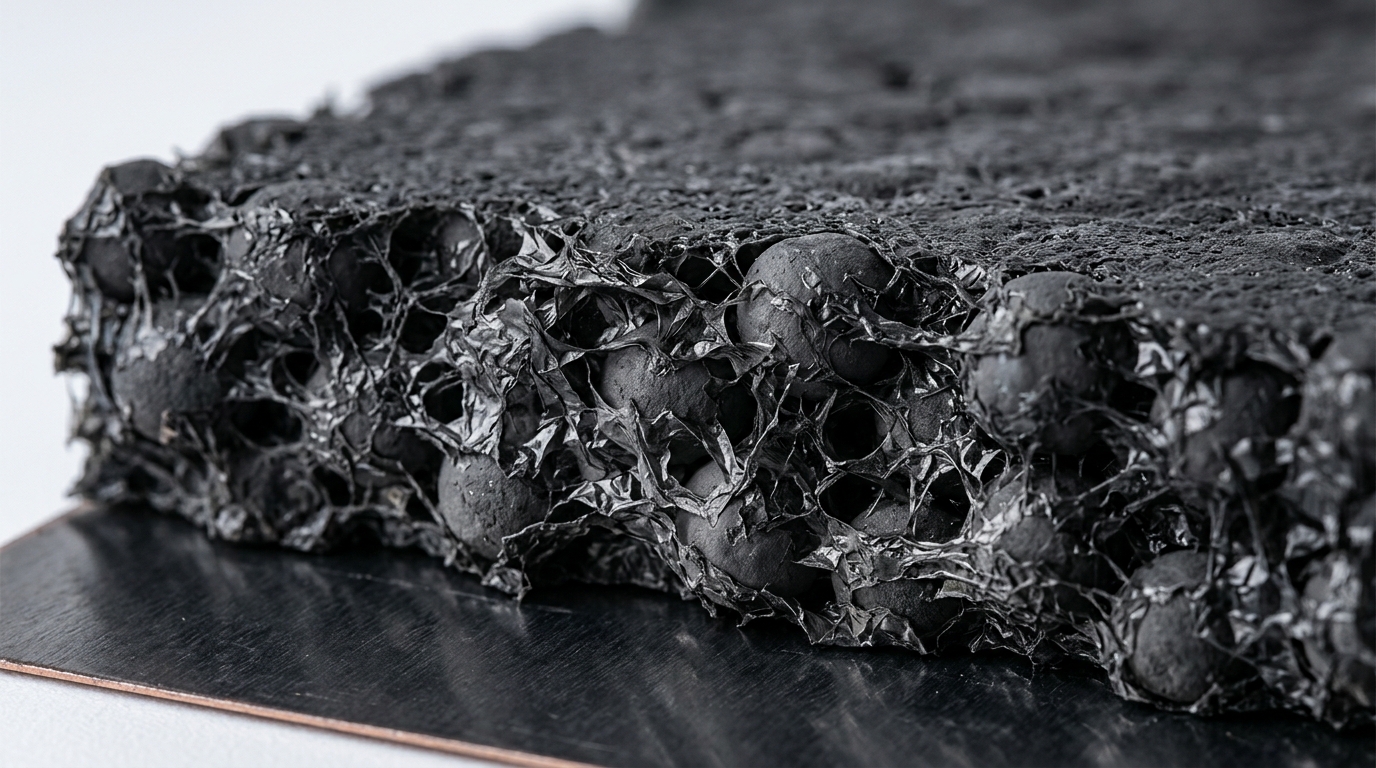
- Thermal Reduction: Rapid heating to elevated temperatures (often exceeding 800°C in inert or reducing atmospheres) causes explosive outgassing of carbon monoxide and carbon dioxide. This exfoliates and reduces the material simultaneously, though it often leaves topological micro-holes in the basal plane.
- Chemical Reduction: Chemical reagents, such as hydrazine hydrate, sodium borohydride, or ascorbic acid (vitamin C), reduce functional groups at lower temperatures. Ascorbic acid is widely favored in environmentally conscious operations to avoid the toxic handling profiles of hydrazine.
- Electrochemical Reduction: Applying cathodic voltages to conductive substrates coated with GO eliminates oxygen functional groups without requiring hazardous chemical reagents or high-temperature processing.
Although reduction recovers substantial electrical conductivity, rGO does not reach the defect-free electronic quality of pristine graphene. The oxidation process inevitably creates Stone-Wales defects, carbon atom vacancies, and disrupted bonding sites that persist through subsequent chemical or thermal reduction steps.
Core Applications in Nanotechnology
Because graphene oxide combines mechanical strength, chemical tunability, and solution processability, it is an active focus within applied nanotechnology.
1. Water Filtration and Molecular Separation Membranes
When GO sheets are deposited layer-by-layer—via vacuum filtration, spin-coating, or spray deposition—they assemble into ordered, lamellar paper-like membranes. Within these laminates, the spaces between non-oxidized carbon regions create frictionless two-dimensional capillaries.
Water molecules pass through these pristine sub-nanometer channels at high speeds via cooperative hydrogen-bonding networks, while the oxidized regions anchor the structure and reject solvated ions, organic dyes, micro-pollutants, and heavy metals. By modifying the interlayer spacing through cross-linking agents (such as diamines or multivalent cations), engineers can tune the molecular cutoff threshold, tailoring membranes for forward osmosis, reverse osmosis, and industrial solvent nanofiltration.
2. Energy Storage: Batteries and Supercapacitors
In clean energy systems, native GO serves as a versatile precursor, structural framework, and protective additive:
- Lithium-Ion and Post-Lithium Batteries: Reduced graphene oxide architectures serve as conductive, high-surface-area scaffolds for high-capacity anode materials (such as silicon, tin oxide, or sulfur cathodes in lithium-sulfur batteries) that otherwise experience severe volume expansion and mechanical degradation during cycling.
- Supercapacitors: Chemically tailored rGO provides high specific surface area, supporting electric double-layer capacitance (EDLC). Furthermore, residual oxygen groups on partially reduced GO introduce pseudocapacitive charge storage mechanisms via fast, reversible Faradaic redox reactions at the electrode-electrolyte interface.
- Solid-State Electrolytes: Low concentrations of GO dispersed in polymer-based solid electrolytes provide mechanical reinforcement while their polar surfaces facilitate lithium-ion dissociation, improving room-temperature ionic conductivity.
- Targeted Drug Delivery: Aromatic, non-oxidized sp2 domains bind hydrophobic chemotherapy drugs (such as doxorubicin) via non-covalent π-π stacking, while surrounding hydroxyl and carboxyl groups allow researchers to graft biocompatible polymers (such as polyethylene glycol, or PEG) and targeting antibodies to direct systemic circulation.
- Biosensors: Because GO readily quenches fluorescence via non-radiative energy transfer, it is frequently incorporated into fluorescent resonance energy transfer (FRET) biosensors to detect viral RNA, DNA sequences, proteins, and metal ions with high analytical sensitivity.
- Photothermal Research: Near-infrared (NIR) light absorption by functionalized GO and rGO complexes enables targeted local hyperthermia in preclinical oncological research, designed to disrupt target cells without damaging adjacent tissues.
3. High-Performance Polymer Nanocomposites
Pristine graphene often aggregates when mixed into polymer matrices because of strong inter-sheet van der Waals forces. Graphene oxide, by contrast, readily integrates into polymers such as poly(methyl methacrylate) (PMMA), epoxy resins, and polyvinyl alcohol (PVA).
The oxygen functional groups on GO participate in covalent bonding or strong hydrogen bonding with host polymer chains. This robust interfacial adhesion ensures effective stress transfer across phase boundaries. Incorporating low volume fractions (0.1 to 2.0 wt%) of GO can substantially increase tensile modulus, ultimate strength, thermal decomposition thresholds, and gas barrier properties—reducing gas permeability in packaging films and aerospace coatings.
4. Nanomedicine and Biosensing Platforms
In nanomedicine, graphene oxide provides high surface-area-to-mass ratios: every atom on its two-dimensional basal plane is an exposed surface atom. Researchers leverage this geometry across several specialized applications:
Biocompatibility and Environmental Safety Considerations
The translation of graphene oxide nanotech from laboratory demonstrations to widespread deployment requires a complete understanding of its interaction with biological and ecological systems. The toxicological profile of GO is not absolute; it depends on sheet lateral dimensions, surface charge, purity, and functionalization state.
Small, highly hydrophilic, polymer-functionalized sheets (under 200 nanometers) show favorable blood circulation profiles and are gradually cleared through renal and hepatobiliary pathways in animal models. Conversely, large, pristine micro-sheets with sharp, irregular edges can mechanically damage cellular membranes or generate reactive oxygen species (ROS), causing oxidative stress and localized cytotoxicity at elevated concentrations.
From an ecological perspective, scientists have demonstrated that native graphene oxide can undergo biological degradation. Specific human and environmental peroxidases—including myeloperoxidase (expressed by human neutrophils), eosinophil peroxidase, and horseradish peroxidase—can catalyze the oxidation and cleave the basal plane of GO over time. These enzymatic pathways break the sheet down into benign, low-molecular-weight degradation fragments, distinguishing GO from bio-persistent carbon materials such as multi-walled carbon nanotubes.
Current Technological and Commercial Scaling Challenges
Despite substantial research progress, the commercial deployment of graphene oxide nanotech continues to confront technical and financial hurdles:
Batch-to-Batch Variability
Unlike single-crystal silicon or precision-synthesized macromolecules, graphene oxide is non-stoichiometric. The precise ratio of epoxy to hydroxyl groups, the distribution of functional groups along the basal plane, the oxygen-to-carbon (O/C) ratio, and the lateral flake size vary between individual production runs. This variability can compromise the consistency of final products in high-precision markets such as microelectronics and regulated therapeutics.
Hazardous Waste and Environmental Footprint
The modified Hummers method requires concentrated sulfuric acid, potassium permanganate, and multi-step hydrogen peroxide washes. Generating one kilogram of dry graphene oxide produces tens to hundreds of liters of acidic, heavy-metal-bearing wastewater that requires comprehensive neutralization and disposal. Developing “green” oxidation protocols that replace harsh mineral acids with recyclable oxidants remains an ongoing research objective.
Defect Control and Structural Degradation
While oxidation is necessary to enable liquid-phase exfoliation and processing, it introduces structural vacancies—missing carbon atoms—in the honeycomb plane that cannot be fully repaired through chemical or thermal reduction. Applications that require exceptional carrier mobility, such as high-frequency electronics, typically rely on chemical vapor deposition (CVD) graphene, which produces continuous, low-defect monolayers despite higher fabrication costs and lower overall yield compared to bulk GO slurries.
Scalable Drying and Redispersion
Transporting GO as an aqueous slurry is cost-inefficient and prone to shelf-life degradation through gradual, spontaneous chemical reduction over time. However, drying GO into dry powders using conventional methods often causes irreversible agglomeration as adjacent sheets collapse and interlock. Mitigating this issue requires specialized freeze-drying (lyophilization) or spray-drying methods that raise the final unit costs of bulk-form materials.
The Horizon for Graphene Oxide Nanomaterials
Graphene oxide nanotech provides an accessible, cost-effective platform for working with two-dimensional carbon lattices outside of high-vacuum, high-temperature synthesis chambers. By balancing structural defects with surface reactivity and colloidal stability, chemical engineers continue to integrate GO into advanced separation media, long-cycle energy storage systems, structural composites, and diagnostic platforms.
As continuous processing reactors, automated quality validation, and cleaner oxidation chemistries replace open-vessel batch synthesis, graphene oxide is poised to transition from an exploratory laboratory nanomaterial into an engineered additive across modern industrial materials science.