
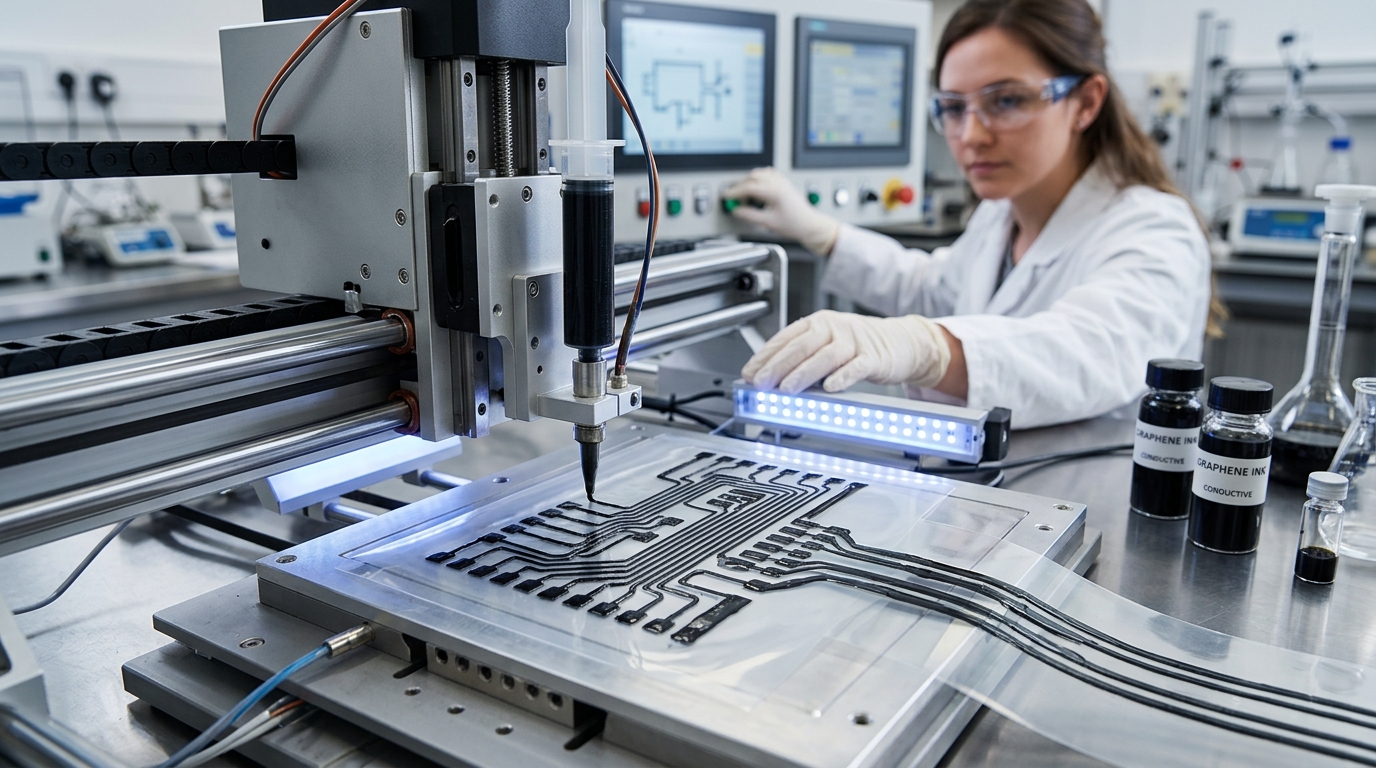
Graphene Inks
Graphene inks are liquid dispersions of single-layer or few-layer graphene flakes engineered for deposition via standard commercial printing technologies. By translating the exceptional electrical conductivity, mechanical robustness, chemical inertness, and thermal transport of carbon nanomaterials into liquid formulations, these inks enable the direct fabrication of flexible electronics, smart packaging, wearable biosensors, and energy storage devices onto substrates ranging from paper and plastic to textiles and ceramics.
While metallic nanoparticle inks—most notably silver and copper—have historically dominated printed electronics, graphene inks provide distinct physical advantages. They resist atmospheric oxidation, withstand rigorous bending and stretching without cracking, and feature lower material density. Realizing these benefits requires balancing chemical formulation, fluid dynamics, deposition mechanics, and post-deposition processing.
Formulation Chemistry and Graphene Precursors
A functional graphene ink is more than just graphene powder mixed into a liquid. It is a finely balanced colloidal suspension where the graphene flakes must remain dispersed without irreversibly agglomerating due to strong inter-sheet van der Waals forces. The electrical, optical, and mechanical performance of the printed pattern depends fundamentally on the chosen precursor material and dispersion chemistry.
Graphene Allotropes and Flake Types
Ink formulators select from three primary graphene precursor types, each presenting distinct performance trade-offs:
- Liquid-Phase Exfoliated (LPE) Graphene: Produced by shearing or sonicating pristine graphite in stabilizing solvents or surfactant-water mixtures. LPE flakes retain the pristine sp2-hybridized carbon lattice, yielding excellent intrinsic electrical conductivity and environmental stability. However, flake concentration is often modest, and lateral dimensions can vary.
- Graphene Oxide (GO): Synthesized via the chemical oxidation of graphite, decorating the basal planes and edges with hydroxyl, epoxy, and carboxyl groups. GO disperses readily in water without surfactants and forms stable, high-concentration inks. Because the oxidative process disrupts the conjugated electron network, GO is an electrical insulator and requires an active chemical or thermal reduction step post-printing to restore conductivity.
- Reduced Graphene Oxide (rGO): Chemically, thermally, or photothermally reduced prior to or after ink formulation. While rGO exhibits restored electrical conductivity, residual oxygen defects and lattice vacancies keep its conductivity lower than pristine LPE graphene. Nevertheless, its dispersibility and yield make it a dominant material in high-throughput printing.
Solvents, Binders, and Stabilizers
The continuous liquid phase determines the evaporation rate, wetting behavior, and compatibility with target substrates. Organic solvents with high surface tension and matching surface energy, such as N-methyl-2-pyrrolidone (NMP) and dimethylformamide (DMF), disperse pristine graphene effectively but are toxic and possess high boiling points that complicate low-temperature drying. Consequently, industrial formulations frequently prioritize eco-friendly solvent systems:
- Aqueous Formulations: Water-based inks require ionic or non-ionic surfactants, such as sodium dodecyl sulfate (SDS) or block copolymers, to prevent re-stacking. The surfactant wraps around the graphene flakes, generating steric or electrostatic repulsion.
- Alcohol-Ether Blends: Mixtures of ethanol, isopropanol, and terpineol are widely used to balance volatility, surface tension, and viscosity for graphic and industrial printheads.
- Polymeric Binders: Polymers such as ethyl cellulose, polyvinyl alcohol (PVA), or polyurethane are added to tune viscosity and enhance substrate adhesion. While binders improve print quality and mechanical durability, they act as insulating barriers between graphene flakes. As a result, binders must either be kept at a minimal concentration or burned off during post-print thermal curing.
Printing Methods and Fluid Rheology
Printing graphene onto a target substrate requires precisely matching the ink’s fluid properties to the mechanical shear forces and droplet-formation physics of the deposition equipment. The key rheological parameters include dynamic viscosity, surface tension, shear-thinning behavior, and the dimensionless Ohnesorge number, which dictates fluid droplet stability.
| Printing Method | Viscosity Range (mPa·s) | Key Rheological Requirements | Common Applications |
|---|---|---|---|
| Inkjet Printing | 1 to 20 | Low viscosity, high surface tension stability, strict filtration (<0.2–0.5 µm flake size) to prevent nozzle clogging. | High-resolution sensors, prototyping, micro-supercapacitors. |
| Screen Printing | 1,000 to 50,000+ | High viscosity, pronounced thixotropy, and shear-thinning behavior to pass through mesh and retain line definition. | RFID antennas, flexible heating elements, textile integration. |
| Gravure / Flexography | 50 to 500 | Moderate viscosity, rapid fluid transfer, fast solvent evaporation for roll-to-roll speeds. | High-volume smart packaging, printed conductive traces. |
| Aerosol Jet Printing | 1 to 1,000 | Atomization-compatible carrier solvent, wide viscosity latitude, narrow flake size distribution. | 3D conformable surfaces, micro-interconnects, aerospace arrays. |
Inkjet Printing Constraints
Inkjet printing offers digital, maskless deposition with high spatial resolution, making it suitable for iterative prototyping and customized electronics. However, it imposes the most stringent physical requirements on graphene inks. The lateral dimension of the graphene flakes must not exceed one-fiftieth of the printhead nozzle diameter (typically under 500 nanometers) to prevent satellite droplet formation and physical nozzle clogging. The ink must exhibit reliable acoustic or thermal droplet break-off without forming long, viscous fluid filaments.
Screen Printing and Thixotropic Pastes
For industrial-scale manufacturing of thicker functional patterns, screen printing is the leading commercial technique. Graphene screen-printing pastes require thixotropic behavior: the paste must decrease in viscosity under the mechanical shear applied by the moving squeegee, flow smoothly through the open screen mesh, and rapidly regain its high resting viscosity upon reaching the substrate to prevent line spreading or slump before drying.
Post-Deposition Processing and Curing Mechanisms
Freshly printed graphene inks are rarely conductive immediately after deposition. The printed pattern consists of isolated graphene flakes separated by residual solvent molecules, insulating surfactants, and polymer binders. Establishing a low-resistance electrical network requires post-deposition processing to induce percolation threshold transitions, where adjacent flakes establish intimate physical and electrical contact.
Thermal Annealing
The standard route to electrical activation involves thermal baking in a convection oven or vacuum furnace. Temperatures exceeding 250°C to 350°C effectively decompose organic binders and desorb insulating surfactants, driving flake-to-flake contact resistance down. While high-temperature annealing yields superior conductivity, it is incompatible with low-cost, heat-sensitive flexible substrates such as polyethylene terephthalate (PET) or paper, which degrade or warp above 120°C to 150°C.
Photonic and Laser Curing
To bypass the thermal limitations of flexible polymers, advanced sintering techniques have been developed:
- Photonic Flash Sintering: High-energy xenon flash lamps deliver short millisecond pulses of broad-spectrum light. The dark graphene pattern strongly absorbs the optical energy, heating locally to hundreds of degrees within fractions of a second, while the transparent or light-colored polymer substrate remains cool and undamaged.
- Laser Sintering: Focused infrared or visible lasers scan the printed path. This technique provides pinpoint thermal input, burning off binders or photothermally converting graphene oxide into reduced graphene oxide without exposing adjacent substrate regions to heat.
- Chemical Vapor Reduction: For graphene oxide inks deposited on temperature-sensitive films, exposure to hydrazine vapor, ascorbic acid baths, or hydrogen plasma removes oxygen functionalities at ambient or mild temperatures.
Electrical, Mechanical, and Chemical Performance
Graphene inks are evaluated based on how their physical properties withstand environmental, mechanical, and electrical stresses in final device architectures.
Electrical Conductivity and Sheet Resistance
The electrical performance of a printed graphene film is conventionally quantified in terms of sheet resistance ($R_s$), expressed in ohms per square ($ ext{Ω}/ ext{sq}$), normalized to a specific film thickness. While single-crystal graphene exhibits ballistic electron transport, printed graphene films are disordered networks where macroscopic charge transport is governed by hopping conduction across inter-flake junction boundaries. As a result, typical commercial graphene ink traces exhibit sheet resistances ranging from $5 ext{ Ω}/ ext{sq}$ to $100 ext{ Ω}/ ext{sq}$ for thick screen-printed layers (several micrometers thick), and $500 ext{ Ω}/ ext{sq}$ to several thousand $ ext{ Ω}/ ext{sq}$ for thin, semi-transparent inkjet-printed layers.
Mechanical Flexibility and Fatigue Resistance
Unlike metal nanoparticle films, which are prone to microcracking, delamination, and electromigration when bent repeatedly over small radii, graphene networks demonstrate exceptional mechanical robustness. The high intrinsic tensile strength and flexible two-dimensional nature of graphene sheets allow printed traces to undergo tens of thousands of flexural, torsional, and stretching cycles with negligible resistance changes. This makes graphene ink an ideal candidate for dynamic mechanical environments such as smart apparel, human-machine interface patches, and deployable aerospace membranes.
Chemical Passivation and Biocompatibility
Graphene is chemically stable, non-corrosive, and impermeable to moisture, oxygen, and standard industrial solvents. When printed as a surface layer, it provides intrinsic environmental passivation. Furthermore, clean pristine graphene and rGO formulations exhibit high electrochemical stability and favorable biocompatibility, which allows direct contact with biological fluids without the toxic metal ion leaching associated with copper or silver systems.
Practical and Commercial Applications
The unique combination of processability and material properties has moved graphene inks from laboratory demonstrations into commercial production across multiple sectors.
Flexible Radio-Frequency (RFID) Antennas and Smart Packaging
Graphene inks enable the high-speed roll-to-roll printing of radio-frequency identification (RFID) and near-field communication (NFC) antennas directly onto cardboard shipping boxes, paper labels, and flexible packaging. The conductivity achieved with thick screen-printed or flexographic graphene layers is sufficient to match impedance requirements across standard UHF (860–960 MHz) and HF (13.56 MHz) bands. Graphene-based antennas offer a more sustainable, metal-free, and readily recyclable alternative to traditional etched aluminum or copper antennas.
Electrochemical and Wearable Biosensors
The high electroactive surface area and fast electron-transfer kinetics of printed graphene make it a benchmark material for electrochemical sensing electrodes. Graphene inks are printed to create disposable test strips that quantify analyte concentrations—such as glucose, lactate, uric acid, and specific viral antigens—in blood, interstitial fluid, and sweat. The surface of the printed graphene can be functionalized with specific enzymes, antibodies, or aptamers to achieve high selectivity.
Printed Heaters and Thermal Management
Because graphene exhibits high thermal conductivity alongside its electrical properties, printed graphene tracks function as uniform, rapid-response Joule heating elements. Screen-printed graphene patterns are integrated into automotive seats, side-mirror defrosters, aerospace de-icing surfaces, and thermal wellness garments. These elements heat evenly across large surface areas without localized hot-spot degradation.
Energy Storage Electrodes
Planar micro-supercapacitors and thin-film battery current collectors utilize high-surface-area graphene inks deposited in interdigitated patterns. The printed graphene serves a dual role: it provides a conductive percolation network that accelerates electron collection while offering an accessible porous matrix for electrolyte ion adsorption and charge storage.
Evaluation Criteria and Selection Metrics
When selecting or formulating a graphene ink for a specific manufacturing process, engineers evaluate several core parameters to ensure process reliability and device performance:
- Flake Lateral Size Distribution: Measured via dynamic light scattering (DLS) or transmission electron microscopy (TEM). Determines printhead compatibility and influences the number of inter-flake junctions per unit length.
- Defect Density ($I_D/I_G$ Ratio): Assessed by Raman spectroscopy. A low ratio of the defect-induced D-band to the graphitic G-band indicates a pristine sp2 lattice, corresponding to higher intrinsic charge carrier mobility.
- Dispersant-to-Graphene Ratio: Quantifies the proportion of non-conductive stabilizers that must be removed during the drying or curing cycle.
- Z-Number (Fluid Printability): The inverse of the Ohnesorge number ($Z = ext{Re} / ext{We}^{1/2}$), calculated from the ink’s density, viscosity, surface tension, and nozzle orifice diameter. Values between 1 and 14 indicate stable, satellite-free droplet formation in drop-on-demand inkjet systems.
- Adhesion Strength: Evaluated using standard cross-hatch tape testing (ASTM D3359) across varying environmental humidity and temperature ranges to ensure the ink adheres robustly to target substrates like polyimide, glass, or textiles.
Engineering Trade-Offs and Manufacturing Realities
Deploying graphene inks requires understanding their operational limits. Graphene inks are not an absolute replacement for metallic conductors in every electronic system. For applications requiring low trace resistance across long, narrow interconnects—such as primary power buses or high-density microprocessors—bulk metals and silver pastes remain superior due to their lower volume resistivity.
Instead, graphene inks excel where mechanical flex-life, biocompatibility, low environmental footprint, chemical resistance, optical semi-transparency, or large-area cost structures dominate the design priorities. By tailoring the precursor choice, fluid rheology, and curing protocols to the specific constraints of the substrate and printing hardware, engineers can implement printed graphene systems that deliver durable, high-throughput functionality across the modern electronics landscape.