Graphene Battery News
The commercial energy storage sector is experiencing a transition as nanomaterial integration moves out of exploratory university labs and into scaled manufacturing facilities. Staying informed on graphene battery news requires separating electrochemical realities from recurring media hype regarding theoretical “miracle batteries.” Between 2024 and 2026, the sector shifted decisively away from conceptual benchtop claims toward high-volume pilot production, specialized industrial deployments, and the strategic acquisition of distressed gigafactory infrastructure.
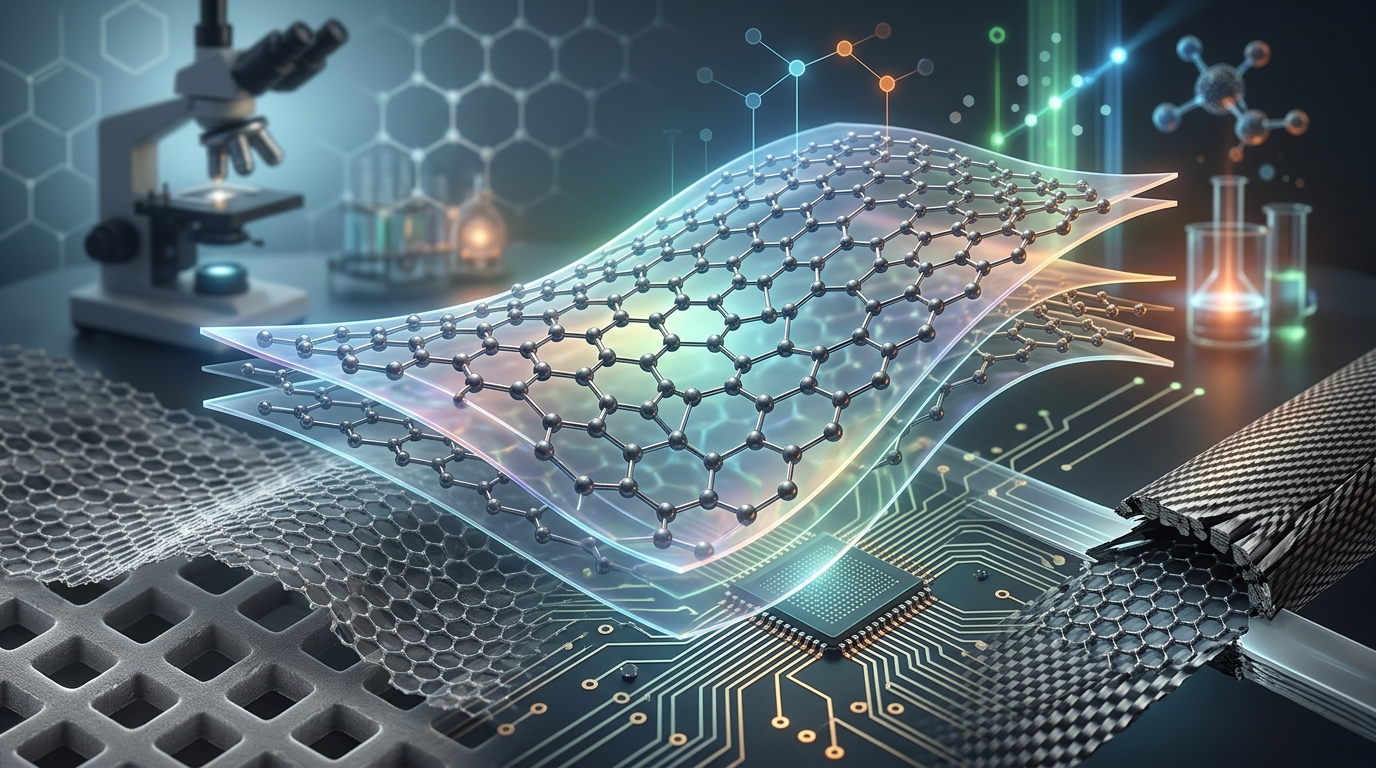
Today, graphene is not replacing electrochemistry wholesale. Instead, it is functioning as a transformative conductive additive and structural scaffolding that resolves critical thermal, kinetic, and degradation barriers in next-generation lithium-ion, lithium-sulfur, and alternative-ion battery platforms.
The Critical Distinction: Pure Graphene vs. Graphene-Enhanced Chemistries
Much of the public confusion surrounding battery commercialization stems from ambiguous terminology. Industry analysts distinguish between two distinct technical categories: theoretical pure-graphene electrodes and commercially viable graphene-enhanced formulations.
The Myth of the Monolithic “Pure Graphene” Battery
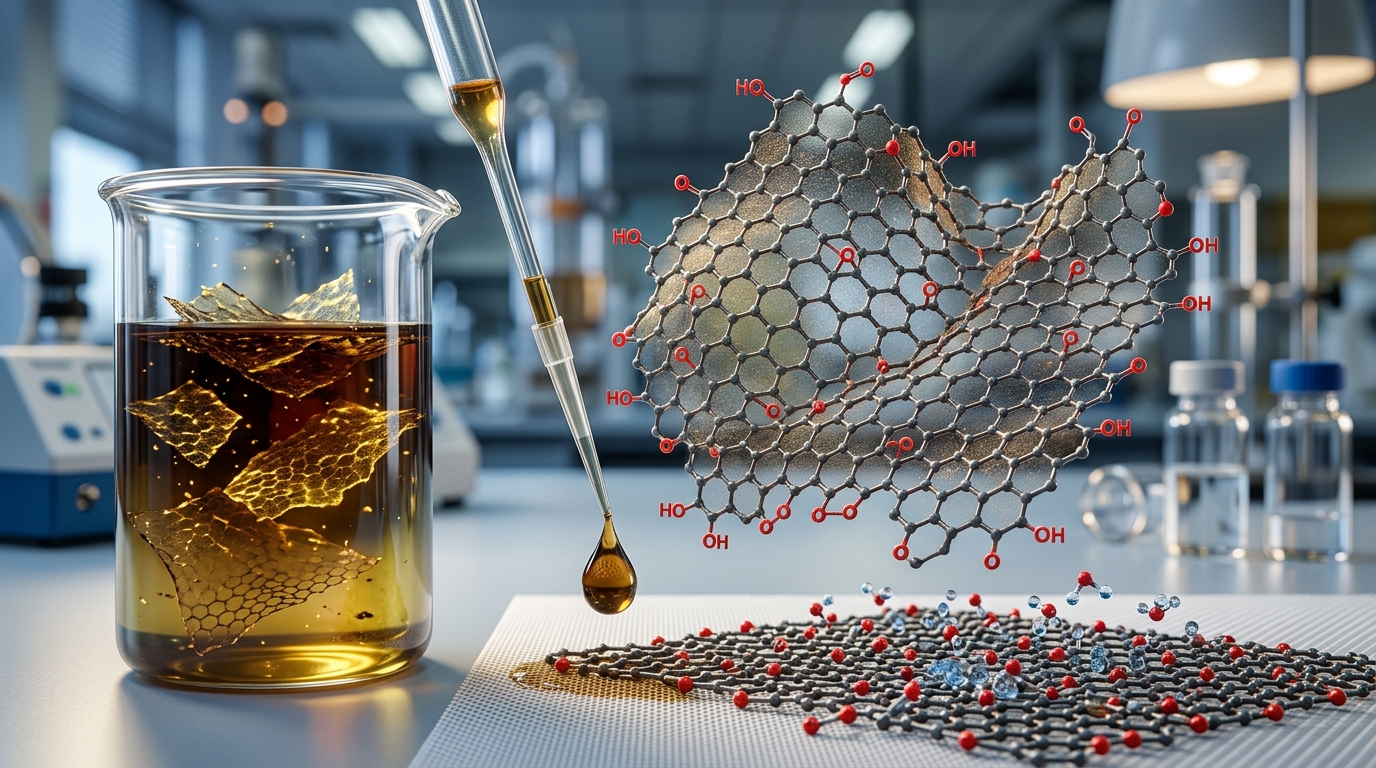
True 100% pure graphene electrodes remain largely confined to fundamental academic literature. While a single layer of sp²-hybridized carbon demonstrates theoretical electron mobility exceeding 200,000 cm²/V·s and a theoretical specific surface area of approximately 2,630 m²/g, translating these characteristics into a monolithic battery electrode introduces severe electrochemical failure modes:
- Massive First-Cycle Capacity Loss: The extreme surface area triggers uncontrolled decomposition of liquid electrolytes, generating an excessively thick Solid Electrolyte Interphase (SEI) layer. This parasitic reaction permanently consumes active lithium ions during the initial charge, slashing first-cycle coulombic efficiency.
- Van der Waals Restacking: Pristine, isolated graphene sheets exhibit an innate thermodynamic tendency to agglomerate and restack into bulk graphite during processing. This restacking collapses the microscopic ion diffusion pathways that researchers attempt to engineer.
- Unacceptable Volumetric Tap Density: Pristine graphene is an exceptionally fluffy, low-density material. Even if a pure graphene cell achieves high gravimetric energy density (Wh/kg), its volumetric energy density (Wh/L) is fundamentally compromised, resulting in bulky packs impractical for passenger electric vehicles.
Graphene-Enhanced Lithium-Ion and Composite Systems
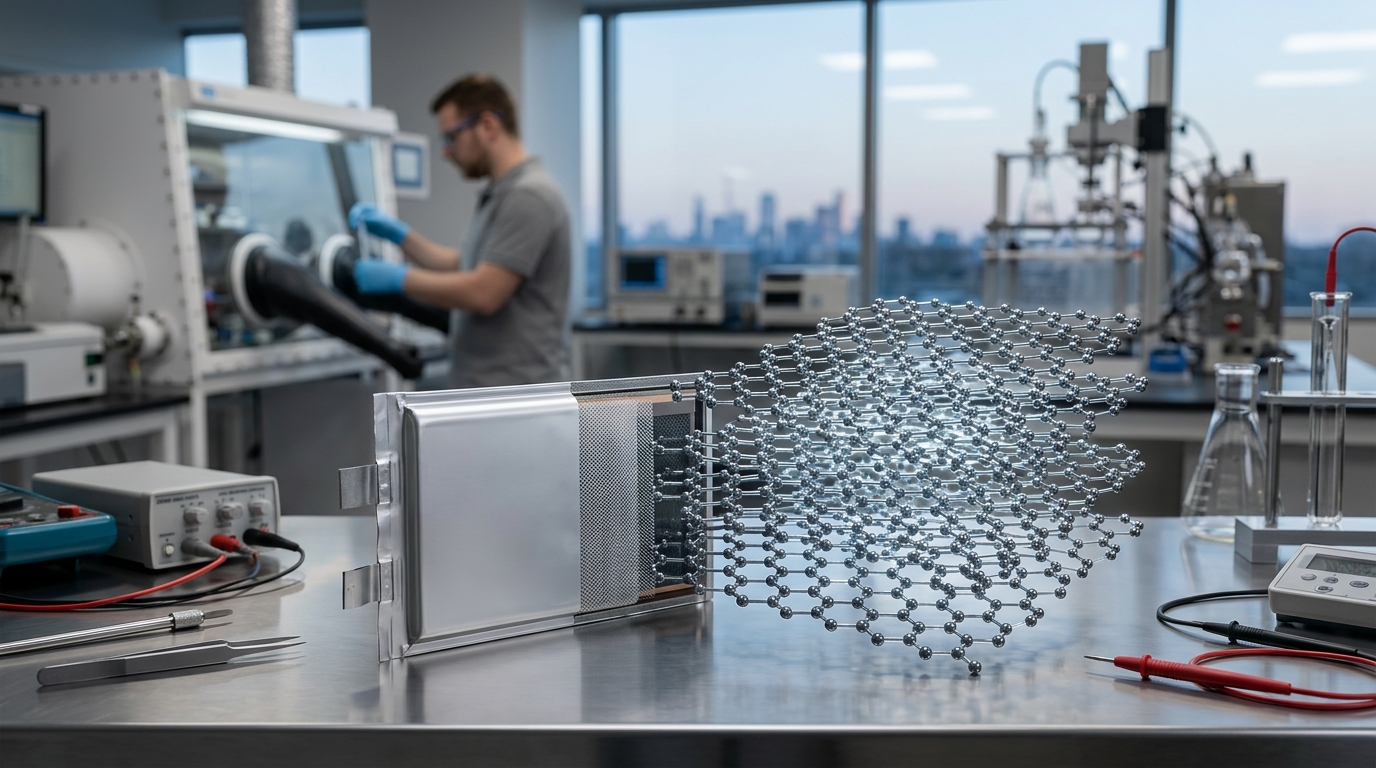
The real-world commercial traction documented across recent news cycles involves graphene-enhanced or graphene-doped chemistries. In these cells, graphene operates as an advanced conductive modifier—typically incorporated at concentrations under 1 to 3 weight percent (wt%)—rather than serving as the sole host active material.
When blended into standard cathode formulations (such as lithium iron phosphate [LFP] or nickel manganese cobalt [NMC]) or integrated into high-capacity silicon-composite anodes, graphene creates an uninterrupted, percolating electrical network. This matrix delivers several distinct performance advantages:
- Accelerated Charge Kinetics (4C to 6C Rates): By drastically lowering cell internal impedance, graphene allows high charging currents without generating catastrophic localized voltage drops.
- Superior Thermal Dissipation: High in-plane thermal conductivity rapidly distributes heat away from localized electrochemical hot spots, suppressing the primary drivers of thermal runaway during ultrafast charging.
- Mechanical Buffering for Silicon Anodes: Silicon expands by roughly 300% upon lithiation. Graphene networks wrap silicon nanoparticles, maintaining electrical connectivity and preventing pulverization across prolonged charge-discharge cycling.
Enabling Next-Generation Chemistries: Solid-State and Lithium-Sulfur
Beyond standard intercalation cells, engineered graphene platforms are overcoming long-standing stability bottlenecks in alternative cell architectures:
- Solid-State Interfaces: Graphene coatings deposited at solid electrolyte-electrode interfaces decrease contact resistance and mechanically suppress the growth of localized lithium dendrites that short-circuit solid-state cells.
- Lithium-Sulfur (Li-S) Stabilization: Li-S chemistry offers theoretical gravimetric capacities far beyond conventional NMC, but historically suffers from rapid capacity fade caused by the “polysulfide shuttle effect”—the dissolution of sulfur intermediates into the liquid electrolyte. Three-dimensional (3D) graphene cages physically encapsulate active sulfur while chemically anchoring polysulfides, maintaining cell capacity over hundreds of duty cycles.
Commercial and Laboratory Milestones (2024–2026)
Industrialization has accelerated, with significant capital expenditure directed into scaled production plants, intellectual property consolidation, and automotive testing.
Lyten: Industrializing 3D Graphene Lithium-Sulfur Cells
California-based startup Lyten has emerged as a primary driver of graphene-enabled lithium-sulfur commercialization. In May 2024, the company hit a major milestone by delivering commercial A-sample Li-S cells to Tier-1 automotive manufacturers, including Stellantis, alongside defense evaluators for rigorous qualification testing.
Lyten subsequently capitalized on supply-chain consolidations across Europe. In July 2025, Lyten acquired the 25,000-square-meter Northvolt Dwa manufacturing facility in Gdańsk, Poland, repurposing Europe’s largest battery energy storage system (BESS) assembly plant to support its proprietary 3D Graphene platforms. Extending its European manufacturing footprint, Lyten entered into an exclusive memorandum of understanding (MoU) in July 2026 to acquire the former Northvolt Drei gigafactory assets located in Heide, Germany, establishing a clear pathway toward multi-gigawatt-hour cell production.
Skeleton Technologies: High-Power “Curved Graphene” Scaling
Estonian-founded Skeleton Technologies has solidified its market positioning around high-power energy storage by deploying its proprietary “Curved Graphene” raw material. Unlike high-energy cells engineered purely for long-range EV cruising, Skeleton’s hybrid SuperBattery targets high-rate power delivery, peak shaving, and sub-minute charging.
In November 2025, Skeleton commissioned its €50 million, 1 GW manufacturing plant in Varkaus, Finland. The facility manufactures high-power hybrid cells pairing curved graphene with niobium materials under an ongoing development partnership with Brazilian niobium producer CBMM. Concurrently, Skeleton progressed commissioning on its €220 million Leipzig “SuperFactory” in Germany, designed for fully automated production capable of generating up to 12 million cells annually using Siemens industrial control architectures.
Graphene Manufacturing Group (GMG): Aluminium-Ion Testing
Australia’s Graphene Manufacturing Group Ltd. (GMG) continues to validate its Graphene Aluminium-Ion (“G+A”) pouch-cell technology. Unlike lithium platforms, aluminum-ion chemistries utilize non-flammable, earth-abundant materials that offer inherent thermal safety.
Following an AU$1.32 million pilot manufacturing grant from the Queensland government in March 2024, GMG achieved verified testing progress in April 2026 at the Battery Innovation Center (BIC) in the United States. Pouch-cell validation demonstrated a doubling of specific energy density—moving from 26 Wh/kg up to 49 Wh/kg at Battery Technology Readiness Level 4 (BTRL 4). While volumetric energy densities remain below levels required for long-range passenger EV traction packs, GMG is explicitly targeting 6-minute fast-charging capabilities for heavy-duty industrial machinery, rail, and stationary mining installations in partnership with Rio Tinto.
Anaphite: Solvent-Free Dry Coating Breakthroughs
In September 2024, UK-based materials startup Anaphite completed a £10.4 million ($13.7 million) Series A funding round to scale its proprietary Dry Coating Precursor (DCP) technology. Traditional battery manufacturing relies on energy-intensive wet slurries containing toxic N-Methyl-2-pyrrolidone (NMP) solvents that require colossal industrial drying ovens.
Anaphite incorporates chemically functionalized graphene directly into dry-powder cathode formulations (compatible with both NMC and LFP chemistries). This dry-coating mechanism eliminates solvent drying ovens entirely, reducing electrode manufacturing energy footprints by up to 90% and slashing projected cell production costs by 30% to 40% while preserving high-rate electrical conduction.
Nanotech Energy: Non-Flammable Cylindrical Cell Production
Nanotech Energy has advanced the commercial roll-out of its 18650 and 21700 cylindrical cells featuring graphene-enhanced internal architectures and specialized non-flammable electrolytes. Operating out of its manufacturing footprint in Chico, California, the company formed partnerships with chemical giant BASF and American Battery Technology Company (ABTC) to establish closed-loop material sourcing, domestic processing, and hydrometallurgical recycling pipelines in North America.
Automotive and Consumer Electronics Pilots Tracker
Graphene-enhanced energy systems have moved from benchtop claims into formal commercial validation programs across diverse end-use sectors:
| Company / Consortium | Chemistry & Material Focus | Target Application | Commercial & Pilot Status |
|---|---|---|---|
| Lyten / Stellantis | 3D Graphene Lithium-Sulfur (Li-S) | Electric Passenger Vehicles | A-samples delivered May 2024; showcased inside the Chrysler Halcyon 800V concept EV. |
| Skeleton Technologies / Acbel Polytech | Curved Graphene + Niobium SuperBattery | AI Data Centers & Hyperscale Infrastructure | Unveiled GrapheneGPU BBU (Battery Backup Unit) at the late-2025 OCP Global Summit. |
| GMG / Rio Tinto / Univ. of Queensland | Graphene Aluminium-Ion (G+A) | Heavy Mining Equipment & Industrial Fast-Charge | Joint Development Agreement (JDA) focused on field validation and harsh-climate operation. |
| Anaphite / Global Tier-1 OEMs | Dry-Coated Graphene-NMC/LFP Cathodes | Automotive Mass Production | Pilot coating trials initiated across the UK and expanded to South Korean manufacturing partners (2024–2025). |
| Nanotech Energy / Commercial Integrators | Graphene-Enhanced Fireproof Li-Ion (18650/21700) | E-mobility, Marine, Industrial Tools | Scaled production with BASF closed-loop supply agreement; cells qualified for fire-sensitive environments. |
Claimed Laboratory Performance vs. Real-World Verified Metrics
A key responsibility in reading graphene battery news is calibrating lab-scale peak data against third-party verified, mass-producible benchmarks.
| Developer / Chemistry | Claimed Lab Peak / Design Target | Verified Metric (Third-Party / BTRL) | Primary Performance Trade-Off |
|---|---|---|---|
| Lyten (3D Graphene Li-S) |
>400 Wh/kg theoretical pouch cell density | A-sample qualification units shipped to automotive OEMs (May 2024) | Cycle life at extreme ambient temperatures requires extensive real-world validation; supply chain scaling. |
| Skeleton Technologies (SuperBattery) |
Full recharge within 60 to 90 seconds | 1 GW automated plant operating; operational C-rate capabilities >60C | Lower gravimetric energy density relative to standard lithium-ion (~140–180 Wh/kg equivalent); suited for power, not range. |
| GMG (Graphene Aluminium-Ion) |
Theoretical cell targets of >100 Wh/kg with 6-minute charge | 49 Wh/kg pouch cell verified by Battery Innovation Center (April 2026) | Gravimetric density remains low (half that of entry-level LFP); current deployment limited to non-automotive niches. |
| Anaphite (DCP Dry Coating) |
40% cell production CAPEX/OPEX savings; identical C-rate to wet slurry | Series A scale qualification with commercial coating toolmakers (2024–2025) | Requires Tier-1 gigafactories to adopt non-standard dry-electrode application equipment. |
Commercialization Bottlenecks and Cost Parity Realities
Despite demonstrable technical milestones, universal commercial adoption faces distinct financial and manufacturing hurdles that prevent graphene from completely upending the cost profile of Tier-1 battery production overnight.
The Cost Parity Differential
Conventional lithium iron phosphate (LFP) and nickel-rich NMC cells operate at scale within mature global supply chains, yielding pack-level manufacturing costs hovering between $100 and $140 per kWh. In contrast, advanced conductive additives and novel ion formulations face a steep initial price floor:
- High Pristine Synthesis Costs: Producing high-purity, low-defect graphene via specialized mechanical exfoliation or chemical vapor deposition (CVD) remains an expensive, high-energy process compared to commodity carbon black or synthetic graphite.
- Premium-Market Realities: Specialized fast-charging cells—such as GMG’s aluminium-ion or high-rate niobium cells—compete in specialized market categories like lithium titanate (LTO), where specialty industrial modules trade at premiums up to $1,200 per kWh.
- Path to Parity: Graphene developers achieve cost viability primarily by minimizing additive content (keeping loadings below 1–2 wt%) or by proving that downstream manufacturing efficiencies (such as Anaphite’s dry coating process) offset raw material costs by slashing facility power bills.
Industrial Dispersion and Slurry Agglomeration
On conventional gigafactory wet-slurry mixing lines, graphene nanoplatelets present rheological challenges. Graphene sheets naturally aggregate due to inter-sheet attraction forces, forming clumps that clog filtering systems and cause localized impedance spikes across the dried electrode foil. Developing proprietary surfactants, masterbatches, and dry powders that guarantee uniform dispersion without degrading active materials remains an active focus for processing engineers.
Market Sizing and Projections: Navigating Analytical Discrepancies
Market research data reveals stark variations regarding the projected market size of graphene batteries. These disparities stem primarily from how analytical firms define the product category:
- Precedence Research: Modeled the global market at approximately $273 million in 2025, climbing to $344 million in 2026, and forecasting an expansion to $2.64 billion by 2035 (representing a 25.5% CAGR).
- Mordor Intelligence: Assessed the 2025 footprint at $260 million, advancing to $330 million in 2026, and tracking toward $1.09 billion by 2031 (a 26.6% CAGR).
- IMARC Group: Visualizes an aggressive trajectory from $137.8 million in 2024 up to $819 million by 2033 (20.8% CAGR).
The variance reflects whether an analyst counts only “pure-play graphene battery ventures” (such as Lyten, GMG, and Skeleton) or includes the gross cell revenue of any standard Tier-1 lithium-ion cell line that incorporates trace graphene conductive pastes into its cathode slurry.
Curated Timeline: 2024–2026 Industry Digest
- March 2024: The Queensland State Government awards an AU$1.32 million grant to Graphene Manufacturing Group (GMG) to commission automated pilot manufacturing cells for its aluminium-ion platform.
- May 2024: Lyten delivers its initial commercial A-sample 3D Graphene Lithium-Sulfur cells to automotive OEMs (including Stellantis) and defense evaluators for independent bench-testing.
- September 2024: UK startup Anaphite secures £10.4 million ($13.7 million) in Series A funding to scale dry-coating precursor formulations that integrate graphene into solvent-free cathode lines.
- November 2024: Caltech researchers publish scalable graphene interfacial coating techniques for high-nickel cathodes, demonstrating significant reductions in structural cracking and cycle degradation.
- July 2025: Lyten completes the strategic acquisition of Northvolt Dwa (a 25,000 m² production facility in Gdańsk, Poland) to accelerate the scale-up of utility-scale energy storage systems based on 3D Graphene.
- November 2025: Skeleton Technologies officially opens its €50 million, 1 GW SuperBattery manufacturing plant in Varkaus, Finland, scaling production of curved graphene-niobium high-rate cells.
- April 2026: GMG confirms third-party validation by the Battery Innovation Center (BIC), reporting that its Graphene Aluminium-Ion pouch-cell energy density reached 49 Wh/kg at BTRL 4.
- July 2026: Lyten executes an exclusive memorandum of understanding with German state bank KfW to acquire the former Northvolt Drei gigafactory assets in Heide, Germany, securing land and facilities for gigawatt-scale Li-S production.
Corporate Watchlist: Key Developers and Risks
Monitoring graphene battery news requires an objective assessment of the operational execution profiles governing key industry players:
Graphene Manufacturing Group Ltd. (TSX-V: GMG | OTCQX: GMGMF)
GMG represents a publicly traded micro-cap player operating in the pilot development and validation stage. The company possesses notable IP in converting natural gas into high-purity graphene without catalyst contamination. However, GMG remains early-stage and pre-revenue with respect to commercial battery shipments. Investors and supply-chain partners must weigh substantial execution risks, including the challenge of transitioning cells from BTRL 4 to commercial automotive qualification (BTRL 8+) and securing high capital expenditures for scaled manufacturing lines.
Lyten, Inc. (Private)
Venture-backed by automotive heavyweights (including Stellantis Ventures) and sovereign-adjacent investment funds, Lyten holds an extensive patent moat covering functionalized 3D Graphene architectures. Its major near-term risk lies in operational integration: acquiring distressed Northvolt assets in Poland and Germany affords massive physical footprints at favorable valuations, but rehabilitating and retooling complex European gigafactory assets for an entirely new Li-S chemistry demands deep manufacturing capital and flawless process execution.
Skeleton Technologies (Private)
Supported heavily by European Union innovation funding mechanisms, Skeleton targets industrial high-power segments rather than competing head-to-head in passenger EV energy-density races. Its commercial risk profile is largely tied to downstream customer adoption within data centers, heavy rail, and high-frequency grid stabilization, where its SuperBattery competes with incumbent supercapacitors and established high-power LTO cells.
Frequently Asked Questions
When will 100% pure graphene batteries enter consumer EVs?
They will not appear in commercial vehicles in the foreseeable future. A battery electrode composed purely of graphene suffers from poor volumetric energy density, extensive first-cycle lithium loss, and rapid restacking issues. The term “graphene battery” in commercial automotive reporting refers exclusively to lithium-ion, solid-state, or lithium-sulfur batteries that use graphene as a conductive additive, protective coating, or structural electrode stabilizer.
Why are developers utilizing graphene in Lithium-Sulfur cells?
Lithium-sulfur cells offer high theoretical gravimetric energy density while eliminating toxic, expensive cobalt and nickel. However, standard Li-S batteries historically degrade within a few dozen cycles because intermediate lithium polysulfides dissolve into the electrolyte. Three-dimensional graphene matrices trap these polysulfides mechanically and chemically, preserving cell integrity and enabling real-world automotive evaluation.
How does graphene enable faster charging without battery damage?
Standard batteries generate substantial heat when charged at high currents due to internal electrical resistance. This localized thermal stress degrades active materials and can cause structural breakdown or thermal runaway. Graphene creates highly conductive, low-resistance electron pathways across the electrode and possesses exceptional thermal conductivity, dissipating heat evenly and allowing cells to accept 4C to 6C charge rates with reduced thermal degradation.
Are graphene-enhanced batteries cost-competitive with LFP cells?
Not on an unadjusted raw-material basis. Standard LFP manufacturing operates at immense global scale, delivering costs down to $100–$140/kWh. Because synthesized graphene commands a higher price per kilogram, it is commercially competitive only when added at low concentrations (under 2 wt%) to yield performance improvements that justify marginal premiums, or when incorporated into novel dry-coating processes that eliminate costly solvent recovery ovens on factory floors.