Graphene Armor
Graphene Ballistic Armor: Mechanics, Composites, and Operational Viability
Graphene armor represents a significant evolution in ballistic material engineering, transitioning protective equipment from heavy monolithic plates toward lightweight, multi-scale nanocomposites. While science fiction frequently depicts single-atom-thick bodysuits capable of stopping heavy munitions, real-world defense engineering utilizes graphene not as a standalone bulk material, but as an advanced structural modifier within hybrid matrices. By leveraging the extraordinary acoustic velocity, tensile strength, and elastic limits of two-dimensional carbon lattices, graphene-enhanced composites disperse dynamic projectile energy faster and more effectively than standard synthetic fibers or unreinforced ceramics.
Understanding the current state of graphene in ballistic defense requires examining its fundamental shock-dissipation mechanics, how it compares with legacy materials like Kevlar and Ultra-High-Molecular-Weight Polyethylene (UHMWPE), and the engineering hurdles that separate micron-scale laboratory tests from macroscopic, certified field armor.
Ballistic Energy Absorption Mechanics
The protective capability of graphene stems from its unique hexagonal carbon lattice, which governs how dynamic mechanical shock waves propagate across a 2D surface. When a high-velocity projectile strikes a ballistic medium, survival depends on how rapidly kinetic energy can be transferred away from the localized point of impact before localized tensile failure occurs.
Acoustic Velocity and Energy Delocalization
Kinetic energy dissipation in any solid armor system is limited by the material’s speed of sound ($c = eta /
ho$). In pristine single- and few-layer graphene, the longitudinal acoustic velocity reaches approximately 22.2 km/s. In contrast, conventional small-arms projectiles travel between 300 m/s (subsonic handguns) and 1,000 m/s (high-velocity rifle munitions).
Because the acoustic velocity within the 2D lattice exceeds the projectile speed by more than an order of magnitude, dynamic stress does not remain localized at the impact center. Instead, kinetic energy delocalizes radially across the graphene sheet well ahead of physical penetration, recruiting adjacent carbon bonds to distribute the load.
Conical Wave Propagation and Dynamic Deformation
Upon supersonic impact, graphene deforms three-dimensionally, generating a fast-expanding conical wave centered on the projectile tip. This out-of-plane cone distributes the kinetic shock across an expanding surface area, transforming localized shearing forces into widespread in-plane tensile strain. The material continues absorbing energy until the cone expansion speed matches the transverse wave limit or until radial cracks nucleate along crystallographic axes.
Tensile Modulus and Specific Penetration Energy
Graphene combines an intrinsic Young’s modulus of approximately 1 TPa with an ultimate tensile strength between 42 GPa and 130 GPa. Crucially, it exhibits an elastic strain limit of 20% to 25%, allowing massive mechanical deformation without instantaneous brittle rupture.
During micro-ballistic impact evaluations using Laser-Induced Projectile Impact Testing (LIPIT)—pioneered in academic research across institutions like Rice University and UMass Amherst—multilayer graphene (10 to 100 nm thickness) demonstrated a specific penetration energy of up to 0.92 MJ/kg. When normalized for mass under equivalent micro-projectile test conditions, this energy absorption value significantly exceeds that of standard structural steel sheets (~0.08 MJ/kg).
Comparative Analysis: Graphene vs. Conventional Armor Materials
Modern personal protective equipment (PPE) and vehicle armor rely on an array of mature materials, including aramid fibers, high-modulus polyethylenes, structural ceramics, and hardened steels. Graphene is not a drop-in replacement for these materials, but rather a performance multiplier within hybrid architectures.
| Material | Key Strengths | Failure Modes & Limitations | Specific Context |
|---|---|---|---|
| Graphene (Lab 2D Lattice) | Fastest acoustic dissipation (22.2 km/s), extreme intrinsic strength, ultra-low density. | Interlayer Van der Waals slippage; defect sensitivity; unavailable as bulk macro-sheets. | Up to 0.92 MJ/kg in micro-scale testing; theoretical bulk density ~2.2 g/cm³. |
| Aramid (Kevlar®) | High thermal tolerance (>400°C), reliable blunt impact and cut resistance, mature manufacturing. | Vulnerable to UV and moisture degradation; heavier than advanced polyethylenes. | Specific gravity ~1.44 g/cm³; energy absorption ~80 J/cm³; baseline soft armor material. |
| UHMWPE (Dyneema® / Spectra®) | Superior strength-to-weight ratio; low specific gravity (~0.97 g/cm³); floats on water. | Low melting point (130–150°C); creep under continuous load; high back-face signature. | Industry standard for lightweight soft vests and composite hard rifle plates. |
| Ceramic Plates (SiC, B₄C, Al₂O₃) | Extreme surface hardness; destroys and blunts hardened steel/tungsten armor-piercing cores. | Brittle catastrophic shattering on initial strike; poor multi-hit capacity without backing. | Density 2.5–3.9 g/cm³; standard strike face for NIJ Level IV armor systems. |
| Ballistic Steel (e.g., AR500) | Low production cost; predictable multi-hit performance; highly uniform quality. | Severe weight penalty; dangerous projectile fragmentation and bullet splatter (spalling). | High density (~7.85 g/cm³); lowest specific penetration energy per unit mass. |
Composite Armor Architectures and Formats
Because macroscopic, freestanding monolithic graphene panels cannot currently be manufactured, modern defense engineering integrates graphene into three primary composite formats.
1. Graphene-Doped Polymers and Fiber Interlayers
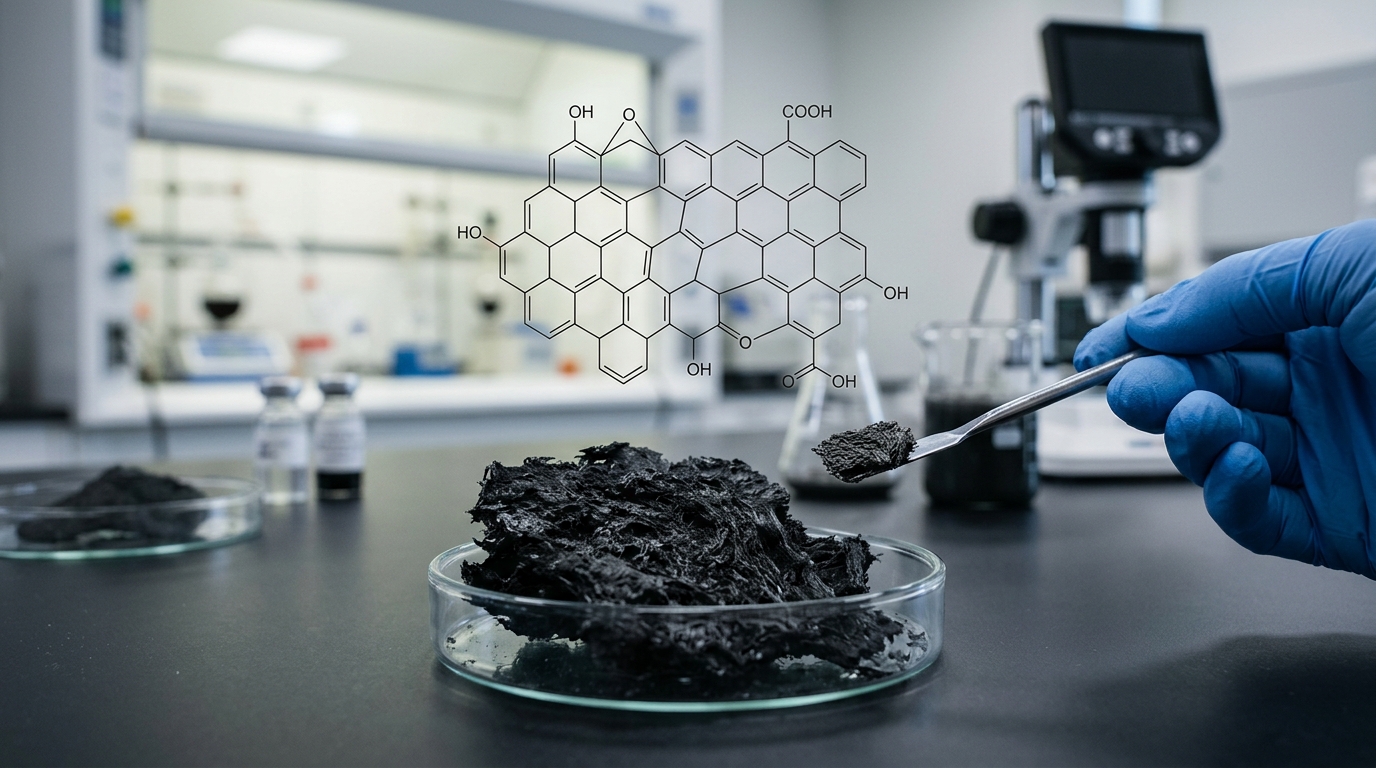
Incorporating Graphene Nanoplatelets (GNPs) or functionalized Graphene Oxide (GO) directly into composite resin matrices (epoxy, vinyl ester, or polyurethane) enhances the structural properties of standard woven ballistic fabrics. When applied to Kevlar or UHMWPE yarn bundles, the graphene-infused resin increases inter-yarn friction. Under ballistic shock, this prevents the projectile from pushing woven fibers aside (“yarn windowing”), distributing localized tensile loads across a wider fabric volume and reducing back-face deformation (BFD) against the wearer’s body.
2. Shear Thickening Fluids (“Liquid Armor”)
Shear Thickening Fluids (STFs) are non-Newtonian suspensions—traditionally composed of silica nanoparticles dispersed in polyethylene glycol—that remain flexible during normal movement but instantly transition into a rigid, solid-like state under high-strain-rate impact. Doping STF formulations with graphene nanoplatelets forms a reinforced hybrid suspension. The high surface area of graphene improves the hydro-cluster formation rate during ballistic shear stress, dramatically increasing puncture, stab, and fragmentation resistance while maintaining garment flexibility.
3. Layered Ceramic-Matrix Composites (CMCs)
Hard armor strike faces designed to defeat armor-piercing (AP) rifle threats rely on ceramics such as silicon carbide (SiC), boron carbide (B₄C), or alumina (Al₂O₃). While these materials shatter hardened steel or tungsten penetrators, their inherent brittleness leads to extensive radial micro-cracking, compromising multi-hit durability.
By introducing GNPs into the ceramic powder sintering process, graphene sheets position themselves along ceramic grain boundaries. Under ballistic impact, these nanoplatelets act as microscopic crack-bridging mechanisms, deflecting and arresting propagating crack tips by up to 70%. This reinforcement preserves the structural integrity of the ceramic tile, allowing it to withstand multiple closely spaced impacts without catastrophic fragmentation.
Technological Readiness Level: Laboratory vs. Field Implementation
Evaluating graphene armor requires distinguishing between micro-ballistic academic demonstrations and certified macroscopic protective systems.
Micro-Ballistics (TRL 3–4)
Testing single-layer and few-layer pristine graphene via Laser-Induced Projectile Impact Testing (LIPIT) confirms the fundamental material physics: superior specific penetration energy, conical shock propagation, and rapid acoustic delocalization. However, these experiments utilize micron-sized silica or gold spheres accelerated into microscopic graphene membranes spanning aperture holes only tens of micrometers wide. These findings demonstrate material potential at the molecular level, not an immediate blueprint for a standalone infantry chest plate.
Hybrid Ballistic Composites (TRL 5–6)
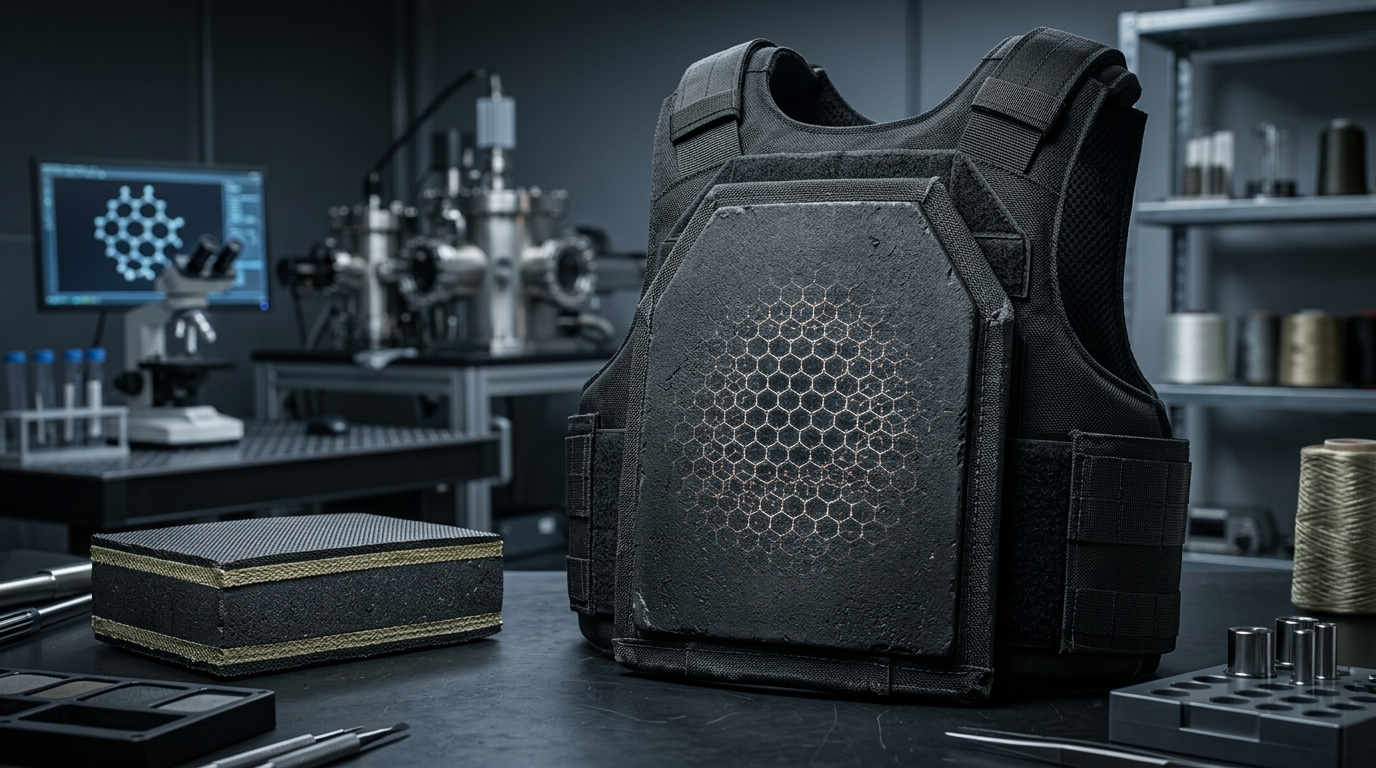
The operational application of graphene armor exists in nanoparticle-doped hybrid systems. Scaled prototypes integrating GNPs into resin-infused fiber laminates, ceramic strike faces, and spall shields are actively undergoing mechanical drop-tower testing, high-velocity gas-gun assessments, and standardized qualification under protocols such as NIJ 0101.06 and NIJ 0101.07 (Levels III and IV). These hybrid systems leverage graphene as an additive to achieve 15% to 20% mass reductions over traditional systems while meeting strict trauma-depth standards.
Engineering and Manufacturing Hurdles
Translating graphene’s theoretical ballistic performance into mass-manufactured protective equipment presents several structural and chemical challenges.
- Nanoparticle Agglomeration: Due to strong intermolecular $pi$-$pi$ stacking interactions, pristine graphene nanoplatelets naturally tend to clump together within polymer resins. Agglomeration creates localized stress concentrators rather than uniform reinforcement, causing early composite failure under dynamic shock.
- Interfacial Shear Strength and Load Transfer: The pristine basal plane of graphene is chemically inert and atomically smooth. Without functionalization (such as covalent silane coupling or controlled oxidation), the polymer or ceramic matrix cannot transfer mechanical shear stress effectively to the graphene sheets, leading to interlaminar debonding under ballistic shock.
- Scalability and Cost Discrepancies: Producing defect-free single-layer graphene via Chemical Vapor Deposition (CVD) remains too expensive and slow for thick, large-scale armor panels. Industrial development instead relies on liquid-phase exfoliation and mechanical shearing to produce GNPs. While cost-effective, these methods yield variable platelet thicknesses and edge defects that lower the mechanical properties compared to theoretical single-crystal sheets.
- Multi-Hit Macroscopic Integrity: While 2D materials effectively absorb single high-velocity impacts in micro-scale setups, macroscopic armor requires durable multi-scale fiber architectures to mitigate the severe shear-band formation caused by successive high-caliber rifle rounds.
Target Defense and Security Applications
As manufacturing processes for graphene-doped hybrid composites mature, several high-value defense use cases have emerged as primary operational targets.
Personal Protective Equipment (PPE)
- Hard Body Armor Inserts: Lightweight hybrid ceramic-GNP strike faces paired with graphene-doped UHMWPE backer plates designed to achieve NIJ Level III and Level IV protection with a 15% to 20% weight reduction compared to standard standalone ceramic plates.
- Blunt Trauma Reduction Packs: Thin, high-modulus graphene-polymer interlayers placed behind soft armor packages to minimize Back Face Deformation (BFD), preventing blunt-force rib fractures and internal organ trauma.
- Ballistic Combat Helmets and Visors: Advanced composite shells offering elevated fragmentation protection (V50 ratings) and improved structural rigidity against blunt impact without adding neck strain.
- Stab and Spike Protection: Hybrid vests incorporating graphene-doped shear-thickening fluids to deliver certified dual-threat ballistic and stab/spike resistance for law enforcement personnel.
Vehicle and Mobile Asset Plating
- Applique Armor Panels: Bolt-on, lightweight composite plating for tactical light utility vehicles, Armored Personnel Carriers (APCs), and uncrewed ground vehicles (UGVs), protecting critical structural zones without degrading payload capacity or fuel efficiency.
- Aviation Floor and Cockpit Liners: Lightweight ballistic panels embedded into the floors and bulkheads of rotary-wing and tactical transport aircraft to defend flight crews against ground-based anti-aircraft small arms and fragmentation.
Blast and Fragmentation Mitigation
- High-Toughness Spall Liners: Graphene-reinforced composite liners installed on the interior hulls of armored combat vehicles to capture high-velocity metal fragments and spall generated by external explosive or projectile impacts.
- Explosive Ordnance Disposal (EOD) Suits: Flexible, graphene-enhanced fragmentation blankets and blast suits engineered to withstand intense overpressure waves and supersonic shrapnel.
- Environmental Barrier Protection: Secondary protection against UV degradation, moisture ingress, and thermal breakdown, extending the field lifespan of underlying aramid and high-modulus polymer fibers in harsh operational environments.