
Graphene for Cars
Integrating graphene for cars is transforming modern automotive engineering by solving persistent trade-offs between mass, structural strength, electrical conductivity, and thermal regulation. Automotive original equipment manufacturers (OEMs) and materials suppliers use graphene as an advanced functional additive to reinforce polymers, improve electrochemical cells, dampen cabin vibrations, and extend component lifespans.
Because graphene consists of a single layer of carbon atoms arranged in a two-dimensional honeycomb lattice, it possesses extraordinary intrinsic properties: tensile strength exceeding 130 gigapascals, thermal conductivity above 3,000 W/mK, and exceptional electron mobility. When incorporated into automotive production at low loading levels, typically below five percent by weight, it imparts these mechanical, electrical, and thermal qualities to conventional host matrices without requiring radical redesigns of vehicle assembly lines.
Acoustic Dampening and Under-the-Hood Thermal Control
One of the earliest high-volume applications of graphene in production passenger vehicles focuses on engine bay components. Internal combustion engines, hybrid powertrains, and high-output electric drive units generate substantial acoustic vibrations and localized thermal spikes that degrade surrounding plastic components and diminish cabin comfort.
Automakers blend graphene nanoplatelets into polyurethane foams used for engine beauty covers, fuel pump covers, and intake manifold isolators. In conventional polyurethane, acoustic absorption often comes at the expense of mechanical integrity and heat dissipation. Adding microscopic graphene sheets creates a dense, tortuous path for sound waves, converting acoustic energy into microscopic thermal dissipation more efficiently than standard foam.
This formulation delivers significant benefits for noise, vibration, and harshness (NVH) mitigation:
- Reduces cabin sound pressure levels across harsh high-frequency registers.
- Increases mechanical compression strength without increasing component density.
- Improves heat deflection temperatures, protecting surrounding wiring harnesses and auxiliary sensors.
- Enables component weight reductions up to twenty percent by permitting thinner foam cross-sections.
Lightweight Structural Composites and Body Panels
Lightweighting remains a critical engineering target across the automotive sector. For electric platforms, reducing body-in-white and chassis mass offsets heavy battery packs and directly extends driving range. For conventional vehicles, lower curb weight improves fuel efficiency and reduces brake and tire wear.
Graphene acts as a potent mechanical reinforcement when dispersed into structural resins like epoxy, vinyl ester, polyamide, and polypropylene. In carbon-fiber-reinforced polymers (CFRP) and sheet molding compounds (SMC), graphene platelets bridge the microscopic resin-rich voids between structural fibers. This structural bridge enhances the interfacial shear strength between the polymer matrix and the fibers, which prevents micro-crack propagation under cyclic fatigue and heavy impacts.
| Material System | Primary Automotive Use | Key Performance Mechanism |
|---|---|---|
| Graphene-Polyurethane Foam | Engine covers, bulkhead insulators | Tortuous acoustic wave scattering and thermal distribution |
| Graphene-Epoxy / CFRP | B-pillars, chassis tubs, crash rails | Interlaminar fracture toughness and impact load transfer |
| Graphene-Elastomer Blends | Tire treads, suspension bushings | Polymer chain cross-linking, heat dissipation, hysteretic tuning |
| Functionalized Graphene Coatings | Clear coats, underside protection | Hydrophobic barrier formation and electrostatic dissipation |
Tire Engineering: Resolving the Classical Trade-Off
Tire design has historically centered on balancing the magic triangle of tire design: rolling resistance, wet grip, and wear resistance. In standard tire compounds, improving one of these three attributes almost inevitably degrades another. Lower rolling resistance traditionally compromises wet-braking traction, while stickier rubber compounds accelerate tread wear.
Integrating tailored graphene sheets into the silica-filled synthetic rubber matrix breaks this compromise. Because graphene disperses across molecular chains, it creates strong physical bonds with the elastomer matrix. This network modifies the compound’s viscoelastic response at different operational frequencies:
Rolling Resistance and Fuel Economy
At the low deformation frequencies associated with a tire rolling along a flat road, graphene stiffens the rubber microscopically, reducing internal energy loss (hysteresis). Lower hysteretic heat generation directly reduces rolling resistance, lowering energy consumption per kilometer.
Wet Grip and Abrasion Resistance
At high deformation frequencies—such as emergency braking on wet pavement—the rubber compound retains the flexibility required to key into micro-roughness on the asphalt, preserving grip. Furthermore, the immense planar tensile strength of graphene inhibits tear propagation and abrasive shear, extending overall tread life and slowing micro-particulate emissions from tire wear.
Electric Vehicle Batteries and Thermal Management
Electric vehicle (EV) adoption relies heavily on improvements in energy density, pack-level safety, and fast-charging capabilities. Graphene addresses several core electrochemical and thermal bottlenecks in lithium-ion and next-generation solid-state architectures.
Silicon-Graphene Anodes
Silicon is an attractive anode material because it offers an electrochemical theoretical capacity roughly ten times higher than standard graphite. However, silicon particles expand by more than three hundred percent during lithiation (charging), causing severe mechanical pulverization and rapid capacity loss. Engineering silicon-graphene composite anodes encapsulates silicon nanoparticles within flexible graphene sheets. The carbon network accommodates volumetric expansion, maintains electrical contact, and preserves the solid electrolyte interphase (SEI) across hundreds of charge-discharge cycles.
Conductive Additives and Current Collectors
On the cathode side, graphene serves as a conductive additive, replacing traditional carbon black. Its high aspect ratio establishes a continuous conductive network at far lower weight fractions, creating space for more active cathode material and boosting pack energy density. Graphene-coated aluminum current collectors also reduce internal cell resistance, minimizing heat generation during rapid direct-current charging.
Pack-Level Thermal Interface Materials
Preventing localized hot spots and thermal runaway requires rapid heat removal from tightly packed battery cells to the liquid cooling plate. Formulating thermal interface materials (TIMs), such as gap fillers, silicone pads, and thermal adhesives, with graphene fillers raises bulk thermal conductivity without sacrificing the electrical insulation required to prevent short circuits.
Automotive Coatings and Exterior Protection
In aftermarket surface care and OEM paint technologies, graphene has emerged as an alternative and supplement to traditional ceramic (silicon dioxide) coatings. These formulations primarily utilize reduced graphene oxide (rGO) blended with silazane or siloxane backbones.
Graphene-infused exterior coatings provide several distinct functional advantages over conventional protective coatings:
- Reduced Water Spotting: Traditional ceramic coatings retain heat because of high thermal absorption, causing mineral-laden water droplets to evaporate quickly and etch the clear coat. Graphene distributes heat across the vehicle panel, slowing localized evaporation.
- Corrosion Barrier: Graphene’s impermeable molecular structure creates a physical barrier that resists chemical attack from road salt, acid rain, and bird droppings.
- Antistatic Characteristics: Graphene provides mild electrical conductivity that dissipates surface static charges, reducing the accumulation of fine road dust on painted surfaces.
In-Cabin Electronics and Smart Surfaces
Modern vehicle interiors increasingly incorporate integrated capacitive controls, smart lighting, and defogging elements. Graphene provides a non-metallic, flexible, transparent conductive medium that can replace indium tin oxide (ITO) in interior touchscreens and curved center consoles.
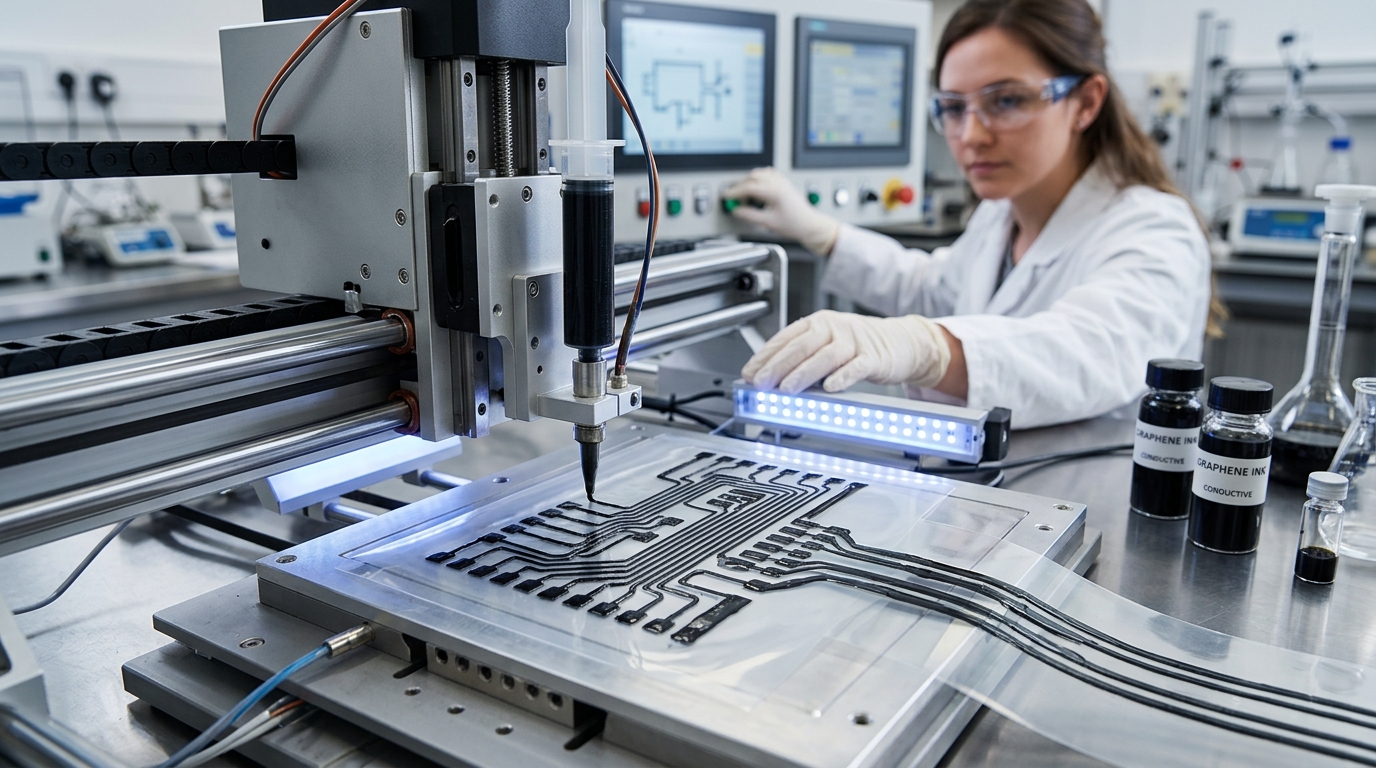
Because graphene films can be applied directly to curved polymeric surfaces, engineers can embed touch sensors and heating grids into structural interior trim pieces, steering wheel grips, and glass surfaces. Printed graphene heating elements on windshields and side windows deliver uniform thermal dissipation across the glass, clearing frost and condensation rapidly while consuming less electrical power than embedded metallic wire grids.
Integration Bottlenecks and Industrial Realities
Despite its performance advantages, adopting graphene across the automotive supply chain requires addressing specific processing and economic factors:
Dispersion and Agglomeration
Pristine graphene exhibits strong van der Waals attraction, which causes individual sheets to agglomerate into multi-layer graphite structures when mixed into liquid polymers or rubber masterbatches. If agglomeration occurs, the composite loses its high surface area and mechanical reinforcement benefits. Achieving uniform dispersion requires surface functionalization, high-shear mixing, or proprietary masterbatch carriers.
Percolation Threshold Optimization
To deliver electrical conductivity or maximum thermal transport, the filler concentration must exceed the percolation threshold, the point at which individual graphene sheets touch to form an uninterrupted transport network. Achieving this threshold with the lowest possible loading is essential to prevent the host material from becoming brittle or overly viscous during injection molding.
Material Standardization and Cost Control
The term “graphene” encompasses a wide range of materials, including single-layer graphene, few-layer graphene, graphene oxide, and thick nanoplatelets. Each variant exhibits vastly different properties and price points. Automotive engineers must precisely match the raw material grade to the intended use case, establishing clear quality standards for lateral flake size, thickness, oxygen content, and purity to ensure consistent performance on the assembly line.