What Is Graphene Oxide?
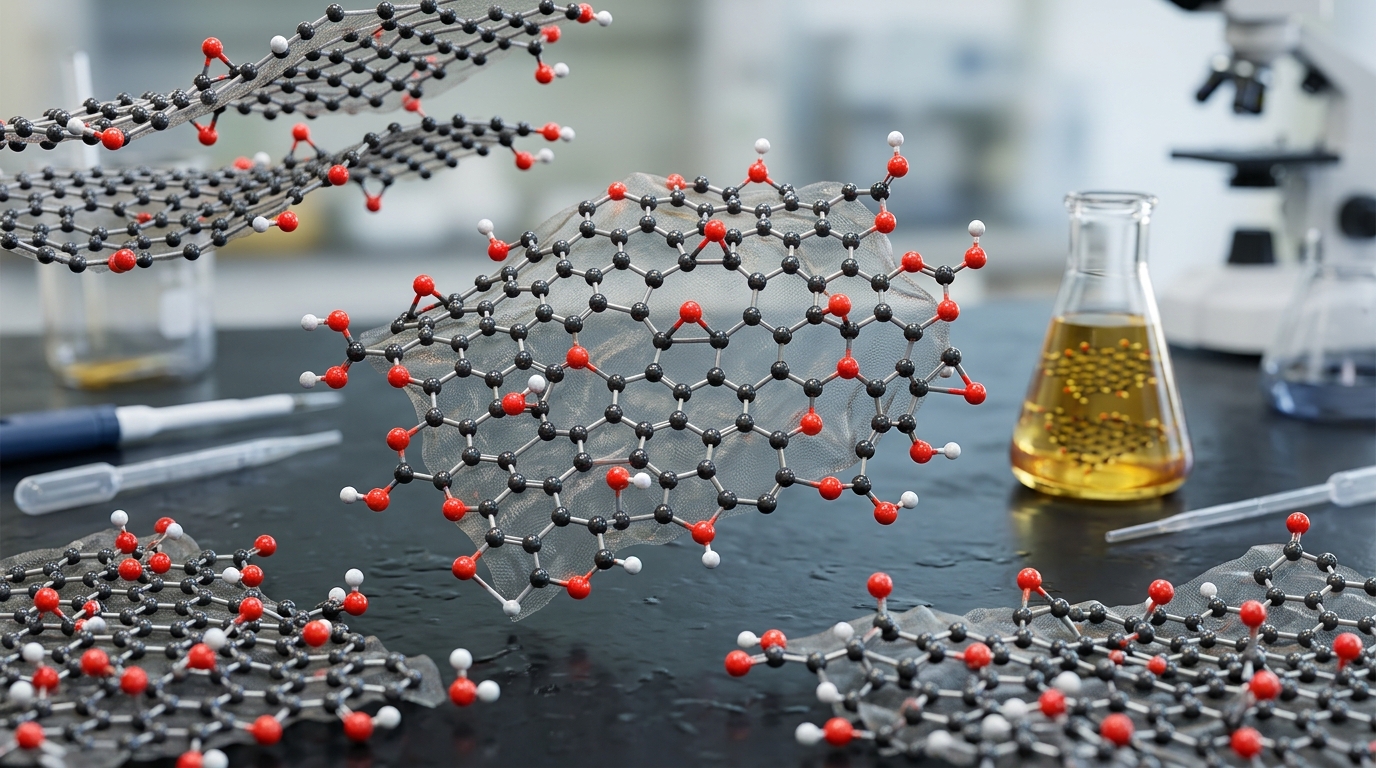
Graphene oxide is a single-layer sheet of carbon atoms decorated with oxygen-containing functional groups. Derived through the heavy chemical oxidation of graphite, it represents a chemically altered cousin of pristine graphene. While pure graphene consists solely of a continuous honeycomb lattice of carbon atoms, graphene oxide disrupts this network by anchoring oxygen atoms above, below, and along the edges of the sheet.
This structural difference changes how the material behaves. Pristine graphene is hydrophobic, chemically inert, and an exceptional electrical conductor. In contrast, graphene oxide dissolves readily in water, forms stable colloidal suspensions, and behaves as an electrical insulator. These unique characteristics make it one of the most accessible and processable nanomaterials in materials science.
The Chemical Structure: Breaking the Carbon Lattice
To understand what graphene oxide is at a molecular level, one must look at its carbon hybridization. In pristine graphene, every carbon atom is in an sp2 hybridized state, sharing electrons across a flat, delocalized pi-electron network that enables rapid electrical transport.
When graphite undergoes aggressive oxidation, oxygen functional groups attach directly to the basal plane and the sheet edges. This chemical bonding forces affected carbon atoms into an sp3 tetrahedral geometry, pulling them out of the flat plane and disrupting the continuous electron pathways. As a result, graphene oxide is fundamentally a hybrid material composed of intact aromatic sp2 carbon clusters surrounded by disordered sp3 carbon-oxygen domains.
Primary Functional Groups in Graphene Oxide
The precise chemical formula of graphene oxide varies depending on synthesis conditions, meaning it does not have a single fixed stoichiometric composition. However, spectroscopic analysis consistently identifies three primary oxygen groups:
- Epoxy groups (-O-): Oxygen atoms bridged across two adjacent carbon atoms on the flat basal plane, creating localized strain in the carbon backbone.
- Hydroxyl groups (-OH): Alcohol groups bonded across the basal plane, contributing significantly to hydrogen-bonding interactions with polar solvents.
- Carboxyl and carbonyl groups (-COOH, -C=O): Primarily situated along the sheet edges and defect sites, providing localized negative charges when dispersed in basic or neutral aqueous solutions.
How Graphene Oxide Is Produced
The manufacturing of graphene oxide relies on top-down chemical exfoliation. While mechanical exfoliation peels graphite layers apart mechanically to yield pure graphene flakes in small quantities, chemical oxidation forces the layers apart at bulk scales.
The foundational chemistry traces back to methods developed by chemists examining graphite reactivity. In 1958, William S. Hummers Jr. and Richard E. Offeman introduced what became the standard chemical route: the Hummers method. This process treats natural flake graphite with a mixture of concentrated sulfuric acid, sodium nitrate, and potassium permanganate.
During the reaction, powerful oxidizing agents intercalate between the tightly stacked graphite sheets. As oxygen groups bond to the carbon atoms, the interlayer spacing increases from approximately 0.34 nanometers in raw graphite to between 0.7 and 1.2 nanometers in graphite oxide. Once washed and subjected to mild sonication or mechanical stirring, these swollen, highly hydrophilic layers easily peel apart into single-atom-thick sheets of graphene oxide suspended in liquid.
Modern industrial production typically uses modified or improved Hummers methods that eliminate sodium nitrate to prevent toxic gas generation and achieve higher oxidation efficiencies with fewer structural defects.
Key Properties and Performance Tradeoffs
The presence of oxygen groups transforms graphene from an intractable, insoluble sheet into an adaptable chemical building block, but it introduces distinct performance tradeoffs.
Water Dispersibility and Colloidal Stability
Pristine graphene rapidly aggregates in water due to strong interlayer van der Waals forces. Graphene oxide overcomes this challenge because its surface hydroxyl and carboxyl groups form extensive hydrogen bonds with water molecules. In aqueous environments, electrostatic repulsion between negatively charged sheets prevents restacking, creating shelf-stable suspensions without requiring chemical surfactants.
Electrical and Thermal Insulation
Because the sp3 carbon-oxygen bonds disrupt the delocalized pi-electron network, as-synthesized graphene oxide exhibits high electrical resistivity, functioning as an electrical insulator. Its thermal conductivity is also markedly lower than that of pristine graphene, as oxygen defects scatter phonons—the vibrational energy packets responsible for heat transport in non-metallic solids.
Mechanical Integrity
Although the introduction of vacancies and sp3 defects reduces the intrinsic tensile strength compared to defect-free graphene, individual graphene oxide monolayers remain exceptionally robust. Monolayer sheets exhibit an elastic modulus near 200 gigapascals, allowing them to reinforce polymers and ceramic matrices effectively when properly dispersed.
Graphene Oxide vs. Pristine Graphene vs. Reduced Graphene Oxide
The graphene family encompasses several related materials that serve distinct engineering roles. The table below outlines how graphene oxide compares to pristine graphene and reduced graphene oxide (rGO).
| Property | Pristine Graphene | Graphene Oxide (GO) | Reduced Graphene Oxide (rGO) |
|---|---|---|---|
| Carbon State | Pure sp2 lattice | Disrupted sp2/sp3 network | Partially restored sp2 network |
| Electrical Behavior | Excellent conductor | Electrical insulator | Semiconductor to moderate conductor |
| Water Solubility | Hydrophobic (aggregates) | Highly hydrophilic (stable) | Mostly hydrophobic |
| Synthesis Cost | High (CVD or mechanical) | Moderate (bulk chemical) | Moderate (chemical or thermal reduction) |
The Reduction Process: Converting GO to rGO
When electrical conductivity or optical transparency is required, engineers frequently use graphene oxide as an intermediate precursor. Through chemical reduction or thermal annealing, oxygen functional groups can be stripped away to restore the aromatic carbon network.
Thermal reduction heats the material rapidly in an inert or reducing atmosphere, causing oxygen groups to decompose into carbon dioxide and steam. Chemical reduction uses reducing agents such as hydrazine, ascorbic acid (vitamin C), or sodium borohydride. While reduction restores electrical conductivity by several orders of magnitude, it does not rebuild vacancy defects or missing carbon atoms in the basal plane. Consequently, reduced graphene oxide rarely matches the theoretical electrical or mechanical limits of defect-free pristine graphene.
Practical Applications Across Industries
Thanks to its chemical reactivity and solution processing capabilities, graphene oxide has transitioned from a laboratory curiosity to an active component in multiple commercial and industrial sectors.
Water Purification and Separation Membranes
When graphene oxide sheets assemble into stacked, multi-layered films, they create sub-nanometer capillaries between the layers. Water molecules travel through these interlayer nanochannels with minimal friction by hopping along unoxidized hydrophobic regions. Meanwhile, hydrated salt ions, micro-pollutants, heavy metals, and organic dyes are physically blocked or chemically adsorbed by functional groups, making GO membranes promising for ultrafiltration and desalination.
Composite Materials and Coatings
Liquid dispersibility allows graphene oxide to blend homogeneously into polymers, resins, and cementitious mixtures. In structural composites, it forms strong interfacial bonds with epoxy networks, increasing tensile strength, fracture toughness, and wear resistance. In protective coatings, tightly packed GO laminates create a tortuous barrier pathway that slows the diffusion of oxygen and moisture, reducing corrosion on underlying metals.
Energy Storage Electrodes
In lithium-ion batteries and supercapacitors, graphene oxide serves as an adaptable precursor for porous electrode scaffolds. Its oxygen groups provide anchoring sites for metal oxide nanoparticles, preventing active materials from agglomerating during repeated charging and discharging cycles.
Biomedical Research and Sensors
The oxygen-rich surface of graphene oxide provides diverse reactive sites for covalent surface functionalization. Researchers conjugate biomolecules, fluorescent tags, and pharmaceutical agents directly to carboxyl or hydroxyl groups. These engineered sheets find use in diagnostic biosensors, where target binding events trigger measurable changes in fluorescence quenching or surface charge.
Limitations, Safety, and Handling
Despite its versatility, graphene oxide presents notable engineering and handling challenges:
- Batch-to-Batch Variability: Because oxidation levels depend heavily on reaction temperature, graphite source, and acid concentration, controlling the precise oxygen-to-carbon ratio across production batches requires rigorous quality control.
- Thermal Instability: Dry graphene oxide decomposes exothermically at temperatures above 150 to 200 degrees Celsius, releasing carbon monoxide and steam as oxygen groups degrade.
- Powder Inhalation Risks: While liquid dispersions are safe to handle with standard laboratory personal protective equipment, dried graphene oxide powder presents respiratory hazards common to high-aspect-ratio carbon nanomaterials, requiring dedicated ventilation and HEPA filtration.
Evaluating Graphene Oxide Quality
When selecting or characterizing graphene oxide for specific applications, material scientists rely on three primary analytical techniques:
- X-ray Photoelectron Spectroscopy (XPS): Determines the exact atomic carbon-to-oxygen (C/O) ratio, which typically ranges from 1.5:1 to 2.5:1 for standard fully oxidized material.
- Raman Spectroscopy: Measures the intensity ratio between the D-band (disordered sp3 carbon) and G-band (graphitic sp2 carbon) to quantify structural defect density.
- Atomic Force Microscopy (AFM): Verifies the single-layer thickness, typically confirming sheets between 0.8 and 1.2 nanometers thick when fully exfoliated.
By understanding how oxygen functional groups modulate its mechanical, electrical, and chemical properties, engineers can deploy graphene oxide either directly as a solution-processable nanomaterial or as a practical gateway to large-scale reduced graphene technologies.