Graphene Oxide
Graphene oxide is a single-layer carbon sheet heavily decorated with oxygen-bearing functional groups across its basal plane and edges. While pristine graphene consists exclusively of a flat, continuous honeycomb lattice of sp2-hybridized carbon atoms, graphene oxide interrupts this network with oxygen atoms, converting portions of the sheet into an sp3-hybridized structure. This chemical transformation turns an otherwise hydrophobic, electrically conductive sheet into a hydrophilic, electrically insulating material that disperses effortlessly in water.
Engineers and material scientists value graphene oxide precisely because it trades pristine electrical conductivity for chemical versatility and processability. It serves as a universal precursor for bulk nanomaterials, a building block for molecular sieves, and an additive that reinforces structural polymers without requiring harsh organic solvents.
Molecular Architecture and Chemical Structure
Understanding graphene oxide requires examining its disordered, non-stoichiometric chemical composition. Unlike conventional molecular compounds with fixed chemical formulas, the oxygen content and exact arrangement of functional groups in graphene oxide vary based on preparation methods and degree of oxidation.
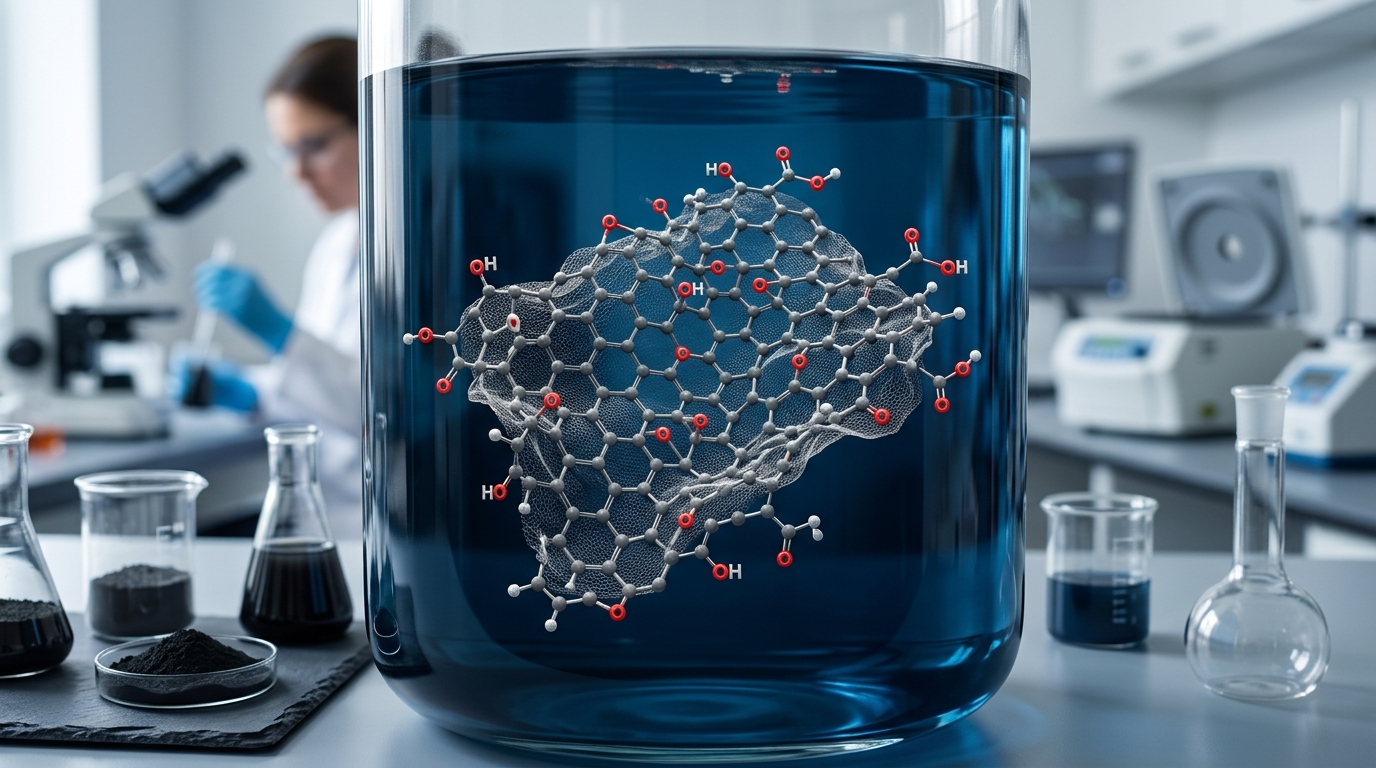
The most widely accepted structural description is the Lerf-Klinowski model. This model describes the basal plane of the carbon sheet as an unoxidized aromatic network interrupted by randomly distributed tertiary hydroxyl and 1,2-epoxide (oxirane) groups. The edges of the flakes terminate predominantly in carboxylic acid, carbonyl, and phenolic groups.
These functional groups create distinct physical characteristics:
- Epoxide and Hydroxyl Groups: Located across the flat face (basal plane), these groups project above and below the carbon sheet, disrupting the extended aromatic π-electron system and creating localized steric strain.
- Carboxyl and Carbonyl Groups: Located along the sheet edges, these ionizable groups provide negative electrostatic charges when dispersed in water at neutral or basic pH, preventing agglomeration through electrostatic repulsion.
- Isolated sp2 Domains: Small, unoxidized aromatic islands remain preserved within the oxidized matrix. These conjugated domains govern optical absorption, fluorescence, and residual electronic states.
How Graphene Oxide is Synthesized
Graphene oxide is produced through the top-down chemical oxidation and subsequent exfoliation of natural or synthetic graphite. The process intercalates strong acids and oxidizing agents into the tightly packed graphite crystal, expanding the interlayer spacing and introducing oxygen functionalities.
The Oxidation Process
The standard foundation for modern production traces back to the method developed by William S. Hummers and Richard E. Offeman in 1958. In the classical Hummers method, graphite flakes are treated with a mixture of concentrated sulfuric acid, sodium nitrate, and potassium permanganate under carefully controlled temperatures. Variations of this approach, often termed Improved or Modified Hummers methods, eliminate sodium nitrate to avoid toxic gas generation and incorporate phosphoric acid to increase the proportion of intact basal planes.
During oxidation, permanganate ions penetrate between the graphene layers. As oxidation progresses, the interlayer distance expands from roughly 0.34 nanometers in pristine graphite to between 0.7 and 1.2 nanometers in fully hydrated graphite oxide, depending on the volume of intercalated water molecules.
Exfoliation into Monolayers
Once graphite oxide is formed, the weak interlayer van der Waals forces are significantly diminished due to the expanded spacing and the presence of polar oxygen groups. Agitation through mechanical stirring, high-shear mixing, or mild ultrasonic exfoliation easily shears the stacked layers apart, producing stable aqueous dispersions of single-layer and few-layer graphene oxide sheets.
Graphene Oxide vs. Pristine Graphene: Key Differences
Choosing between pristine graphene and graphene oxide involves fundamental trade-offs between electrical performance, chemical reactivity, and ease of manufacturing.
| Property | Pristine Graphene | Graphene Oxide (GO) |
|---|---|---|
| Carbon-to-Oxygen Ratio | Very high (> 50:1) | Low (typically 2:1 to 4:1) |
| Electrical Conductivity | Exceptional conductor (~10^4 to 10^5 S/m) | Electrical insulator (~10^-3 S/m or lower) |
| Dispersibility in Water | Extremely poor (hydrophobic, precipitates) | Excellent (hydrophilic, forms stable colloids) |
| Atomic Hybridization | Predominantly sp2 planar network | Mixed sp2 and sp3 domains with atomic defects |
| Optical Transparency | ~97.7% per single atomic layer | Varies with oxidation; yellowish-brown in solution |
| Chemical Functionalization | Difficult; requires non-covalent or harsh methods | Facile; reactive oxygen sites bind readily |
The Reduction Pathway: Converting GO to rGO
Because graphene oxide is an electrical insulator, many engineering applications require restoring its electrical conductivity. This is accomplished through reduction, yielding reduced graphene oxide (rGO). Reduction removes a large fraction of the oxygen-containing groups and partially restores the conjugated sp2 carbon network.
Chemical Reduction
Treating graphene oxide dispersions with reducing agents—such as hydrazine hydrate, sodium borohydride, ascorbic acid (vitamin C), or polyphenols—strips oxygen species from the sheets. Ascorbic acid is widely favored in industrial and biological contexts as a non-toxic alternative to hydrazine. While chemical reduction restores electrical conductivity by several orders of magnitude, it leaves behind structural vacancies and residual heteroatoms.
Thermal and Flash Reduction
Exposing dry graphene oxide powder or films to high temperatures (ranging from 300°C to over 1000°C) in an inert or reducing atmosphere causes rapid deoxygenation. The sudden release of gaseous carbon dioxide and steam generates immense internal pressure that can spontaneously exfoliate stacked layers. Thermal reduction produces high-surface-area rGO powders ideal for energy storage, though the gas release creates topological defects and carbon vacancies across the basal plane.
Electrochemical Reduction
Electrochemical reduction applies a negative potential to a graphene oxide-coated electrode in an electrolyte solution. This method requires no hazardous chemical reagents and can be performed at room temperature, making it a common choice for fabricating modified electrodes in chemical and biological sensors.
Major Practical Applications
1. Separation and Nanofiltration Membranes
When graphene oxide sheets are deposited layer-by-layer, they form dense, laminated papers with precisely spaced interlayer nanochannels. In the presence of water, these laminar capillaries allow ultrafast permeation of water molecules while physically sieving out multivalent ions, organic dyes, microplastics, and heavy metal complexes.
Unlike conventional polymeric membranes, graphene oxide membranes resist biofouling and withstand higher mechanical pressures, making them a major focus for industrial wastewater treatment and water desalination research.
2. Polymer Composites and Structural Coatings
The rich surface chemistry of graphene oxide enables strong interfacial bonding with polar polymers, including polyvinyl alcohol (PVA), epoxy resins, and polyamides. Adding low weight percentages (often below 1%) of graphene oxide significantly improves tensile strength, elastic modulus, and thermal stability in host matrices.
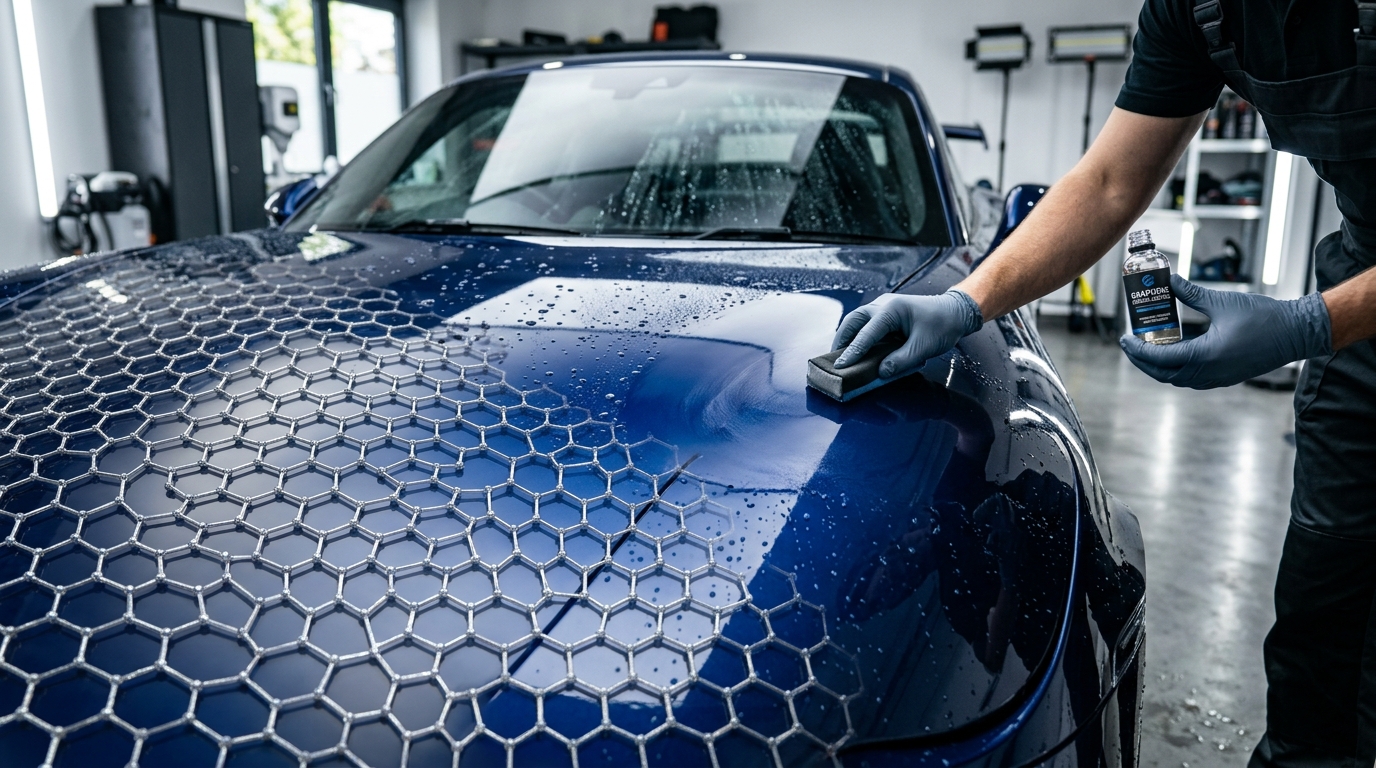
Furthermore, the impermeable nature of the individual sheets creates a tortuous diffusion path for gases, transforming GO-loaded coatings into effective gas barrier films that protect metals against corrosion and extend the shelf life of specialty packaging.
3. Electrochemical Energy Storage
In lithium-ion batteries and supercapacitors, graphene oxide serves primarily as a versatile manufacturing precursor. When processed into porous conductive aerogels, foams, or reduced hybrid electrodes, it provides a high surface area for electrolyte wetting and rapid ion diffusion. Intercalating metal oxide nanoparticles (such as silicon, tin oxide, or manganese oxide) onto graphene oxide sheets prevents the active material from pulverizing during repetitive charge-discharge cycles.
4. Biomedical and Analytical Sensing
Because graphene oxide is water-dispersible and features an array of anchoring sites, it serves as a substrate for immobilizing biomolecules, enzymes, and fluorescent tags. In optical biosensors, the material acts as a broad-spectrum fluorescence quencher. When a target analyte displaces a fluorescently labeled probe bound to the graphene oxide surface, the fluorescence signal recovers, allowing rapid detection of specific DNA sequences, proteins, or environmental toxins.
Key Manufacturing Trade-Offs and Limitations
While graphene oxide offers unmatched chemical versatility, several practical barriers must be addressed during industrial implementation:
- Structural Defect Density: The aggressive oxidation chemistry that makes graphite water-soluble also tears vacancies and topological tears into the carbon plane. Even after intensive chemical or thermal reduction, rGO never fully recovers the mechanical strength or electrical conductivity of pristine, mechanically cleaved graphene.
- Batch-to-Batch Variability: Flake lateral size, sheet thickness distribution, and the exact carbon-to-oxygen ratio fluctuate based on graphite source quality, reaction temperature, and sonication duration. This variability complicates quality control for precision electronic applications.
- Thermal Instability: Dry graphene oxide undergoes exothermic decomposition at relatively low temperatures (around 150°C to 200°C), where rapid outgassing of water vapor and carbon oxides can damage film structures if processing temperatures are not carefully controlled.
- Corrosive Waste Stream: Standard synthesis protocols consume large volumes of concentrated acids and strong oxidizers, producing acidic, heavy-metal-containing rinse water that requires extensive neutralization and filtration before disposal.
Evaluation Criteria for Commercial Material
When assessing graphene oxide for industrial or laboratory adoption, evaluate these key material metrics:
The carbon-to-oxygen ratio (C/O ratio), typically measured via X-ray Photoelectron Spectroscopy (XPS), defines the oxidation level; standard commercial material generally ranges between 1.5:1 and 2.5:1. Lateral flake size, quantified through Dynamic Light Scattering (DLS) or Atomic Force Microscopy (AFM), dictates dispersion viscosity and mechanical reinforcement efficiency. Raman spectroscopy provides an evaluation of structural quality, where the intensity ratio of the D band (representing structural defects) to the G band (representing intact graphitic carbon) tracks the degree of lattice disruption.
By balancing these structural metrics against processing requirements, engineers can utilize graphene oxide either as an independent functional material or as a cost-effective precursor to advanced reduced graphene architectures.