
Graphene Aerogel
A graphene aerogel is a macroscopic, three-dimensional (3D) porous network composed of interconnected, atomically thin graphene sheets. By translating the intrinsic nanoscale properties of two-dimensional graphene—such as high electron mobility, thermal conductivity, and mechanical strength—into a self-supporting bulk monolith, graphene aerogels overcome the persistent problem of sheet restacking. Often characterized as one of the lightest solid materials known, graphene aerogels feature extreme porosity, low density, high specific surface area, and tunable electrical conductivity, making them a central focus of research in energy storage, environmental remediation, and thermal management.
Structural Architecture of Graphene Aerogels
At the structural level, a graphene aerogel is composed of individual or few-layer graphene (or reduced graphene oxide) sheets joined together at junction points to form a cellular, sponge-like lattice. Unlike bulk graphite, where planar sheets are held tightly by van der Waals forces, the synthesis of an aerogel physically separates the sheets into a stable 3D continuous framework containing a hierarchical distribution of pores:
- Micropores (less than 2 nm): Formed primarily by defects, structural wrinkles, or atomic vacancies within the individual graphene sheets.
- Mesopores (2 to 50 nm): Created by the overlapping, crosslinking, and tortuous spacing between adjacent graphene sheets.
- Macropores (greater than 50 nm): Large void cells and channels generated during solvent displacement, ice templating, or gas evolution during processing.
This hierarchical porosity prevents irreversible sheet agglomeration (restacking via π-π interactions) and maintains an open framework that permits rapid mass and charge transport throughout the entire volume of the material.
Key Physical and Chemical Properties
Graphene aerogels exhibit an exceptional combination of physical, electrical, and mechanical metrics derived from their low solid fraction and interconnected carbon backbone.
Ultra-Low Density and High Porosity
Graphene aerogels are among the least dense materials engineered, with typical bulk densities ranging from 0.5 mg/cm³ to 50 mg/cm³ depending on the synthesis route and target application. In specialized laboratory formulations, densities as low as 0.16 mg/cm³ have been achieved—lower than the density of ambient air (approx. 1.2 mg/cm³ at standard temperature and pressure) when evacuating internal gases. The corresponding open porosity frequently exceeds 99.0% to 99.9%, meaning that nearly the entire volume of the material consists of empty or fluid-filled voids.
Specific Surface Area
Theoretical single-layer graphene possesses a specific surface area of approximately 2,630 m²/g. In synthesized 3D aerogels, experimental Brunauer-Emmett-Teller (BET) surface areas typically range from 400 m²/g to 1,200 m²/g. While sheet overlap and residual junction points lower the accessible area relative to the theoretical maximum, this surface area remains significantly higher than that of standard graphite or non-porous carbon electrodes.
Mechanical Compressibility and Elastic Resilience
Unlike conventional silica aerogels, which are notoriously brittle and shatter under tensile or shear strain, graphene aerogels can be engineered to exhibit remarkable mechanical elasticity. Many graphene aerogels demonstrate superelasticity, recovering completely from compressive strains of 50% to over 90% without structural collapse. The flexible sp²-hybridized carbon sheets act as micro-springs within the cellular wall matrix, distributing applied loads across the 3D network.
Electrical and Thermal Conductivity
Because the network walls are composed of continuously bonded or physically overlapping graphitic domains, graphene aerogels maintain a continuous path for electrical conduction. Bulk electrical conductivities typically range from 0.1 S/m to over 100 S/m, which can be further increased through high-temperature graphitization (annealing at 1,000°C to 3,000°C). Thermal conductivity is highly tunable: while the solid pathway conducts heat efficiently along the graphene planes, the extreme gas-phase void fraction and boundary scattering can be leveraged to produce effective thermal insulators in the perpendicular direction.
Standard Fabrication and Synthesis Routes
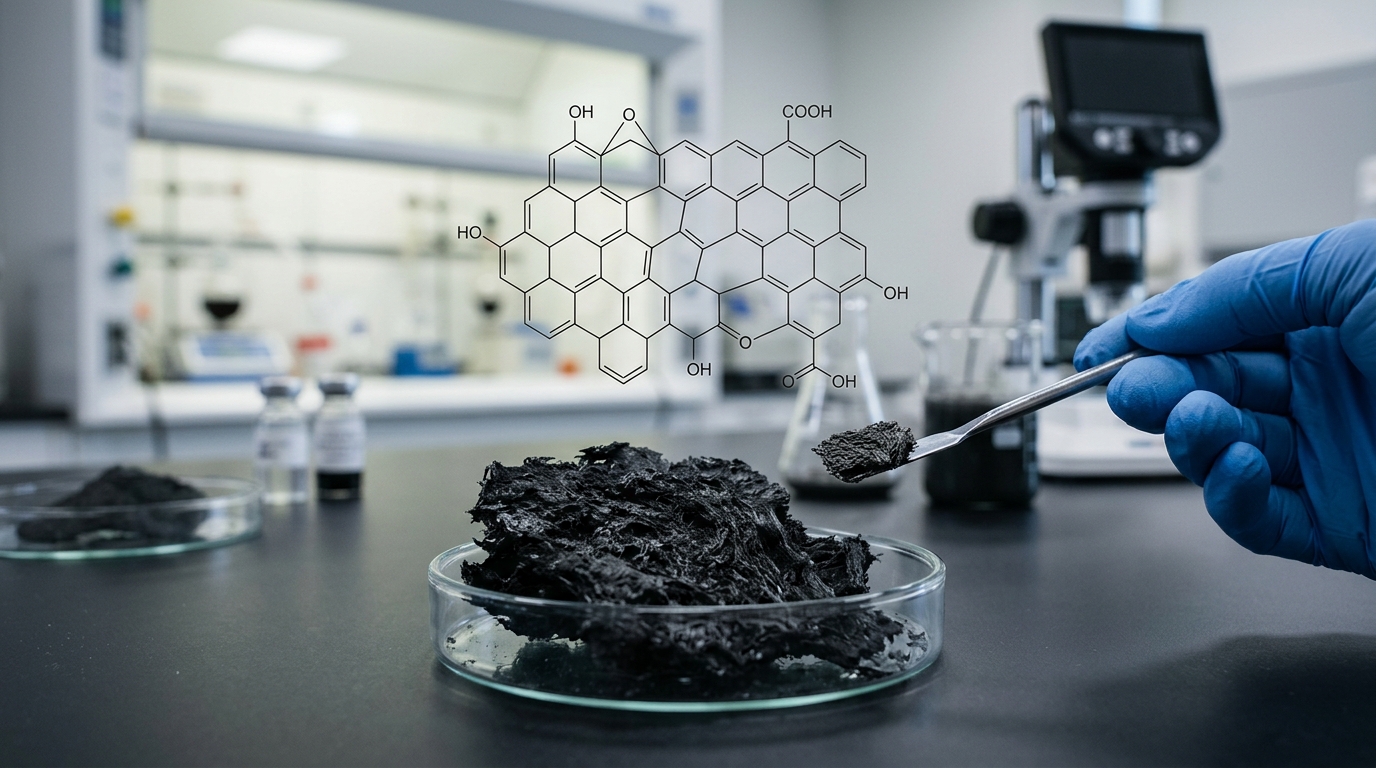
Transforming 2D graphene sheets into a stable 3D macroscopic monolith requires specialized processing to prevent aggregation during the removal of the liquid phase. The primary precursor is typically Graphene Oxide (GO) due to its high water dispersibility and oxygen-containing functional groups (hydroxyl, epoxy, and carboxyl groups) that facilitate chemical tailoring.
1. Hydrothermal Reduction and Self-Assembly
Hydrothermal processing is the most widely adopted route for producing graphene hydrogels, which are subsequent precursors to aerogels:
- An aqueous suspension of GO is sealed in an autoclave and heated to 120°C–200°C under autogenous pressure.
- Thermal energy removes oxygen functional groups, restoring hydrophobic π-conjugated networks.
- The increasing hydrophobicity and π-π interactions drive the randomly dispersed sheets to self-assemble into a 3D interconnected hydrogel network entrapping the water.
2. Lyophilization (Freeze-Drying) and Ice Templating
To preserve the delicate 3D hydrogel structure without capillary-force-induced collapse during drying, water is removed via sublimation:
- Directional Freezing: Controlling the freezing temperature gradient causes ice crystals to grow directionally, rejecting the graphene sheets into the interstitial spaces between ice dendrites.
- Sublimation: Under low pressure (vacuum freeze-drying), the ice sublimes directly from solid to gas, leaving behind an anisotropic or isotropic cellular architecture that mirrors the shape of the ice crystals.
3. Supercritical Drying
An alternative to freeze-drying is supercritical fluid extraction, often using carbon dioxide (CO₂):
- The hydrogel’s pore water is replaced with an intermediate solvent (e.g., ethanol or acetone).
- The gel is placed in an autoclave with liquid CO₂, which is brought above its critical point (31.1°C, 7.39 MPa).
- At supercritical conditions, the liquid-gas interface vanishes, eliminating surface tension and capillary pressure completely, yielding an aerogel with minimal structural shrinkage and exceptionally high pore preservation.
4. Chemical Vapor Deposition (CVD) on 3D Metal Templates
To produce defect-free, highly crystalline graphene aerogels without starting from GO, CVD can be performed on sacrificial 3D templates:
- A porous metal matrix (such as nickel or copper foam) serves as both the catalyst and structural template.
- Hydrocarbon gases (e.g., methane) decompose at high temperatures (approx. 1,000°C), depositing pristine graphene layers uniformly onto the metal scaffolding.
- The underlying metal template is chemically etched away using an acid or ferric chloride solution, leaving behind an ultra-lightweight, freestanding 3D graphene foam with superior electrical conductivity and mechanical integrity.
Comparative Analysis: Graphene vs. Traditional Aerogels
Graphene aerogels occupy a distinct performance space compared to established silica aerogels and traditional amorphous carbon aerogels (typically derived from resorcinol-formaldehyde precursors).
| Property / Parameter | Graphene Aerogel | Silica Aerogel | Traditional Carbon Aerogel |
|---|---|---|---|
| Primary Structure | Interconnected 2D sp² carbon sheets | Amorphous silicon dioxide (SiO₂) network | Pyrolyzed organic polymer (amorphous carbon) |
| Typical Density | 0.5 – 30 mg/cm³ | 10 – 150 mg/cm³ | 50 – 500 mg/cm³ |
| Electrical Conductivity | High (0.1 – 100+ S/m) | Insulator (<10⁻¹² S/m) | Moderate (1 – 10 S/m) |
| Mechanical Behavior | Elastic, highly compressible, resilient | Brittle, fragile under tension/shear | Rigid, brittle, prone to fracturing |
| Surface Area (BET) | 400 – 1,200 m²/g | 500 – 1,000 m²/g | 400 – 900 m²/g |
| Primary Application Strengths | Energy storage, EMI shielding, absorption | High-performance thermal insulation | Thermal insulation, high-temperature electrodes |
Doping and Composite Variants
To tailor the chemical reactivity, mechanical modulus, or pseudocapacitive behavior of graphene aerogels, researchers frequently introduce secondary phases or heteroatoms:
- Heteroatom Doping: Incorporating nitrogen (N), boron (B), sulfur (S), or phosphorus (P) into the carbon lattice modulates the local electronic band structure, increases active sites for electrochemical reactions, and enhances wetting with polar electrolytes.
- Polymer Reinforcement: Crosslinking graphene frameworks with polymers like poly(vinyl alcohol) (PVA), polydimethylsiloxane (PDMS), or cellulose improves tensile strength and fatigue resistance, preventing degradation over thousands of compression cycles.
- Metal Oxide Decoration: Anchoring nanoparticles of transition metal oxides (e.g., Fe₃O₄, MnO₂, RuO₂, or TiO₂) onto the graphene walls prevents nanoparticle agglomeration while providing high pseudocapacitance or catalytic functionality supported by the conductive graphene matrix.
Major Practical Applications
1. Electrochemical Energy Storage
The combination of continuous electron conduction pathways and rapid ionic diffusion through open macropores makes graphene aerogels exceptional electrode architectures for energy storage devices:
- Supercapacitors: Graphene aerogels serve as double-layer capacitor electrodes, providing high power densities and operating stability over hundreds of thousands of charge-discharge cycles.
- Lithium-Sulfur (Li-S) Batteries: The high internal volume accommodates high sulfur loading while physically trapping intermediate lithium polysulfides, mitigating the destructive “shuttle effect.”
- Lithium-Ion & Post-Lithium Batteries: 3D porous structures accommodate the volumetric expansion and contraction of alloying anodes (such as silicon or tin) during cycling.
2. Environmental Remediation and Selective Sorption
Due to their superhydrophobic and superoleophilic nature (often achieved after thermal or chemical reduction), graphene aerogels are highly effective for water purification and hazardous spill recovery:
- They can selectively absorb non-polar organic solvents, petroleum oils, and toxic hydrocarbons from water surfaces at capacities ranging from 100 to over 900 times their own weight.
- Because of their elastic compressibility, absorbed oils can often be recovered simply by mechanical squeezing, allowing the aerogel to be reused over multiple cycles.
3. Electromagnetic Interference (EMI) Shielding
Modern electronic devices require lightweight materials capable of blocking or attenuating stray electromagnetic radiation. Graphene aerogels provide high EMI shielding effectiveness through a combination of electrical conductivity and multiple internal reflections:
- Electromagnetic waves entering the porous network bounce repeatedly off internal cell walls.
- The waves are converted into thermal energy via ohmic losses within the conductive graphene framework, offering high shielding effectiveness (often exceeding 30–60 dB in the X-band) at minimal weight penalties compared to solid metal sheets.
4. Thermal Insulation and Management
When properly engineered, the low solid fraction and highly tortuous structure of graphene aerogels inhibit convective, conductive, and radiative heat transfer. Depending on the pore engineering and composition, they can be utilized as ultra-lightweight insulation in aerospace applications or, conversely, infiltrated with Phase Change Materials (PCMs) such as paraffin wax to construct stable thermal management composites for high-power electronics.
Technological Limitations and Commercial Scaling Challenges
Despite their superior performance in laboratory settings, several technical and economic hurdles continue to restrict large-scale industrial commercialization of graphene aerogels:
Precursor Quality and Batch Variability
Most commercial routes rely on graphene oxide synthesized via variants of Hummers’ method. This process generates substantial quantities of acidic waste and results in batch-to-batch variations in lateral flake size, oxidation degree, and defect density, all of which directly influence the mechanical and electrical integrity of the final self-assembled aerogel.
Drying Economics and Processing Complexity
Both supercritical CO₂ drying and vacuum freeze-drying are energy-intensive, batch-limited processes requiring specialized, high-pressure, or cryogenic equipment. The long cycle times associated with solvent exchange and water sublimation significantly elevate manufacturing costs, limiting the cost-effectiveness of graphene aerogels in price-sensitive bulk markets.
Mechanical Friability and Handling
While graphene aerogels demonstrate impressive compressibility, they generally possess low shear strength and poor resistance to abrasive wear. In the absence of polymer crosslinkers or protective encapsulation, dry monoliths can shed micro-flakes or suffer structural degradation when subjected to mechanical vibration or high fluid shear stresses.
Scalability of Continuous Manufacturing
Current fabrication methods are primarily limited to casting discrete molds. Developing continuous roll-to-roll or high-throughput manufacturing lines that preserve uniform pore architectures across large spatial areas remains an ongoing engineering challenge.