Graphene Phone
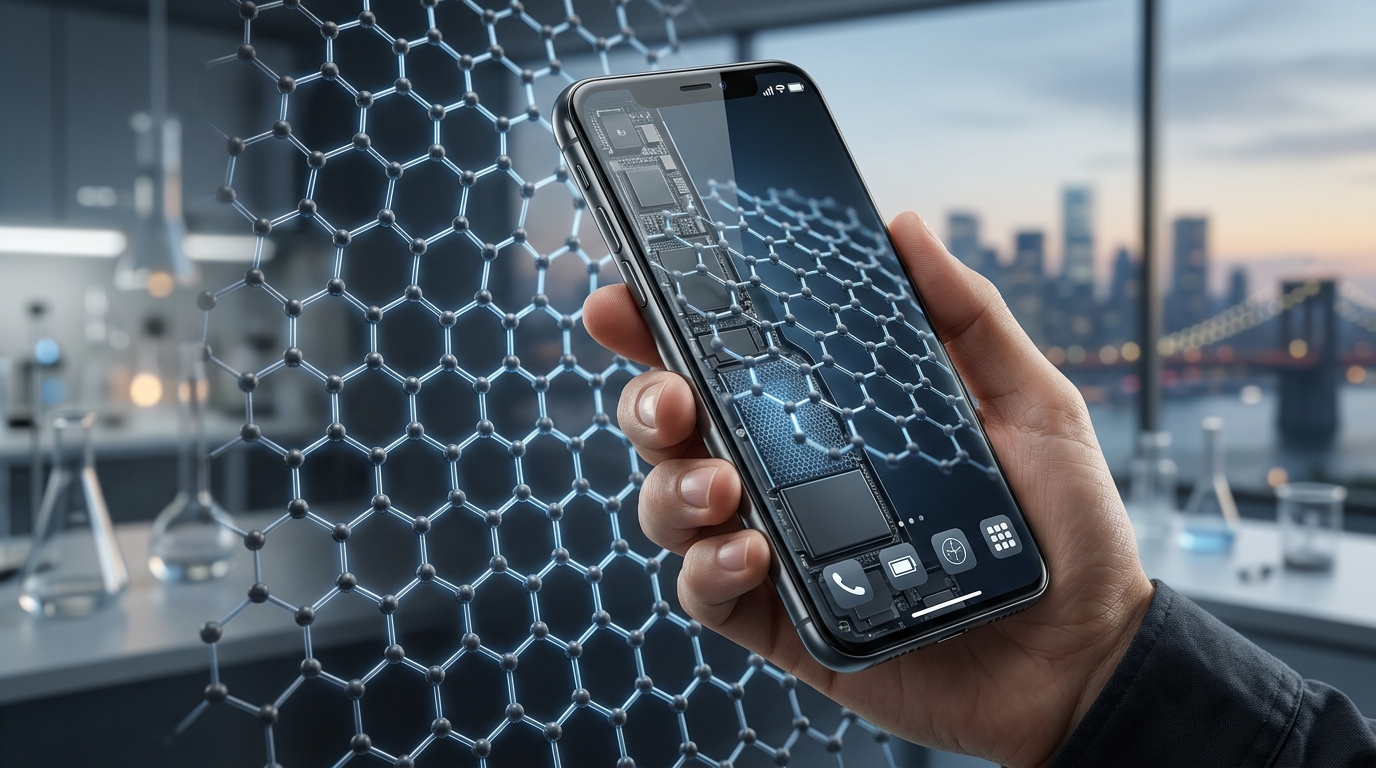
A true graphene phone is not carved from a single slab of pure carbon. Instead, it is a smartphone engineered with graphene-enhanced components that solve the most stubborn physical bottlenecks in mobile computing: overheating, battery degradation, display fragility, and radio signal interference. By integrating two-dimensional carbon lattices into critical subsystems, device manufacturers push mobile hardware beyond the thermal and electrical limits of conventional metals and silicon.
When Andre Geim and Konstantin Novoselov isolated single-layer graphene in 2004, the material captured worldwide attention for its extraordinary physical properties. A single atomic layer of carbon arranged in a hexagonal honeycomb lattice exhibits theoretical electron mobility exceeding 200,000 cm²/V·s, intrinsic tensile strength roughly 200 times that of structural steel, and thermal conductivity reaching up to 5,300 W/m·K. Translating these microscopic attributes into consumer mobile electronics requires targeting specific components where conventional materials fail under intense miniaturization.
Thermal Management: Dissipating Processor Heat
Modern mobile system-on-chip (SoC) architectures generate intense localized heat under heavy processing loads, high frame-rate gaming, and fast charging. When internal temperatures exceed safe operating thresholds, smartphones undergo thermal throttling, deliberately reducing clock speeds to prevent hardware damage. Standard thermal management relies on copper foil, aluminum heat sinks, and synthetic graphite sheets.
Graphene transforms thermal dissipation through superior in-plane thermal conductivity. While conventional synthetic graphite films achieve thermal conductivities between 1,000 and 1,700 W/m·K, engineered graphene films routinely deliver values between 1,500 and 2,000 W/m·K while remaining significantly thinner and more pliable.
- Heat Spreading Kinetics: Graphene dissipates heat via acoustic phonons—quantized vibrational modes traveling through the tightly bound carbon lattice. The absence of out-of-plane atomic bonds in pristine monolayers allows heat to disperse horizontally across the entire surface area of the chassis rather than concentrating beneath the processor.
- Bending Resilience: Synthetic graphite sheets develop micro-fractures after repeated folding, degrading their heat-spreading efficiency. Graphene-based heat dissipation films withstand tens of thousands of folding cycles without structural delamination, making them essential for foldable and rollable smartphone form factors.
- Thickness Reduction: Thinner thermal interfaces allow engineers to expand internal volume for larger battery packs or slimmer exterior designs without sacrificing thermal dissipation capacity.
Battery Architecture and Fast-Charging Mechanics
Smartphone battery performance is governed by the electrochemical kinetics of lithium-ion systems. Pushing energy into a standard graphite anode at high currents causes localized overheating, increased internal resistance, and lithium plating, which permanently reduces capacity and creates safety hazards.
Graphene does not completely replace lithium chemistry; rather, it functions as a high-performance conductive additive and structural framework within the battery cell. Manufacturers blend few-layer graphene or reduced graphene oxide into electrode slurries to create continuous, three-dimensional electron pathways.
Anode and Cathode Modification
Standard anodes rely on bulk graphite, which accommodates one lithium ion for every six carbon atoms. Incorporating graphene creates inter-layer spacing and mesoporous channels that facilitate rapid lithium-ion diffusion. On the cathode side, blending graphene with materials like lithium cobalt oxide or lithium iron phosphate reduces internal electrical resistance, allowing current to flow freely during rapid charge cycles.
Thermal Suppression During Rapid Charging
The primary bottleneck in charging speeds above 50 watts is internal Joule heating. By dramatically lowering the cell’s equivalent series resistance (ESR), graphene-doped batteries generate substantially less waste heat during high-wattage charging protocols. This reduction in operating temperature maintains cell integrity, suppresses dendrite formation, and preserves cycle life across hundreds of charge-discharge routines.
Touchscreens, Displays, and Foldable Optics
Every capacitive smartphone display requires a transparent conductive layer to register touch inputs and transmit light from the underlying display panel. For decades, the industry standard has been indium tin oxide (ITO). Despite its high transparency and electrical conductivity, ITO has severe mechanical vulnerabilities: it is brittle, ceramic-like, and cracks easily when bent or stretched.
Graphene synthesized via chemical vapor deposition (CVD) provides an electrically conductive, optically transparent alternative for flexible displays. A single layer of pristine graphene absorbs merely 2.3% of visible light, offering more than 97% optical transmittance across the visible spectrum.
Advantages for Flexible and Foldable Screens
- Mechanical Flexibility: CVD graphene films can undergo elastic deformation past 20% strain without fracturing, allowing seamless folding at tight radius angles where ITO films crack.
- Indium Independence: Indium is a scarce, expensive post-transition metal subject to supply constraints. Carbon is universally abundant, providing a sustainable material foundation for high-volume manufacturing.
- Integrated Touch Sensors: Graphene conductive traces can be patterned directly onto flexible polymer substrates, merging the touch-sensor array and structural cover film into a single ultra-thin layer.
High-Frequency Communications and Signal Integrity
Modern mobile communication standards utilize high-frequency spectrum bands, including millimeter-wave (mmWave) frequencies. High frequencies suffer from rapid atmospheric attenuation and poor penetration through phone enclosures. Furthermore, packed internal electronics generate substantial electromagnetic crosstalk between processors, cameras, and radio modules.
Graphene provides lightweight electromagnetic interference (EMI) shielding without the mass and thickness of traditional metallic shields like aluminum or Mu-metal. Because graphene exhibits high electrical conductivity coupled with a massive internal surface area, it absorbs and reflects stray electromagnetic radiation across broad bandwidths.
Graphene-based planar antennas also leverage ballistic electron transport over sub-micron distances. These compact antenna designs resonate efficiently at gigahertz and terahertz frequencies, facilitating high data throughput while occupying minimal edge real estate along the smartphone frame.
Acoustic Transducers and Embedded Sensors
Beyond heat, power, and displays, graphene’s unique mechanical properties enhance peripheral audio and sensor hardware within modern handsets.
Micro-Speaker Diaphragms
Smartphone micro-speakers must balance stiffness and low mass to produce clear sound without distortion across wide frequency ranges. Conventional speaker diaphragms use polymers or thin metal foils that flex unevenly at high volumes, introducing harmonic distortion. A graphene-polymer composite diaphragm is exceptionally stiff yet lightweight, enabling rapid acoustic response times, broader frequency response, and reduced power consumption.
Piezoresistive and Biometric Sensors
Graphene exhibits a distinct piezoresistive effect, meaning its electrical resistance changes predictably under mechanical strain or surface pressure. This property allows manufacturers to engineer ultra-sensitive under-display pressure sensors, optical fingerprint scanners with improved signal-to-noise ratios, and ultra-thin force-touch input surfaces along device chassis edges.
Material Forms and Manufacturing Realities
The term graphene covers a wide family of carbon nanostructures. Understanding how graphene is integrated into smartphones requires differentiating between material forms, processing techniques, and manufacturing constraints.
| Subsystem | Primary Graphene Form | Synthesis / Processing Method | Key Performance Benefit |
|---|---|---|---|
| Thermal Dissipation | Multi-layer graphene films / nanoplatelets | Thermal reduction & roll-to-roll calendering | Rapid in-plane heat spreading (>1,500 W/m·K) |
| Battery Electrodes | Graphene nanoplatelets / reduced graphene oxide | Liquid-phase exfoliation & chemical reduction | Reduced internal resistance and thermal suppression |
| Flexible Touchscreens | Continuous single-to-few-layer sheets | Roll-to-roll Chemical Vapor Deposition (CVD) | Mechanical bendability with >90% transparency |
| EMI Shielding | Graphene-polymer composites | Solution blending & spray coating | Lightweight broadband signal isolation |
| Acoustic Drivers | Graphene oxide composite membranes | Vacuum filtration & thermal curing | Reduced acoustic distortion and broad frequency range |
Integration Bottlenecks
While graphene delivers compelling performance advantages, several engineering bottlenecks govern its adoption rate:
Defect Density and Sheet Resistance: Large-area CVD graphene frequently contains grain boundaries, microscopic tears, and point defects that elevate sheet resistance above ideal theoretical values. Transferring single-atom sheets from copper growth substrates onto smartphone display panels without introducing wrinkles remains technically demanding.
Interfacial Contact Resistance: Integrating graphene into silicon-based semiconductor stacks introduces high electrical contact resistance at metal-graphene junctions. While graphene transistors operate at exceptional theoretical frequencies, this interfacial barrier prevents graphene from outright replacing silicon in central processing units.
Yield and Cost Economics: High-purity single-layer films require cleanroom environments, specialized transfer equipment, and strict quality control. Consequently, bulk-processed graphene nanoplatelets and reduced graphene oxide are widely used in thermal and battery systems, whereas single-layer optical films remain limited to specialized hardware configurations.
Evaluating Graphene-Enhanced Smartphone Hardware
Discerning genuine engineering integration from promotional marketing requires evaluating verifiable hardware mechanisms. A capable graphene-enhanced device leverages the material to overcome specific thermal, mechanical, or electrical limits.
- Thermal Equilibrium: Effective integration is demonstrated by stable frame rates and modest surface temperature deltas during sustained computational workloads, showing that heat is moved quickly away from the processor to the chassis perimeter.
- Charging Retention Curves: Real battery improvements manifest as higher sustained charging wattage across a larger percentage of the charge cycle, paired with long-term capacity retention over hundreds of full discharge cycles.
- Structural Reliability: In flexible hardware, graphene-based conductive traces maintain uniform conductivity across sharp bend radiuses without developing high-resistance stress fractures.
The practical graphene phone is an evolving reality composed of progressively upgraded subsystems. By replacing structurally brittle, thermally constrained, and chemically vulnerable materials with robust two-dimensional carbon lattices, mobile engineers continue to build faster, cooler, and more durable handheld devices.