
Ethos Graphene
Surface protection in detailing and protective surface care evolved significantly with the transition from organic carnauba waxes to inorganic ceramic sealants. Ethos graphene represents a specialized refinement in this field, formulating microscopic carbon nanomaterials into liquid ceramic resin matrices to enhance automotive paint protection. By suspending functionalized carbon allotropes inside a siloxane or polysilazane carrier, this coating system addresses several structural vulnerabilities inherent to conventional silicon dioxide (SiO2) coatings, notably water spotting and heat retention.
The Fundamental Chemistry of Graphene-Infused Coatings
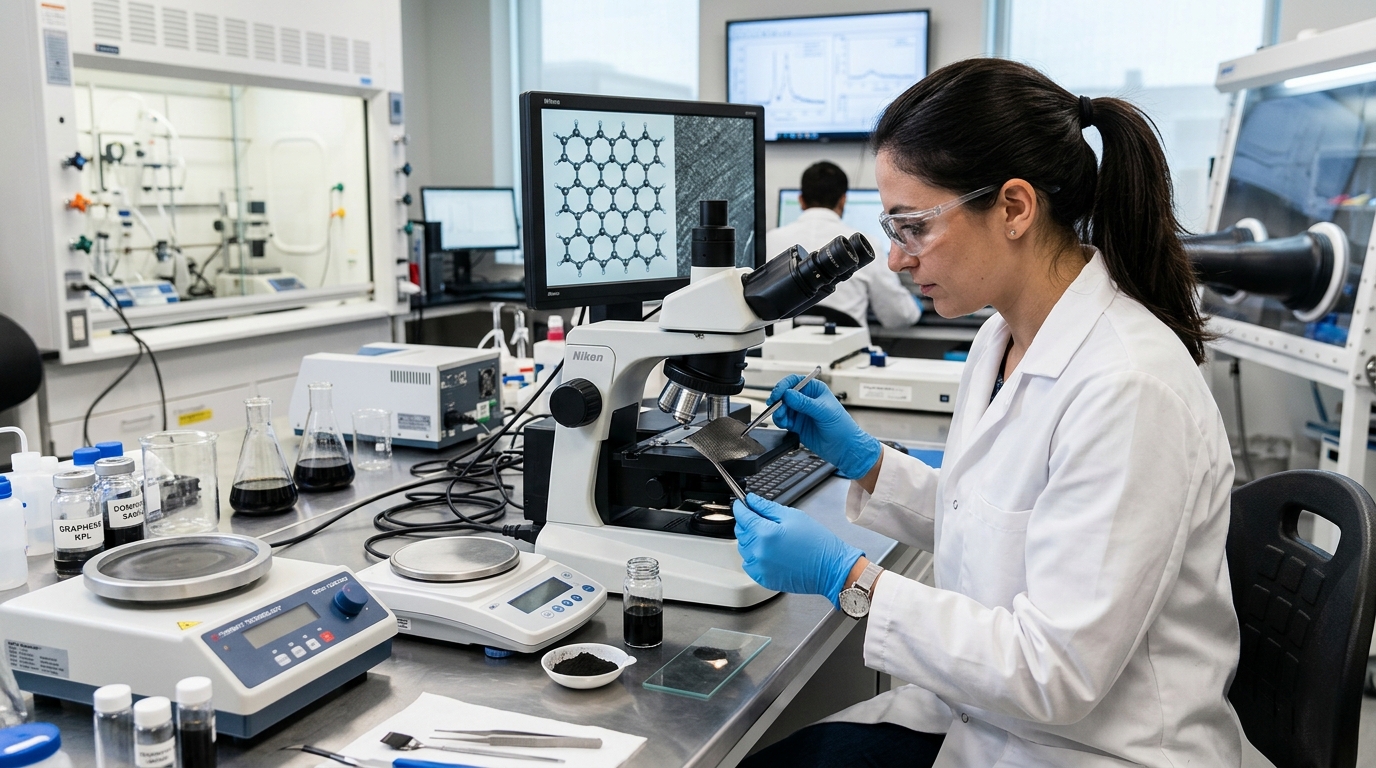
To understand how Ethos graphene functions, one must first distinguish pure monolayer graphene from practical liquid coating formulations. Free-standing, pristine monolayer graphene cannot adhere directly to automotive clear coats on its own. Instead, commercial formulations utilize engineered nanomaterial variants—predominantly reduced graphene oxide (rGO) or functionalized graphene nanoplatelets (GNPs)—integrated into an organosilicon resin.
In standard ceramic coatings, silicon dioxide or titanium dioxide polymers form a rigid crystalline quartz structure upon curing. While exceptionally hard and chemically resistant, standard ceramic layers can attract and retain thermal energy under direct sunlight. When hard mineral water evaporates on a hot ceramic-coated panel, calcium and magnesium salts bake into the surface, creating severe mineral deposits known as water spots.
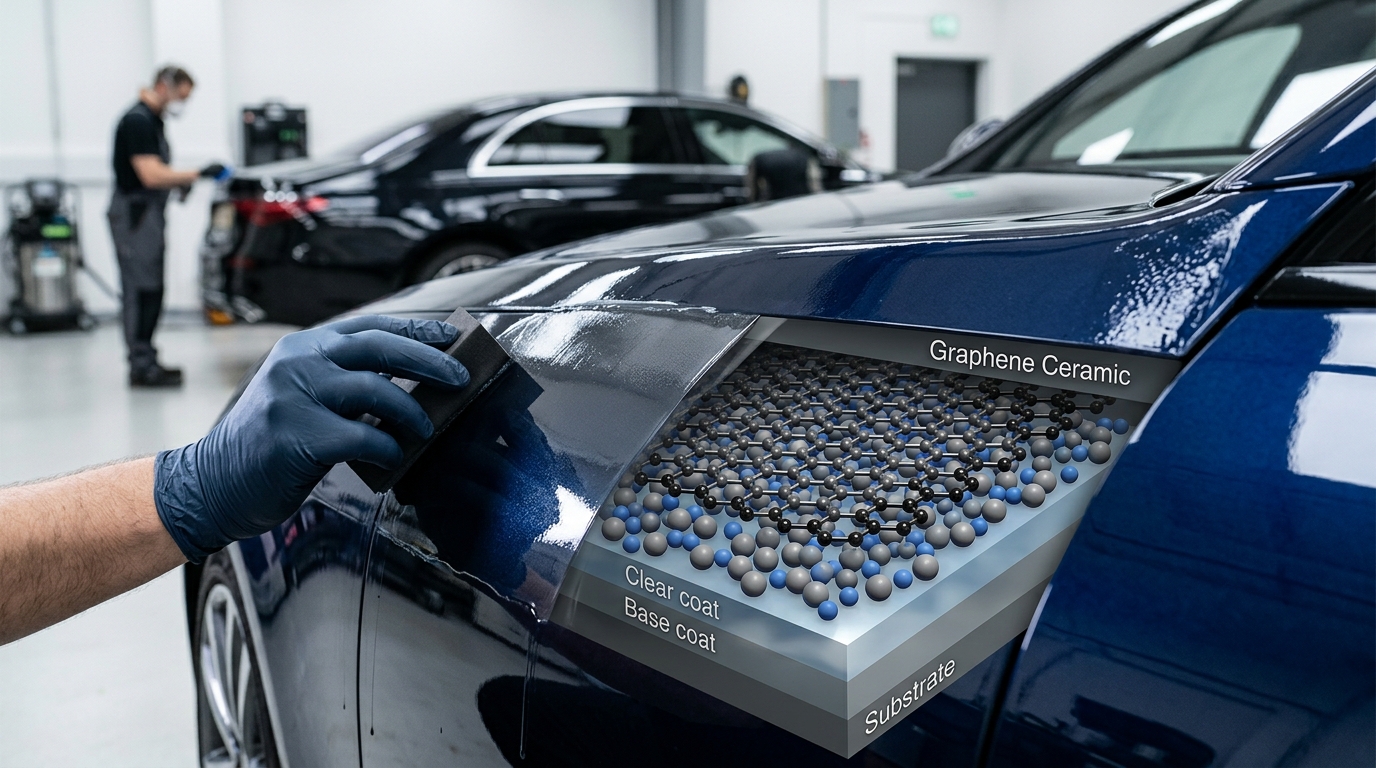
Infusing a silazane backbone with graphene alters these surface dynamics. Carbon nanomaterials introduce a two-dimensional hexagonal lattice structure that distributes throughout the resin matrix. When the liquid carrier evaporates during the cross-linking phase, these carbon sheets orient within the curing polymer, creating a denser, more cohesive barrier with distinct physical and thermal characteristics.
Mechanisms of Action: Why Graphene Modifies Polymer Performance
The addition of graphene allotropes to protective surface coatings influences four specific operational mechanisms: thermal dissipation, hydrophobic fluid dynamics, chemical resistance, and mechanical resilience.
1. Thermal Dissipation and Mineral Resistance
Graphene possesses exceptional intrinsic thermal conductivity. Within a coating matrix, the dispersed nanomaterials help distribute localized heat across the treated substrate rather than allowing concentrated thermal hot spots. This rapid thermal dissipation lowers surface temperatures during sun exposure. Because the surface remains cooler, water droplets roll off or evaporate at lower baseline temperatures, significantly reducing the chemical etching associated with concentrated mineral deposits.
2. Fluid Dynamics and Hydrophobic Contact Angles
A treated surface alters the surface energy of the substrate, generating an elevated water contact angle typically ranging between 110 and 118 degrees. More importantly, the nanostructured surface reduces the roll-off angle (sliding angle), allowing water droplets to release under minimal physical inclination or kinetic airflow. This sheeting dynamic sweeps accumulated particulate contaminants away before they can bond to the clear coat.
3. Chemical and Environmental Barrier Properties
The two-dimensional packing density of graphene platelets creates a tortuous diffusion pathway. Corrosive agents—such as acidic bird droppings, insect acids, alkaline road salts, and industrial fallout—cannot readily penetrate the tightly packed matrix. The cured barrier exhibits stability across an extensive chemical spectrum, generally resisting sustained exposure from pH 2 through pH 12.
4. Mechanical Cohesion and Anti-Marring Traits
While marketing claims often exaggerate scratch-proof capabilities, graphene does enhance the surface’s tensile strength and flexural resilience. By reinforcing the polymer network, the coating forms a durable sacrificial barrier layer that minimizes microscopic swirl marks and wash-induced marring compared to untreated factory clear coats.
Ethos Graphene vs. Traditional SiO2 Ceramic Coatings
Evaluating graphene matrix technology alongside conventional ceramic systems clarifies the exact operational differences between the two categories.
| Performance Attribute | Traditional SiO2 Ceramic Coating | Ethos Graphene Matrix Coating |
|---|---|---|
| Primary Active Matrix | Silicon Dioxide (SiO2) / Polysilazane | Polysilazane infused with Graphene/rGO |
| Water Spot Susceptibility | Moderate to High (due to localized heat retention) | Low to Moderate (enhanced thermal dissipation) |
| Average Water Contact Angle | 100° – 110° | 110° – 118° |
| Water Roll-Off / Sliding Angle | Moderate (~20°–30°) | Very Low (~10°–15°) |
| Surface Tactility | Glassy, occasionally grabby | Extremely slick, low friction coefficient |
| Flexibility / Cissing Resistance | Relatively brittle crystalline structure | Higher tensile flexibility, reduced micro-cracking |
The Application and Curing Mechanism
Applying an advanced nanocomposite coating is a rigorous multi-stage procedure dictated by chemical bonding requirements. Graphene coatings require direct covalent bonding with the polyurethane clear coat, meaning intermediate contaminants will compromise the coating’s longevity.
Substrate Preparation
The clear coat must be brought to an optically flat, completely bare state prior to application:
- Decontamination: Chemical iron removers and mechanical clay bars eliminate embedded metallic fallout and environmental debris.
- Correction: Machine compounding and polishing remove oxidized paint, scratches, and factory clear coat imperfections.
- Solvent Wipe: Thorough paint de-contamination using isopropyl alcohol or dedicated panel prep solvents strips residual polishing oils, silicones, and surfactants.
Chemical Cross-Linking and Flashing
Once wiped onto a cool panel using a microfiber applicator block, the solvent carrier begins evaporating immediately. This phase, known as the flash time, is marked by visible rainbowing or sweating on the surface. During this interval, atmospheric moisture triggers chemical cross-linking, bonding the silazane chains to the paint substrate while locking the carbon nanostructures into place.
Leveling the coating with high-density microfiber towels removes excess resin before high spots harden. Most formulations achieve initial surface cure within 24 to 48 hours, with full chemical resistance setting in over a seven-day window as the matrix reaches maximum density.
Technical Trade-offs and Practical Limitations
While graphene matrix coatings provide clear material advantages, objective analysis requires separating demonstrated mechanical benefits from commercial exaggeration.
Dispersion Challenges
The primary manufacturing challenge with graphene in liquid coatings is dispersion stability. Raw graphene sheets naturally attract one another via van der Waals forces, leading to agglomeration. If graphene clogs into microscopic clumps within the bottle, it fails to integrate into the cross-linked network and can cause hazing or uneven cure profiles. Effective formulations rely on advanced surfactants and stable chemical functionalization to maintain uniform liquid suspension.
Hardness Realities
Consumer literature frequently quotes pencil hardness ratings like 9H or 10H. In practical material science, pencil hardness does not translate to resistance against stone chips, sharp physical abrasives, or heavy physical impact. A micron-thin coating—regardless of graphene concentration—serves as a resilient sacrificial wear layer, not an impenetrable armor plating.
Evaluating Coating Longevity and Maintenance
A properly applied graphene matrix coating maintains its integrity through thousands of miles when cared for correctly. Tracking coating health relies on observable performance indicators:
- Hydrophobic Degradation: If water begins to flatten rather than bead into tight, spherical droplets, traffic film or road oil has likely masked the top layer.
- Surface Decontamination Washes: Using a pH-neutral, additive-free automotive shampoo lifts road grime without leaving polymer residues that interfere with the graphene’s surface tension.
- Periodic Descaling: Mineral-rich waters can leave trace salt films over time. Occasional washing with mildly acidic specialty shampoos dissolves these surface minerals without degrading the underlying chemical bonds.
By understanding the precise chemical composition and thermodynamic principles behind Ethos graphene, detailers and vehicle owners can make informed decisions based on genuine material science rather than surface protection marketing.