Head Graphene Xt Speed Mp
The head graphene xt speed mp represents a pivotal milestone in sports equipment engineering, where advanced two-dimensional nanomaterials moved from laboratory synthesis to high-performance sporting goods. Manufactured by HEAD, this tennis racquet utilizes an engineered carbon-composite matrix infused with functionalized graphene to alter the mass distribution and kinetic transfer of the frame. By re-engineering the structural core of the racquet, the design achieves high swing speeds, clean energy transfer, and distinct baseline power without increasing the overall static weight of the frame.
Understanding the engineering behind this racquet requires examining the intersection of nanomaterial science, structural mechanics, and rotational physics. Rather than using graphene as a cosmetic additive, the frame leverages the exceptional mechanical properties of graphene to redistribute mass away from the central shaft toward the operational extremities: the handle and the racquet tip.
The Material Science: From Pristine Carbon to Graphene XT
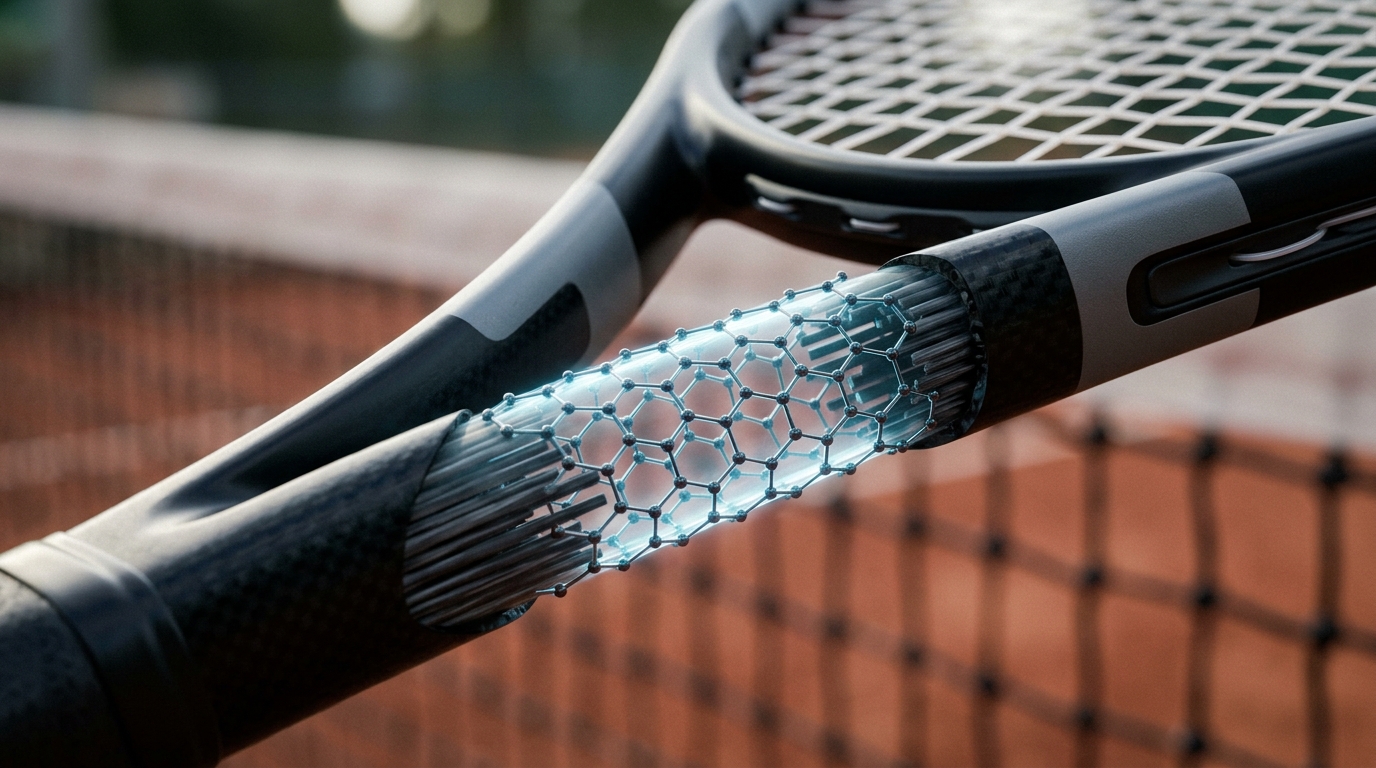
Graphene is an allotrope of carbon consisting of a single layer of atoms arranged in a two-dimensional hexagonal lattice. In isolation, pristine monolayer graphene possesses an intrinsic tensile strength exceeding 130 gigapascals and an elastic modulus of approximately 1 terapascal. However, integrating a single-atom-thick sheet into a three-dimensional bulk structure presents significant manufacturing hurdles. Raw, unfunctionalized graphene sheets naturally tend to agglomerate due to strong van der Waals forces, which can create structural defects within host polymers.
To overcome agglomeration, the composite engineering behind Graphene XT uses engineered graphene nanoplatelets (GNPs) chemically integrated into a thermoset epoxy resin matrix. These nanoplatelets consist of multi-layer graphene stacks designed with a high aspect ratio and surface chemical treatments that improve bonding with the resin. When woven alongside continuous structural carbon fibers in pre-impregnated composite sheets (prepregs), the graphene-reinforced matrix provides greater interlaminar shear strength and localized stiffness than conventional carbon-epoxy systems.
In the evolution of HEAD racquet materials, Graphene XT was engineered with a customized platelet morphology that yielded up to a 30 percent improvement in structural strength at the microscopic level compared to initial graphene-composite iterations. This reinforcement allowed composite engineers to dramatically thin the walls of the racquet shaft while maintaining the load-bearing capacity necessary to endure the extreme forces of high-velocity ball impacts.
The Polarized Weight Distribution Mechanism
The central mechanical philosophy of the Head Graphene XT Speed MP is polarized mass distribution. Traditional tennis racquet design typically distributed mass somewhat evenly along the frame or added mass to the bridge to prevent twisting. However, concentrating mass in the central throat region contributes to overall static weight without directly optimizing rotational dynamics or sweet-spot stability.
By reinforcing the shaft with a graphene-enhanced composite, engineers removed non-structural dead weight from the central section and redistributed it to the extreme ends of the frame: the tip (12 o’clock position on the head) and the base of the handle. This redistribution fundamentally alters the racquet’s moment of inertia across two primary axes.
- Longitudinal Axis (Twistweight): Mass shifted toward the 3 and 9 o’clock perimeter, paired with structural rigidity from the graphene matrix, raises torsional stability against off-center impacts.
- Transverse Axis (Swingweight): Mass placed at the tip increases the dynamic swing resistance relative to the pivot point (the player’s hand), translating higher angular momentum into the ball at contact.
- Recoil Weight: Weight placed in the handle anchors the frame against sudden deceleration upon impact, stabilizing the hand and arm against shock.
This design allows players to swing a lighter static-weight racquet with the striking force and kinetic energy output typically associated with a significantly heavier conventional frame.
Engineering Specifications of the Speed MP Platform
The “Speed MP” designation defines a midplus (MP) geometric profile intended for modern, fast-swinging baseline and all-court players. The physical geometry and mechanical parameters are engineered to balance maneuverability, aerodynamic efficiency, and ball pocketing.
- Head Size: 100 square inches (645 square centimeters), providing a balanced sweet spot with sufficient margin for error on high-spin strokes.
- Unstrung Mass: Approximately 300 grams (10.6 ounces), positioning the frame in the versatile intermediate-to-advanced weight class.
- Unstrung Balance: Roughly 320 millimeters (approximately 4 to 5 points head-light), compensating for the tip mass to preserve rapid acceleration.
- Beam Width: Constant 22-millimeter straight beam, which maintains predictable deflection characteristics across the entire hoop.
- String Pattern: 16 mains by 19 crosses, balancing open spacing for spin generation with structural density for directional control.
- Nominal Stiffness Rating: Approximately 67 RA, indicating a firm composite structure that emphasizes power output and energetic rebound.
On-Court Dynamics: Translating Physics to Performance
The real-world playability of the Head Graphene XT Speed MP is defined directly by its mechanical architecture. When a ball impacts the stringbed, several kinetic mechanisms take place simultaneously.
Kinetic Energy Transfer on Groundstrokes
Because the frame features a lower static mass in the throat and higher mass at the head, the racquet accelerates rapidly through the forward swing path. According to the laws of rotational mechanics, kinetic energy scales with the square of angular velocity. The lower rotational inertia around the shoulder and wrist joints enables higher swing speeds, while the concentrated tip mass ensures substantial kinetic energy transfer to the ball upon collision.
Torsional Rigidity and Directional Accuracy
When impact occurs outside the geometric center of the head, off-center torque forces the frame to twist along its longitudinal axis. The graphene-reinforced matrix provides structural resistance to this torsional shear, reducing deflection angle errors. As a result, off-center strikes retain a higher percentage of their intended launch angle and depth compared to racquets with flexible, unreinforced shafts.
Spin Potential and String Interaction
The 16×19 string grid, combined with the 100-square-inch hoop and fast swing speed, facilitates aggressive topspin production. The aerodynamic 22mm beam cuts through the air with minimal drag during vertical brush paths (the classic modern windshield-wiper stroke). The rigid hoop perimeter allows the main strings to displace laterally and snap back quickly, imparting rotational velocity to the tennis ball through the friction-snapback mechanism.
Performance Tradeoffs and Structural Limitations
No composite design can maximize all performance variables simultaneously. The specific mechanical choices in the Head Graphene XT Speed MP introduce clear tradeoffs that players and equipment technicians must evaluate.
Vibrational Feedback and Arm Comfort
The combination of a high stiffness rating (around 67 RA) and mass concentrated away from the throat means that vibrational frequencies upon impact transmit differently than in flexible, uniform-graphite frames. While the frame provides crisp auditory feedback and immediate power, the higher-frequency shock profile offers less intrinsic vibration damping. Players with existing wrist or elbow sensitivities often require softer multifilament or natural gut string setups at lower tensions to mitigate peak impact shock.
Touch, Flex, and Ball Dwell Time
Traditional, flexible racquets deform significantly upon ball impact, increasing dwell time—the duration the ball stays compressed against the stringbed. The rigid, polarized architecture of the Graphene XT Speed MP shortens dwell time. While this rapid rebound enhances pace on baseline drives, it reduces the tactile feedback required for delicate touch shots, drop volleys, and low-speed slice placements.
Composite Comparison: Graphene XT vs. Traditional Layups
To contextualize how the material integration of Graphene XT altered racquet behavior, the following table compares key technical parameters between standard carbon-fiber composite layups and the polarized Graphene XT architecture.
| Mechanical Attribute | Traditional Carbon-Epoxy Layup | Head Graphene XT Composite |
|---|---|---|
| Mass Distribution | Uniformly distributed along shaft and bridge | polar weight distribution (tip and handle) |
| Shaft Wall Thickness | Standard composite cross-section | Thinned cross-section with higher tensile resilience |
| Dynamic Swing Speed | Standard relative to static weight | Elevated due to reduced central inertia |
| Impact Rebound Speed | Moderate; energy absorbed through frame flex | High; rigid hoop provides spring-like return |
| Torsional Deflection | Higher twisting on off-center hits | Reduced twisting via high-modulus hoop reinforcement |
| Vibrational Profile | Dampened, lower-frequency spectrum | Crisp, higher-frequency feedback loop |
Manufacturing and Quality Control Considerations
Integrating nanomaterials into production sporting equipment demands rigorous industrial controls. In the fabrication of the Head Graphene XT Speed MP, the graphene nanoplatelets must be dispersed evenly throughout the liquid epoxy before carbon fiber prepregs are rolled and placed into curing molds.
If the nanoplatelet concentration is uneven, localized stress concentrations can develop, creating weak zones susceptible to microcracking under repetitive fatigue. High-pressure bladder molding is used during thermal curing to force out air voids and ensure that the graphene-rich resin thoroughly wets every continuous carbon filament. The result is a unified composite skin where the structural properties remain uniform across production batches.
Evaluation Criteria: Determining Player Suitability
The Head Graphene XT Speed MP is engineered around specific mechanical parameters that suit particular play styles. Evaluating whether this structural profile aligns with a player’s biomechanics involves several criteria:
- Swing Path Style: Players who utilize full, fast, modern vertical swing paths benefit the most from the aerodynamic beam and polarized tip weight.
- Baseline Power Requirements: Counter-punchers and aggressive baseliners seeking effortless depth and ball speed will appreciate the frame’s stiff, energetic rebound.
- Customization Potential: The neutral 300-gram unstrung platform provides a solid baseline for technicians wishing to apply tungsten or lead tape for specific swingweight adjustments.
- Physical Conditioning: Players capable of generating their own stability and who do not require an ultra-flexible, vibration-absorbing frame will maximize the performance benefits of this material architecture.
By blending advanced carbon nanotechnology with targeted mass distribution, the Head Graphene XT Speed MP demonstrates how microscopic composite reinforcement can directly shape macroscopic athletic performance.