
Graphene News
Recent developments in 2D materials have accelerated the transition of graphene from controlled laboratory environments to large-scale commercial deployments. This curated graphene news intelligence hub outlines the latest technical breakthroughs, commercial pilot programs, academic milestones, and market adoption timelines shaping the sector.
Major Technical Breakthroughs
Materials science research across leading institutions has delivered significant advancements in synthesis efficiency, fundamental quantum physics, and semiconductor integration:
- Scalable Methane-to-Graphene Oxide Conversion: Researchers at Texas A&M University demonstrated a nonthermal plasma-water interface technique capable of converting methane directly into high-purity graphene oxide (GO) and hydrogen gas. This direct conversion pathway bypasses traditional graphite mining and the hazardous chemical oxidation reagents associated with conventional modified Hummers’ methods.
- Direct Observation of Hydrodynamic Electron Flow: A collaborative investigation between the Indian Institute of Science (IISc) and the National Institute for Materials Science (NIMS, Japan) confirmed that electrons in pristine monolayer graphene can flow collectively as a low-friction, viscous quantum fluid, validating long-standing theoretical models of 2D hydrodynamic electron transport.
- Semiconducting Epigraphene Development: Building upon foundational work at Georgia Tech and Tianjin University, researchers have advanced the fabrication of epitaxial graphene grown on silicon carbide (SiC). The resulting material maintains a robust ~0.6 eV bandgap while demonstrating room-temperature charge-carrier mobilities ranging from 5,000 to 10,000 cm²/V·s, addressing one of the primary historical barriers to graphene logic devices.
- Field-Boosted Superconductivity in Multilayer Superlattices: Physicists at MIT and partnering labs reported magnetic-field-resilient superconductivity alongside fractional Chern insulator states in rhombohedral pentalayer and moiré graphene structures, offering experimental platforms for topological quantum computing architectures.
Categorized Industry Sector News
Graphene adoption is advancing across distinct vertical sectors, each driven by specific physical, electrical, and thermal properties.
Energy Storage and Fast Charging
Graphene integration in energy systems addresses ion transport resistance, thermal management, and cycle longevity across both traditional lithium platforms and non-lithium chemistries:
- High-Rate Open-Pore Supercapacitors: Engineering teams at Monash University developed highly curved, open-pore graphene frameworks. By unlocking internal surface area, these electrode structures achieve rapid power discharge capabilities well above standard lithium-ion systems while nearing the energy density of lead-acid systems.
- Aluminum-Ion Cells and Cathode Coatings: Graphene Manufacturing Group (GMG) expanded manufacturing trials for its graphene aluminium-ion cell designs. Concurrently, automotive battery manufacturers in the European Union and South Korea began pilot testing ultra-thin graphene conductive coatings on high-nickel cathodes to reduce thermal degradation during 10-minute fast-charging cycles.
- Space-Rated Battery Packs: Under the European Union’s Horizon Europe GRAPHERGIA program, Pleione Energy initiated orbital validation testing for graphene-enhanced cylindrical lithium-ion modules engineered for CubeSat nanosatellites, focusing on thermal stability in vacuum conditions.
Electronics, Logic, and Acoustic Sensors
As silicon scaling approaches atomic limits, 2D materials are moving into wafer-level integration:
- Contact Resistance Reduction: Semiconductor roadmaps are evaluating bandgap-engineered graphene and hybrid graphene-contacted 2D transition metal dichalcogenides (TMDs) to minimize parasitic contact resistance at sub-2nm nodes.
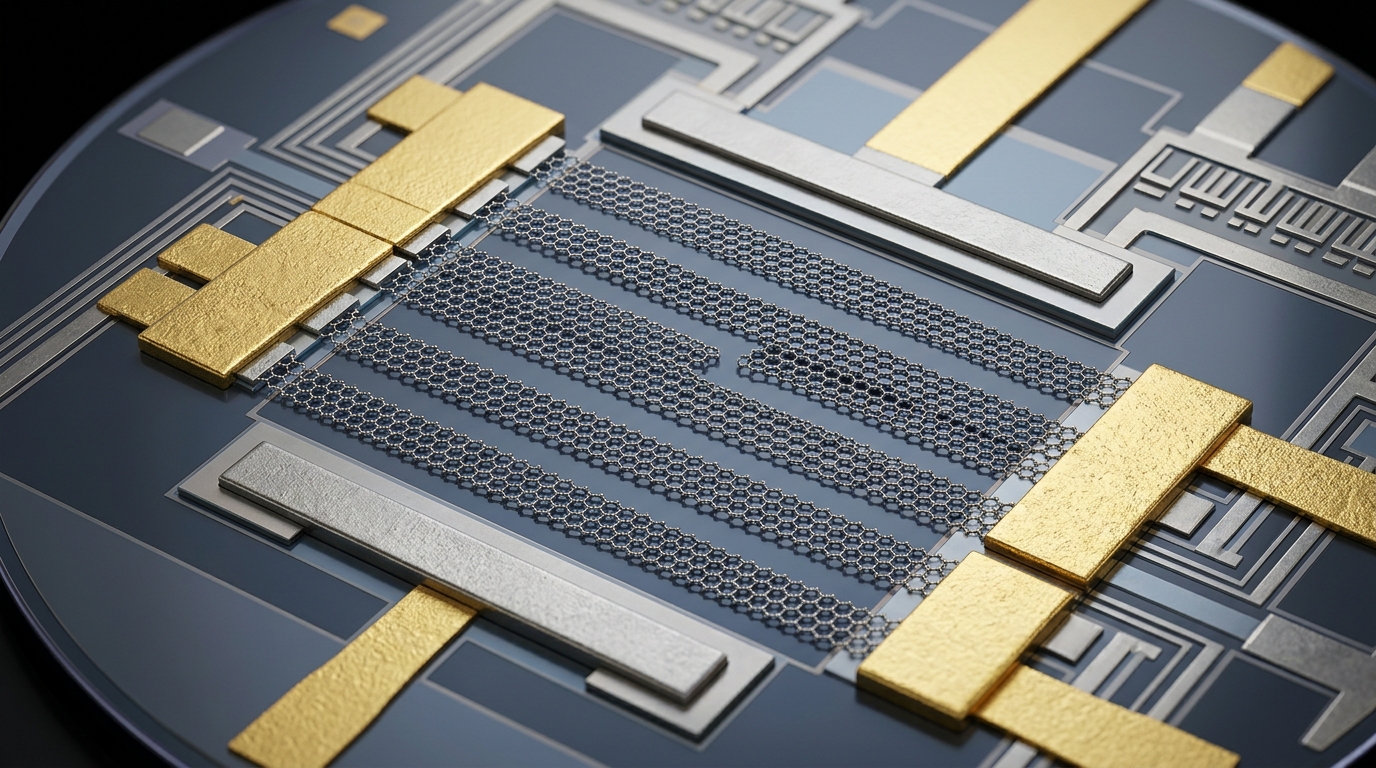
- Wafer-Scale Acoustic Transducers: Research teams validated transfer-free graphene membrane drum arrays directly integrated onto silicon substrates. These MEMS microphones demonstrate an order-of-magnitude increase in acoustic sensitivity alongside a ~90% reduction in package volume compared to standard capacitive MEMS sensors.
Advanced Composites and Civil Infrastructure
Industrial applications of bulk graphene nanoplatelets (GNPs) continue to scale across construction, aerospace, and protective coatings:
- Low-Carbon Concrete Formulations: Concrete mixes reinforced with functionalized graphene (such as Concretene) underwent expanded civil infrastructure field trials. The additive improves early compressive strength development while reducing required cement volumes by 15% to 30%, lowering embodied carbon profiles.
- Toughness in Aerospace Resins: First Graphene Ltd finalized its acquisition of US-based MITO Material Solutions, integrating functionalized graphene additives into thermoset epoxy resins to enhance impact resistance and limit interlaminar delamination in structural aerospace parts.
- Self-Sensing Structural Panels: The GRAPHERGIA consortium, in partnership with Adamant Composites, deployed test panels with embedded graphene-based triboelectric sensors for real-time structural health monitoring in high-stress composite parts.
Biomedical Devices and Diagnostics
Biocompatibility and high signal-to-noise ratios make graphene interfaces valuable for clinical monitoring and therapeutic delivery:
- Human Neural Interfaces: INBRAIN Neuroelectronics completed patient enrollment in first-in-human clinical evaluations of high-density graphene cortical interfaces during neurosurgical procedures. The devices achieved micrometer-scale signal resolution for functional brain mapping without device-related adverse events.
- Targeted Onco-Therapeutic Delivery: Investigators from Okayama University and the CNRS (under the IRP C3M framework) published functional frameworks for pH-sensitive graphene oxide nanocarriers. These carriers selectively release therapeutic payloads inside the acidic microenvironments of solid tumors while minimizing off-target toxicity.
Commercialization Milestones and Corporate Activity
Commercialization efforts increasingly focus on scaling production volume, standardizing quality, and securing regional regulatory clearances.
| Company / Initiative | Region | Key Milestone / Corporate Action | Primary Target Sector |
|---|---|---|---|
| HydroGraph Clean Power | Canada / USA | Signed long-term facility agreements for a 360–750+ t/year production plant in Bellville, Texas; partnered with NEI Corp and Volfpack Energy. | Conductive masterbatches and EV battery additives. |
| Graphene Manufacturing Group (GMG) | Australia | Obtained U.S. EPA clearance; commenced bulk exports of THERMAL-XR thermal coatings to North America; expanded Al-ion pilot capacity. | HVAC energy-efficiency coatings and fast-charging cells. |
| First Graphene Ltd | Australia | Acquired MITO Material Solutions; scaled specialized functionalized masterbatch production lines. | Thermoset aerospace composites and ballistic defense. |
| Levidian | United Kingdom | Expanded commercial deployments of its modular LOOP decarbonization hardware, generating hydrogen and net-zero graphene from natural gas. | Industrial elastomers, tire compounds, and composite resins. |
| INBRAIN Neuroelectronics | Spain | Secured FDA Breakthrough Device Designation; finished acute clinical trials; scaled cleanroom production ahead of planned commercialization. | High-resolution Brain-Computer Interfaces (BCI). |
| GRAPHERGIA Consortium | European Union | Initiated three pilot deployments focusing on smart textiles, aerospace sensor skins, and CubeSat energy packs. | Wearable tech, aerospace, and space power. |
Academic Research Milestones and Citation Log
Key academic peer-reviewed publications establishing recent foundational progress include:
- Staack et al., Texas A&M University (Nature Communications, July 2026): Demonstrating single-step plasma synthesis of graphene oxide directly from hydrocarbon gas streams.
- Ghosh et al., Indian Institute of Science & NIMS (Nature Physics, April 2026): Experimental observation and mapping of hydrodynamic electron liquid flow in monolayer graphene devices.
- Ju et al., Massachusetts Institute of Technology (Nature, mid-2026): Documenting magnetic field-enhanced superconductivity and non-Abelian topological phase signatures in rhombohedral pentalayer graphene.
- Majumder et al., Monash University / AM2D (Nature Communications, Dec 2025): Synthesis of morphologically curved graphene electrode architectures for high-power supercapacitors.
- de Heer et al., Georgia Institute of Technology & Tianjin University (Nature, 2024–2026): Production and transport verification of semiconducting epigraphene on silicon carbide wafers.
Industry Trends and Deployment Timelines
Market projections indicate sustained growth, though long-term revenue estimates vary based on industrial adoption rates:
- Conservative Outlook: Analysts at IDTechEx project the global market for graphene and related 2D materials will reach approximately $2.7 billion by 2036, driven primarily by bulk additives.
- Aggressive Outlook: SNS Insider estimates the global market will scale from $900 million in 2025 to $12.4 billion by 2035, reflecting a compound annual growth rate (CAGR) of roughly 30%.
- North American Market: DataM Intelligence projects the U.S. domestic market will expand from $193.5 million in 2025 to $2.02 billion by 2033 (CAGR of 34.2%).
The progression of graphene technology from laboratory synthesis to widespread commercial adoption follows three distinct phases:
- Near-Term (Active Market): Bulk graphene nanoplatelets (GNPs) serve as functional performance additives in polymer composites, anticorrosion coatings, civil infrastructure, athletic equipment, and point-of-care microfluidic diagnostic sensors.
- Mid-Term (Specialty Deployment): Expansion of fast-charging battery formulations, industrial-scale grid supercapacitors, structural self-sensing aerospace components, and commercial deployment of clinical-grade neural interfaces.
- Long-Term (High-Tech Integration): Commercialization of wafer-scale semiconducting graphene logic circuits, hybrid 2D computing components, room-temperature quantum sensing arrays, and topological quantum logic elements.
Industry Events and News Monitoring
Stay informed on emerging materials science developments and enterprise scale-up milestones:
- Graphene Flagship Initiatives & 2D Materials Summits: International conferences continue to showcase annual progress across European, Asian, and North American research hubs.
- Ongoing Intelligence: Subscribe to industry trade feeds and technical journals to receive validated updates on material characterization standards, patent filings, and pilot validation trials.