Motorola Graphene
Thermal management and material durability represent two of the most critical engineering bottlenecks in modern consumer electronics. As mobile system-on-chips (SoCs) demand higher power draws for on-device artificial intelligence, advanced computational photography, and high-refresh-rate gaming, device chassis dimensions continue to shrink. In response to these thermodynamic challenges, Motorola graphene integration has emerged as a central pillar of hardware engineering across Motorola Mobility and its parent company, Lenovo.
While popular industry rumors often conflate advanced carbon nanomaterials with hypothetical “super-batteries,” Motorola’s practical deployment focuses on precision thermal routing, multi-layer graphite/graphene dissipation sheets, and composite interface materials. This guide provides a balanced, engineering-focused evaluation of Motorola’s graphene initiatives, patent portfolio, fast-charging architectures, competitive positioning against major Android OEMs, and future hardware trajectories.
Motorola and Lenovo: Advanced Materials and Patent Landscape
Motorola Mobility LLC, operating as a wholly owned subsidiary of Lenovo Group Ltd., approaches 2D nanomaterials through a rigorous intellectual property and hardware packaging strategy. Lenovo’s centralized research and development divisions, alongside Motorola’s mobile hardware teams, hold extensive patent filings focused on thermal spreading, planar dissipation, and micro-scale electronics packaging.
Key Areas of Patent Focus
- Thermal Ground Planes and Multi-Layer Routing: Motorola and Lenovo hold patents covering multi-layer heat spreading assemblies that route thermal energy laterally away from compact processing hubs. These designs incorporate high-conductivity carbon films bonded directly to structural mid-frames.
- Interfacial Thermal Conductance: Patented packaging solutions focus on reducing thermal contact resistance between high-density multi-chip modules (MCMs)—such as Qualcomm Snapdragon platforms—and the exterior chassis or display substrates.
- Flexible Heat Conduits for Foldables: Specialized mechanical filings outline anisotropic thermal sheets designed to flex across mechanical hinges without experiencing delamination, fracturing, or thermal performance degradation over hundreds of thousands of fold cycles.
These initiatives address a fundamental limitation of traditional metallurgy: standard copper and aluminum components carry significant weight penalties and mechanical fatigue limits when machined into sub-millimeter profiles.
Graphene Thermal Management Systems in Motorola Hardware
The primary commercial deployment of graphene in Motorola devices is located within the multi-layered cooling stack. In modern flagships, such as select models in the Motorola Edge and Razr foldable portfolios, passive thermal dissipation relies on a hybrid hierarchy of materials designed to handle high heat flux.
The Mechanics of In-Plane Thermal Dissipation
Monolayer, pristine graphene exhibits theoretical in-plane thermal conductivity between 3,000 and 5,300 W/m·K, vastly outperforming pure bulk copper (~400 W/m·K) and aluminum (~237 W/m·K). In practical industrial manufacturing, multi-layer graphene and graphene-graphite hybrid composite sheets achieve effective commercial thermal conductivity ranging from 1,000 to 1,800 W/m·K.
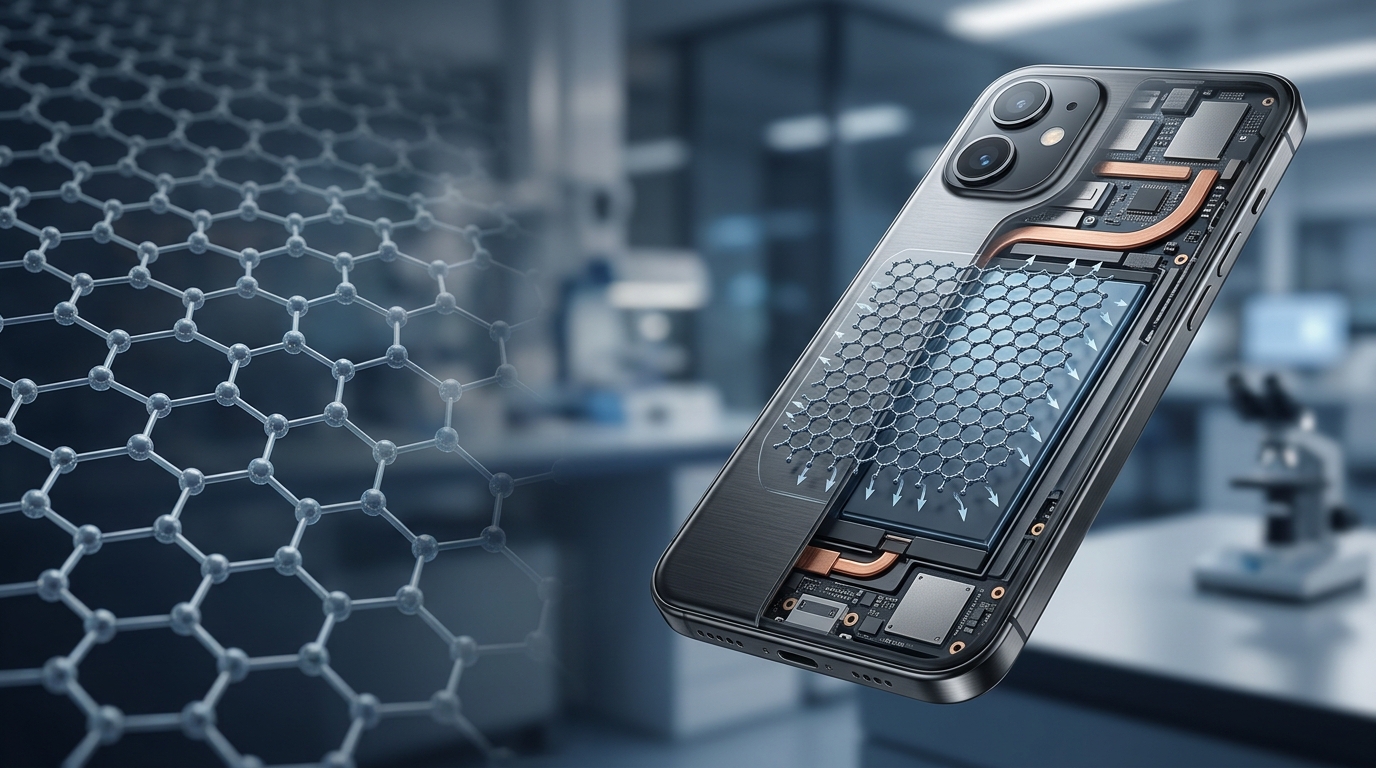
Motorola utilizes these macroscopic graphene films to achieve rapid in-plane thermal distribution. When an SoC generates a concentrated thermal spike, the graphene layer quickly diffuses the heat laterally across the entire surface area of the device chassis. This lateral spreading prevents localized thermal saturation and allows the heat to dissipate evenly through the external casing and display panel.
Hybrid Cooling Architecture
Motorola’s high-performance thermal design integrates several distinct layers:
- Thermal Interface Materials (TIMs): Specialized phase-change pads or micro-particle pastes positioned directly between the SoC die and the primary spreader to eliminate air gaps.
- Ultra-Thin 3D Vapor Chambers (VC): Liquid-vapor phase-change copper envelopes (often engineered at thicknesses $le$ 0.3 mm) that absorb peak localized heat flux.
- Graphene Heat Dissipation Sheets: Micro-thin, highly anisotropic carbon layers applied over broad internal surfaces, including battery cavities and display backplates, to provide secondary spreading and broad-spectrum passive radiation.
Engineering Solutions for the Foldable Form Factor
The Motorola Razr series presents unique thermodynamic difficulties. Foldable smartphones feature split internal architectures, where the primary processor, main display controller, and radio-frequency (RF) front-end modules are housed in one half of the chassis, while secondary batteries and auxiliary components occupy the other.
Traditional rigid heat pipes cannot bridge the mechanical hinge without failing under continuous mechanical stress. Flexible graphene sheets solve this design constraint. Due to their mechanical flexibility, high tensile strength, and anisotropic conductivity, thin graphene films can traverse hinge mechanisms. This enables Motorola engineers to transfer excess thermal energy from the processor-dense half of the device to the auxiliary chassis half, effectively doubling the usable dissipation surface area.
Graphene Battery Technology: Industry Rumors vs. Commercial Reality
Consumer discourse regarding “graphene batteries” is frequently distorted by exaggerated claims of instant charging and miraculous energy densities. An objective engineering breakdown reveals the true role of carbon nanomaterials in Motorola’s energy storage roadmap.
Deconstructing the “Pure Graphene Battery” Myth
There is currently no commercially viable, mass-produced smartphone operating on a pure graphene battery. Complete graphene-electrode cells face severe industrial barriers, including high manufacturing costs at scale, low volumetric energy density compared to dense lithium chemistries, and chemical instabilities during repetitive cycling.
Motorola’s Real-World Power Architecture
Motorola’s fast-charging ecosystem—commercialized under the TurboPower brand (scaling from 68W to 125W wired delivery)—relies on advanced Lithium-Ion and emerging Silicon-Carbon (Si-C) anode chemistries. Within this architecture, graphene is employed not as the primary charge-storage medium, but as an advanced functional additive:
- Conductive Electrode Additives: Graphene nanoplatelets are integrated into electrode slurries to establish a robust, highly conductive electrical percolation network. This reduces internal cell resistance ($R_{int}$) and mitigates resistive heat generation during high-current charging stages.
- External Thermal Wrapper Films: High-rate TurboPower charging generates elevated temperatures across the battery pouch. Graphene-infused wrapping films disperse this heat uniformly across the cell surface, eliminating localized thermal hotspots that degrade electrolyte integrity.
Competitive Benchmark: Motorola vs. Rival Smartphone OEMs
Motorola operates in a highly competitive hardware landscape where advanced carbon materials and vapor chamber innovations represent key differentiators. The following table contrasts Motorola’s implementation with major Android competitors:
| Manufacturer / Ecosystem | Primary Thermal & Advanced Material Deployment | Representative Device Series | Commercial Status |
|---|---|---|---|
| Motorola / Lenovo | Hybrid 3D Vapor Chambers + Multi-Layer Graphene Spreading Sheets + Flexible Hinge Conduits | Edge Series, Razr Foldables | Broadly commercialized in premium & foldable lines |
| Huawei | Thick sintered graphene thermal films paired with graphene-enhanced TIMs | Mate Series, Mate Foldables | Pioneered early mass adoption |
| Xiaomi | Loop LiquidCool technology coupled with multi-layer graphene spreaders | Xiaomi Flagship / Ultra Series, Mix Fold | Mature high-volume deployment |
| Realme / Honor | Ultra-thin biomimetic vapor chambers with core graphene thermal layers | GT Series, Magic Series | High-volume commercial integration |
Consumer Performance Benefits of Graphene Integration
The inclusion of graphene thermal sheets and carbon nanomaterials translates into distinct, measurable improvements in real-world smartphone operation:
1. Mitigation of Thermal Throttling
Mobile processors utilize aggressive thermal throttling algorithms to protect silicon from permanent junction degradation. When thermal dissipation is slow, the CPU and GPU must reduce operating clock speeds rapidly. Motorola’s graphene thermal spreaders lower thermal resistance, delaying throttling triggers and allowing the chipset to sustain peak performance during heavy processing tasks such as extended 3D gaming, high-framerate 4K/8K video capture, and local AI computation.
2. Reduction of Chassis Hotspots
Concentrated heat accumulation can make a smartphone uncomfortable to hold. By distributing high heat flux across the entire rear casing and frame, graphene sheets reduce concentrated touch temperatures, ensuring a more uniform and manageable surface thermal profile under prolonged load.
3. Preservation of Battery Longevity
Elevated operating temperatures accelerate solid electrolyte interphase (SEI) degradation and lithium plating within fast-charging cells. By keeping peak pack temperatures within optimal operational thresholds during 68W+ TurboPower cycles, graphene thermal routing preserves long-term battery health and reduces cell capacity degradation across multi-year lifecycles.
Future Outlook: Emerging Hardware Applications
Beyond passive cooling sheets and battery conductive additives, Motorola and Lenovo continue to evaluate advanced 2D nanomaterials for next-generation mobile hardware integration.
Flexible Transparent Conductive Films (TCFs)
Modern foldable touchscreens predominantly rely on Indium Tin Oxide (ITO) or ultra-thin metal mesh for touch-sensor layers. However, ITO is inherently brittle and susceptible to micro-cracking when subjected to repeated bending cycles. Graphene transparent conductive films offer exceptional optical transparency, low sheet resistance, and mechanical elasticity, making them a promising replacement for ITO in future iterations of foldable displays to reduce display crease wear.
High-Frequency RF and Sub-THz Antennas
As cellular communications advance toward higher millimeter-wave (mmWave) and sub-terahertz frequencies, antenna layout constraints within compact smartphone frames become increasingly severe. Research into printed graphene-based and carbon-nanocomposite antennas demonstrates high radiation efficiency within ultra-thin z-height clearances, offering potential solutions for next-generation wireless architectures.
Reinforced Structural Composites
Device weight reduction remains a top objective in foldable and large-screen hardware design. Carbon-nanotube and graphene-reinforced polymer resins provide high tensile strength with minimal mass penalty. Implementing these structural composites within internal mid-frames and outer casing panels can improve drop absorption and frame rigidity while keeping total device weight exceptionally low.