Graphene Battery News
Developments surrounding graphene energy storage frequently promise revolutionary breakthroughs in electric vehicles, consumer electronics, and renewable energy grids. However, following graphene battery news effectively requires separating laboratory discoveries from scalable industrial manufacturing. Most devices referred to as graphene batteries are not constructed entirely of pure carbon sheets; instead, they are conventional electrochemical cells enhanced by graphene additives to solve specific physical and chemical bottlenecks.
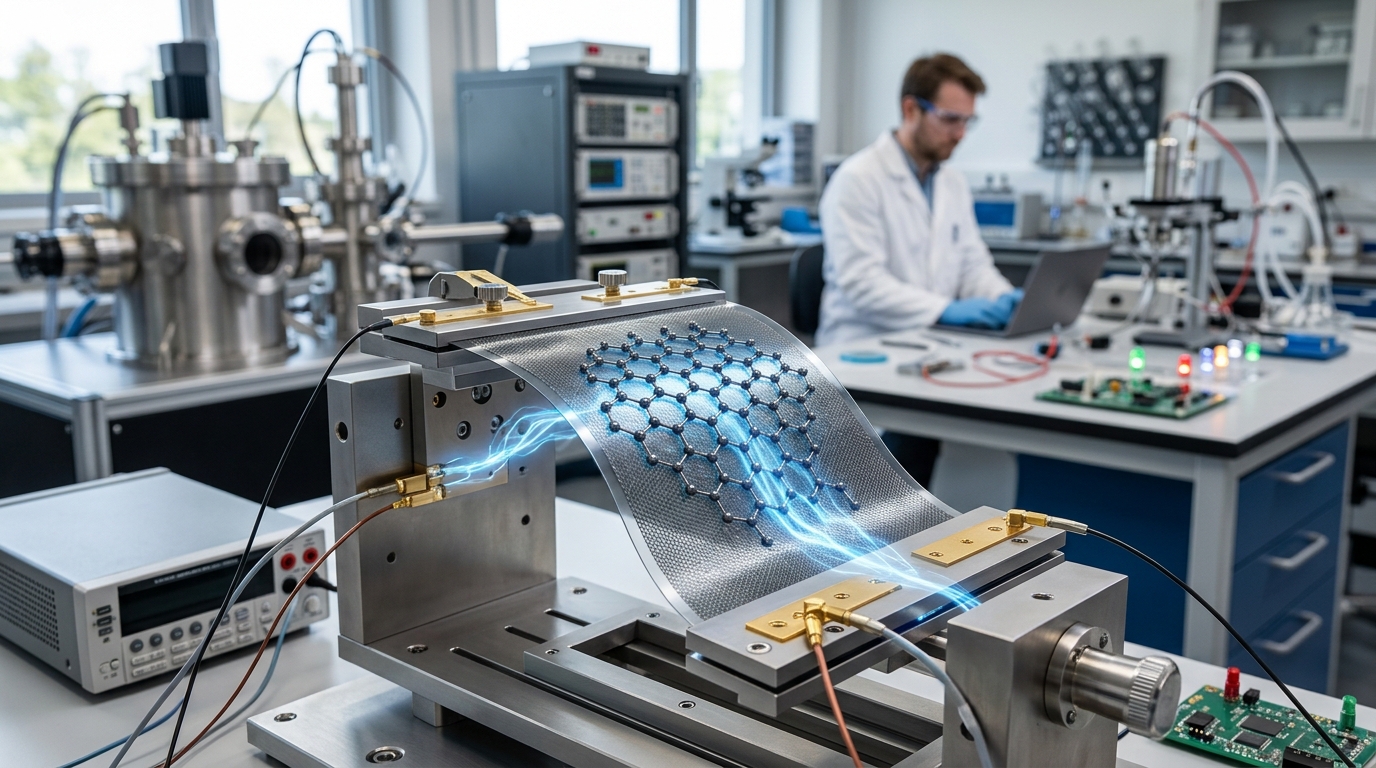
Graphene is a single-atom-thick layer of carbon arranged in a two-dimensional honeycomb lattice. Its theoretical electrical conductivity, exceptional mechanical strength, and immense specific surface area make it an attractive material for electrical energy storage. In practice, incorporating graphene into battery systems addresses three persistent challenges: slow ion transport, internal heat generation, and mechanical degradation during cycling.
The Core Mechanisms: How Graphene Modifies Battery Chemistry
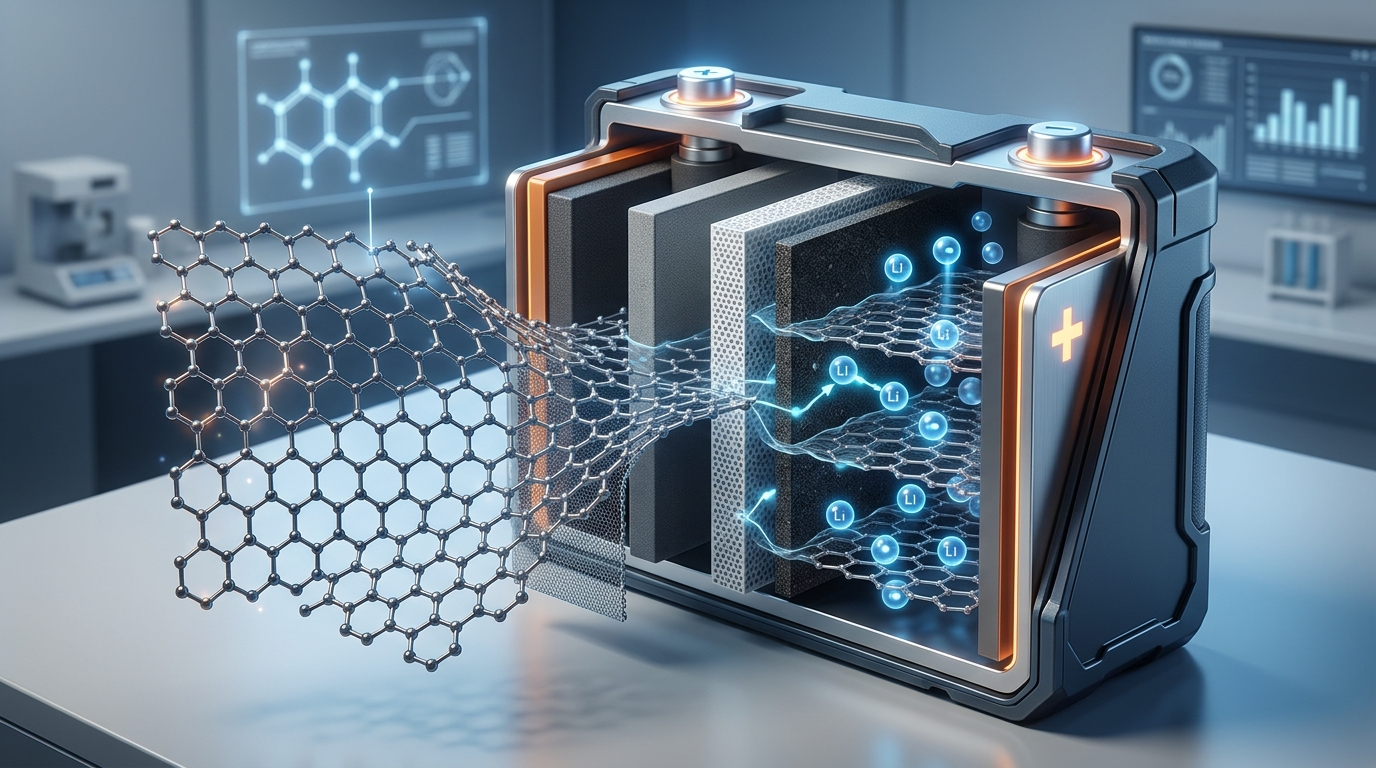
In standard lithium-ion batteries, energy storage relies on intercalation, where lithium ions move between a cathode (typically a transition metal oxide) and an anode (typically graphite) through a liquid electrolyte. While reliable, this architecture faces strict kinetic and thermal limits. Graphene enters this structure not as a wholesale replacement for lithium chemistry, but as an enabling scaffold across several critical cell components.
1. Conductive Additives and Electron Highways
Traditional electrode formulations blend active materials with conductive carbon black and polymer binders. Because standard carbon black consists of spherical particles with point-to-point contact, electrical resistance within the electrode remains relatively high. Graphene provides a planar, two-dimensional conductive network. A small weight percentage of graphene nanoplatelets forms a continuous conductive web over the active material particles, dramatically lowering internal electrical impedance.
Lower electrical resistance directly translates into less resistive heating during operation. This thermal reduction allows cells to sustain high C-rate charging—meaning batteries can accept and deliver intense electrical currents without exceeding safe operating temperatures.
2. Silicon-Graphene Anode Stabilization
Silicon is widely recognized as the next major anode material because its theoretical storage capacity exceeds that of graphite by nearly an order of magnitude. However, silicon particles expand by up to 300 percent in volume when absorbing lithium ions, rapidly pulverizing the electrode structure and breaking electrical contacts within dozens of cycles.
To solve this, materials engineers construct silicon-graphene composite anodes. In these architectures, flexible graphene sheets encapsulate or interweave with silicon nanoparticles. The graphene matrix serves a dual purpose: it acts as a mechanical cushion that accommodates silicon expansion without fracturing, while maintaining a permanent conductive pathway to the current collector. This engineering innovation enables higher energy storage per unit mass while preserving operational longevity.
3. Thermal Dissipation and Safety Enhancement
Thermal runaway represents one of the most critical failure modes in electrochemical cells, occurring when internal short circuits or rapid discharge generate localized heat faster than the cell can dissipate it. Graphene exhibits in-plane thermal conductivity far superior to standard copper current collectors.
By integrating graphene coatings onto current collectors or blending it into separators, battery designers facilitate uniform heat distribution across the entire cell surface. Eliminating localized hotspots reduces degradation of the solid electrolyte interphase (SEI layer) and substantially lowers the risk of catastrophic cell failure.
Comparing Graphene Battery Architectures
Different implementations of graphene provide distinct tradeoffs between gravimetric capacity, power delivery, and manufacturing complexity. The following comparison highlights how these architectures function in practice:
| Architecture Type | Primary Role of Graphene | Key Advantages | Primary Engineering Limitation |
|---|---|---|---|
| Graphene-Enhanced Li-ion | Conductive additive in cathode/anode | Faster charge acceptance, cooler operation | Modest increase in absolute energy density |
| Silicon-Graphene Composite | Structural binder and conductive matrix | High gravimetric energy density | Complex synthesis, volume management |
| Graphene Hybrid Supercapacitor | High-surface-area electrostatic electrode | Near-instantaneous charging, extreme cycle life | Lower volumetric energy density than chemical cells |
| Solid-State with Graphene Scaffolds | Interfacial stabilizer and dendrite barrier | Suppression of lithium dendrites, broad thermal range | High interfacial resistance, scalable assembly costs |
Overcoming Key Engineering and Manufacturing Hurdles
While experimental cells show impressive numbers in controlled laboratory environments, scaling these designs to commercial volume presents several non-trivial chemical and mechanical challenges.
The Problem of Agglomeration
Due to strong attractive forces between individual atomic sheets, graphene tends to restack into bulk graphite during electrode slurry mixing. This phenomenon, known as van der Waals agglomeration, destroys the material’s active surface area and degrades its electrical benefits. Preventing restacking requires specialized surfactants, covalent functionalization, or precise shear-mixing techniques that increase processing time and cost.
Slurry Viscosity and Electrode Density
Graphene has a very low bulk density and high specific surface area. Adding substantial amounts of pristine graphene to standard battery slurries dramatically increases viscosity, requiring excessive solvent volumes to achieve coatable mixtures. Evaporating these extra solvents creates porous, low-density electrodes that reduce the battery’s total volumetric capacity—a critical drawback for space-constrained applications like mobile phones and passenger vehicles.
Purity, Defects, and Consistency
Graphene quality varies widely depending on the production route. Liquid-phase exfoliation, chemical reduction of graphene oxide, and plasma synthesis yield materials with varying layer counts, lateral flake sizes, and oxygen defect contents. Residual oxygen groups on graphene oxide surfaces can react irreversibly with lithium ions during the initial charge cycle, causing permanent capacity loss and degrading first-cycle coulombic efficiency.
How to Evaluate Graphene Battery Announcements
Separating genuine technical progress from marketing exaggeration requires analyzing specific operational parameters. When reviewing battery performance claims, evaluate the following criteria:
- Cell-Level vs. Pack-Level Metrics: Laboratory reports often quote energy densities calculated purely from active electrode material. Commercial viability depends on the complete cell weight, which includes current collectors, separators, electrolyte, terminals, and safety housing.
- C-Rate and Thermal Conditions: A battery capable of a five-minute charge cycle must demonstrate that capability without requiring external active cooling systems that add excessive weight to the final product.
- Cycle Life Under 100% Depth of Discharge: Fast-charging claims are only commercially meaningful if the battery retains at least 80 percent of its initial capacity over hundreds of standard operational cycles.
- Dendrite Mitigation: In lithium-metal systems, check whether the graphene layer effectively prevents dendrite formation—microscopic needle-like lithium structures that pierce separators—under high current densities.
Implementation Pathways Across Industries
The integration of graphene into commercial storage follows pragmatic pathways dictated by cost-benefit realities rather than universal replacement of existing infrastructure.
In high-performance power tools and specialized consumer hardware, graphene additives are already utilized to accelerate charging speeds and prevent overheating during continuous peak draw. In the electric vehicle sector, the focus centers primarily on silicon-graphene composite anodes, which offer extended driving range without expanding pack dimensions.
For heavy industrial and stationary grid storage, where battery lifespan and thermal resilience outweigh weight constraints, graphene-enhanced chemistries provide reduced degradation under erratic power surges from renewable generation sources. Understanding these specific structural roles clarifies why graphene remains an essential material in the ongoing evolution of electrochemical energy storage.