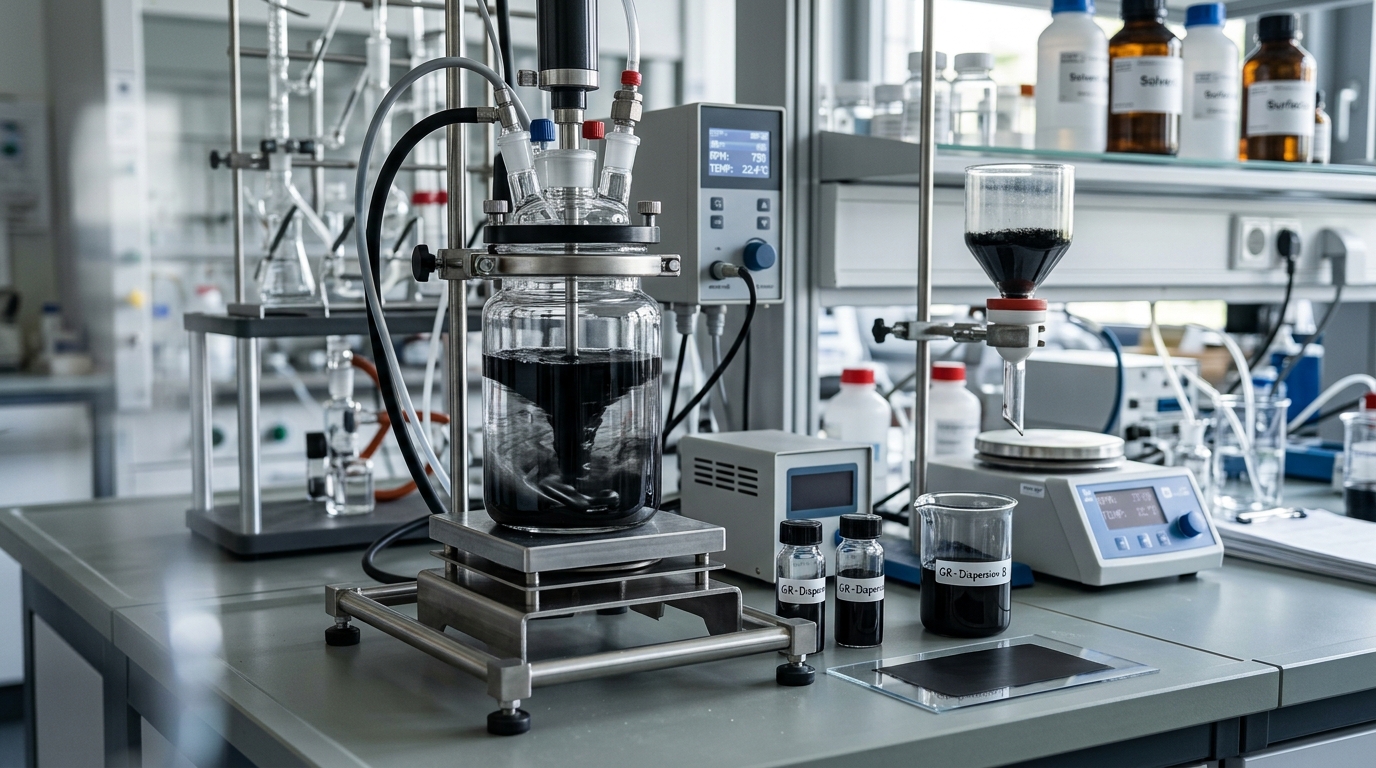
Graphene Dispersions
Graphene dispersions are colloidal suspensions of single- or few-layer graphene sheets distributed throughout a liquid carrier medium. Unlike bulk graphite or dry graphene nanoplatelet powders, dispersions maintain the two-dimensional separation of individual sheets within a liquid phase, preventing spontaneous restacking caused by strong interplanar van der Waals forces. In commercial materials engineering, supplying graphene in liquid dispersion form is often the primary route for integrating 2D carbon into functional coatings, energy storage matrices, polymer compounds, and printed electronics.
Graphene Dispersions vs. Dry Graphene Powders
Working with dry graphene powder presents distinct processing challenges. When graphene sheets are isolated and dried into macroscopic powders, the uncoordinated pi-electron surfaces naturally draw together, forming dense, irreversibly agglomerated clusters. Re-exfoliating dry powder back into individual monolayers requires high shear energies that can shred flake lateral dimensions and introduce structural defects.
Dry powders also present occupational hygiene and process-handling challenges. Due to their ultra-low bulk density and nanoscale thickness, dry flakes easily aerosolize, requiring specialized containment, local exhaust ventilation, and personal protective equipment to mitigate inhalation risks. In contrast, graphene dispersions provide several distinct operational advantages:
- Suppression of Re-agglomeration: Liquid-phase solvation or surface-active agents maintain physical separation between individual sheets, preserving high specific surface area.
- Dust-Free Handling: Suspending the nanomaterial eliminates the risk of airborne particle inhalation during dispensing, measuring, and downstream mixing.
- Uniform Matrix Blending: Dispersions can be directly metered into liquid resin systems, polymer solutions, or aqueous formulations without requiring dry-grinding or prolonged high-energy redispersal steps.
- Controlled Rheology: Formulators can tailor viscosity, surface tension, and drying kinetics through carrier selection to suit specific deposition techniques like slot-die coating, screen printing, or spray application.
Common Carrier Media and Solvent Systems
The choice of carrier fluid dictates the maximum achievable concentration, dispersion stability, and compatibility with the target end-use matrix. Carriers fall broadly into three technical categories: organic polar aprotic solvents, water-based formulations, and lower-toxicity volatile organics.
Polar Aprotic Solvents (NMP and DMF)
Thermodynamically, pristine graphene exfoliates and disperses best in solvents whose surface energy closely matches the surface energy of graphene (approximately 70 to 115 mJ/m2). Solvents such as N-Methyl-2-pyrrolidone (NMP), N,N-Dimethylformamide (DMF), and ortho-dichlorobenzene (DCB) exhibit surface tensions near 40 mN/m, minimizing the net enthalpy of mixing. In pure NMP, pristine graphene can achieve stable dispersion without added surfactants.
However, industrial deployment of NMP and DMF faces significant headwinds. Both solvents have high boiling points (over 150 °C for DMF and 200 °C for NMP), which complicates thermal removal in coating and printing processes. Furthermore, NMP is classified as a substance of very high concern (SVHC) under European REACH regulations due to reproductive toxicity, driving the industry toward greener alternatives.
Water-Based Systems
Water is the ideal carrier from an environmental, health, and cost perspective. However, pristine graphene is inherently hydrophobic, with water exhibiting a much higher surface tension (approximately 72.8 mN/m) than the graphene basal plane. Pure water cannot wet or disperse pristine graphene flakes without stabilization aids. To overcome this thermodynamic mismatch, aqueous graphene dispersions rely on ionic or non-ionic surfactants, hydrophilic surface functionalization, or hybrid polymeric stabilizers to generate adequate interfacial compatibility.
Alcohols and Volatile Solvents
For printing applications where fast evaporation is critical, lower alcohols such as isopropanol (IPA), ethanol, and ethyl lactate are frequently used. While the surface energy match of alcohols is imperfect compared to NMP, stable systems can be prepared by using specialized secondary co-solvents, cellulosic binders (such as ethyl cellulose), or tailor-made polymeric dispersants.
Stabilization Mechanisms
Colloidal particles in suspension are governed by DLVO (Derjaguin-Landau-Verwey-Overbeek) theory, which balances attractive van der Waals interactions against repulsive forces. Because graphene sheets are atomically flat, face-to-face attractive forces are exceptionally high. Preventing spontaneous re-stacking requires engineering specific repulsive forces at the sheet interface.
| Stabilization Mechanism | Primary Stabilizer Type | Operating Principle | Typical Media |
|---|---|---|---|
| Electrostatic | Ionic surfactants (SDS, CTAB), pH-induced surface charges | Builds electrical double-layer; mutual charge repulsion (zeta potential > |30 mV|) | Water, polar aqueous blends |
| Steric Hindrance | Non-ionic surfactants (Triton X-100, Pluronics), polymers (PVP) | Bulky polymer chains adsorb on basal planes, physically blocking close contact | Water, alcohols, glycols |
| Electrosteric | Polyelectrolytes, lignosulfonates, gum arabic | Combines ionic charge repulsion with long-chain spatial hindrance | Aqueous industrial slurries |
| Surface Functionalization | Covalent (carboxylation, sulfonation) or non-covalent (pyrene derivatives) | Modifies surface chemistry directly to match carrier polarity | Water, polar organics |
Electrostatic Stabilization
Electrostatic stabilization relies on imparting a net electrical charge to the graphene sheets. In aqueous media, ionic surfactants like sodium dodecyl sulfate (SDS, anionic) or cetyltrimethylammonium bromide (CTAB, cationic) adsorb onto the hydrophobic basal plane via their non-polar tails, leaving charged ionic headgroups extended into the aqueous phase. The resulting repulsive electrical double layer counteracts van der Waals attraction. The magnitude of this repulsion is commonly quantified by measuring the dispersion’s zeta potential.
Steric and Electrosteric Hindrance
Steric stabilization utilizes long-chain macromolecules that non-covalently anchor to the graphene surface while solvophilic polymer segments extend outward into the solvent. When two functionalized sheets approach each other, the spatial compression of these polymer brushes creates an osmotic and entropic resistance that pushes the sheets apart. Triblock copolymers (such as Pluronic/poloxamer grades) and poly(vinylpyrrolidone) (PVP) are standard industrial choices. This mechanism is particularly robust because, unlike purely electrostatic systems, steric stabilization does not collapse in high-ionic-strength (saline) environments.
Covalent vs. Non-Covalent Modification
Dispersions can also be stabilized by functionalizing the graphene lattice itself. Covalent functionalization introduces polar chemical groups (such as hydroxyl, carboxyl, or amine groups) directly onto carbon atoms. While this facilitates stable interaction with polar solvents, it disrupts the sp2 hybridization of the carbon lattice, significantly lowering intrinsic electrical and thermal conductivity. In contrast, non-covalent modification uses aromatic anchoring molecules (such as pyrene derivatives) that attach to the basal plane via pi-pi stacking without breaking carbon bonds, preserving the native electrical properties of the sheet.
Pristine Graphene vs. Graphene Oxide Dispersions
Engineers must carefully distinguish between true pristine/few-layer graphene dispersions and graphene oxide (GO) dispersions, as their chemical properties and performance characteristics differ fundamentally.
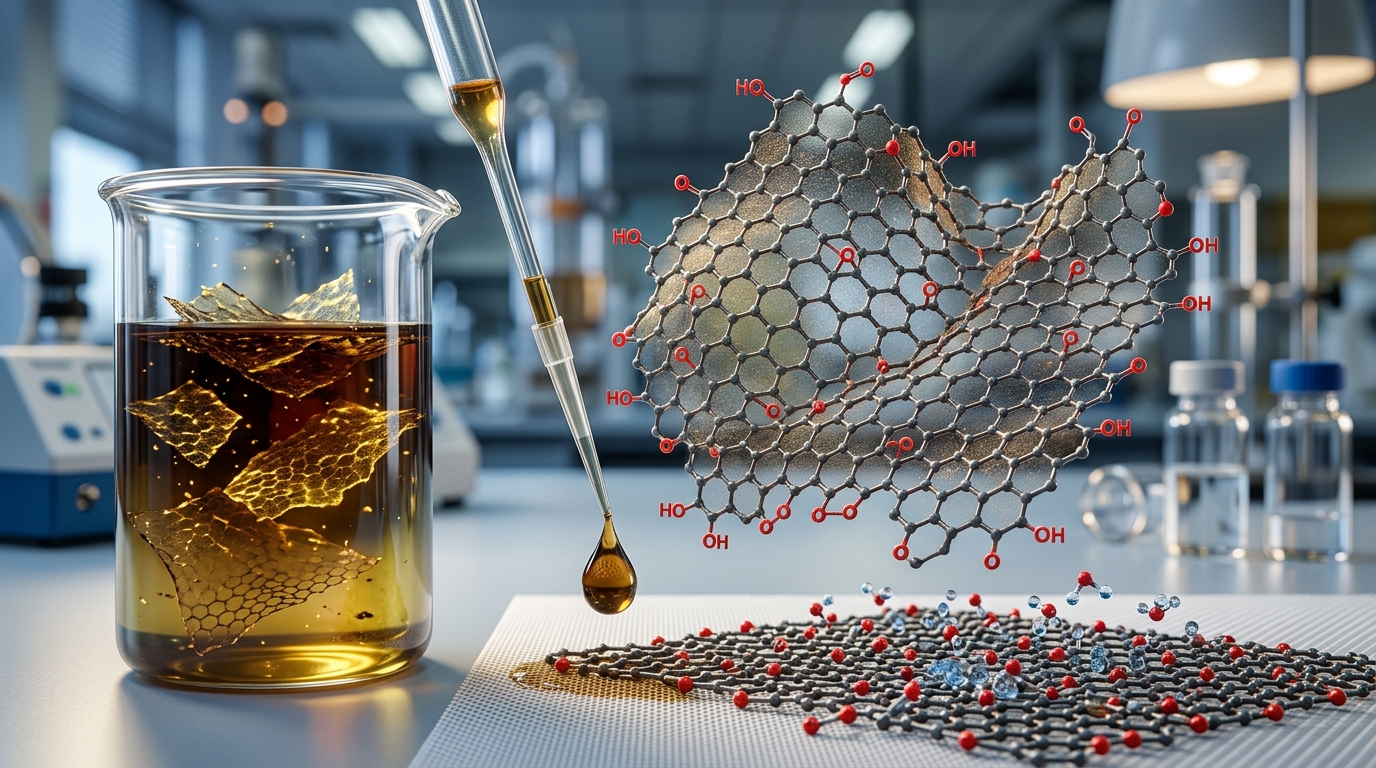
- Graphene Oxide (GO): Produced via aggressive chemical oxidation of graphite (e.g., modified Hummers’ method), GO is heavily decorated with oxygen-containing functional groups (epoxide, hydroxyl, carboxyl). These functional groups make GO intrinsically hydrophilic, allowing it to exfoliate readily in pure water without any surfactants, yielding stable colloidal solutions. However, GO is an electrical insulator due to disrupted sp2 hybridization. To restore conductivity, downstream processes must chemically or thermally reduce it to reduced graphene oxide (rGO), which rarely recovers the full structural integrity and performance of unoxidized graphene.
- Pristine Graphene Dispersions: Produced directly through mechanical, physical, or mild chemical exfoliation methods without heavy oxidative damage. The pristine carbon lattice remains intact, offering high baseline electrical conductivity and thermal performance. However, because pristine sheets lack oxygen functionality, dispersing them requires specialized solvent selection, surfactant additions, or high-energy mechanical processing.
Dispersion Processing and Exfoliation Methods
Formulating stable graphene dispersions typically involves exfoliating graphite precursor material directly into the liquid carrier, or breaking down pre-exfoliated agglomerates into isolated flakes.
Liquid-Phase Exfoliation (LPE)
Liquid-phase exfoliation involves subjecting graphite powder to high shear stresses while suspended in a stabilizing solvent. When the applied mechanical shear stress exceeds the inter-sheet van der Waals cohesive strength (estimated near 0.1 to 1 MPa depending on sheet dimensions), the layers slide apart. Solvent molecules immediately wet the newly exposed surfaces to stabilize the isolated sheets.
Ultrasonic Cavitation
Ultrasonication relies on acoustic cavitation. As high-intensity ultrasound waves travel through the liquid medium, they create localized low-pressure voids that collapse violently. The microscopic shockwaves and micro-jets generated during cavitation collapse deliver localized tensile and shear stresses that cleave graphite layers apart.
- Bath Sonication: Delivers mild, distributed energy. Primarily used for small-scale bench research, it suffers from poor energy transfer efficiency and struggles to process higher concentrations.
- Probe (Tip) Sonication: Delivers localized high-power acoustic density directly into the liquid. While highly effective at exfoliating flakes, prolonged probe sonication can introduce structural defects, fragment flakes into smaller lateral sizes (scission), and contaminate the batch with titanium particles eroded from the sonicator probe tip.
High-Shear Mixing and Microfluidization
For scalable industrial production, continuous mechanical processing methods are preferred over batch ultrasonication:
- High-Shear Rotor-Stator Systems: Force fluid through narrow gaps between rotating and stationary heads at high velocities, producing intense hydrodynamic shear that peels graphene flakes apart without significant basal damage.
- Microfluidization: Accelerates fluid slurries under high pressure (often exceeding 1,000 to 2,000 bar) through micro-scale interaction chambers. The resulting interaction of fluid collision, high shear rates, and sudden pressure drops achieves high exfoliation yields with consistent flake-size distribution.
Stability Challenges and Shelf-Life Degradation
Maintaining long-term colloidal stability remains a primary challenge for commercial suppliers and downstream formulators. Because graphene flakes possess high mass-to-thickness ratios and strong inter-sheet attractive potentials, dispersions are prone to several degradation mechanisms over time:
Re-agglomeration and Flocculation
Over extended storage times, Brownian motion leads to frequent collisions between suspended sheets. If the thermal energy of the system overcomes the electrostatic or steric barrier, flakes adhere at contact points. This initially manifests as loose flocculation, which can progress into tight, face-to-face restacking that cannot be reversed by simple agitation.
Sedimentation Dynamics
Suspended graphene sheets are subject to gravitational sedimentation governed by modified Stokes’ law for non-spherical particles. Large flakes settle out faster than smaller ones. If a dispersion has an uncontrolled lateral flake size distribution, phase separation will occur, resulting in a dense sediment layer at the bottom of the container and a dilute supernatant above.
Shelf-Life Mitigation Strategies
Commercial dispersion formulators employ several operational strategies to prolong product shelf life beyond 6 to 12 months:
- Centrifugal Fractionation: Post-exfoliation centrifugation removes unexfoliated thick graphite particles and oversized flakes, narrowing the particle size distribution to improve stability.
- Rheology Modifiers: Incorporating thixotropic agents increases low-shear resting viscosity, mechanically arresting flake sedimentation during storage, while allowing the fluid to thin under shear during industrial dispensing.
- Solvent Preservation: Formulations susceptible to atmospheric moisture uptake or solvent evaporation are packed under inert headspaces (such as nitrogen) in sealed containers to prevent drift in surface tension or surfactant concentration.
Analytical Characterization of Dispersions
Formulators require quantitative, repeatable analytical techniques to evaluate flake concentration, layer thickness, lateral size distribution, and colloidal stability.
Zeta Potential Analysis
Zeta potential evaluates the effective surface charge at the slipping plane of a colloid in suspension. For electrostatically stabilized graphene dispersions, a zeta potential magnitude greater than |30 mV| (positive or negative) indicates sufficient electrostatic repulsion to resist rapid agglomeration. Values between -15 mV and +15 mV generally indicate a formulation at high risk of rapid sedimentation.
UV-Vis Absorption Spectroscopy
Ultraviolet-visible (UV-Vis) spectroscopy is a rapid, non-destructive method used to determine graphene concentration in transparent or semi-transparent media. Dilute graphene dispersions show an absorption spectrum characterized by an absorbance peak in the deep UV region (typically around 230 to 270 nm) with a broad tail across visible wavelengths. By applying the Beer-Lambert law ($A = eta imes C imes l$), the concentration ($C$) can be determined from optical absorbance ($A$) once the optical absorption coefficient ($eta$) has been experimentally established for the specific material system.
Dynamic Light Scattering and Microscopy
While Dynamic Light Scattering (DLS) is standard for spherical colloids, its application to graphene dispersions is limited. DLS models particles as equivalent hydrodynamic spheres, which distorts lateral dimensions when measuring high-aspect-ratio 2D sheets. Consequently, DLS is best used as a comparative batch-to-batch quality control metric rather than an absolute size measurement. Accurate morphology profiling requires complementary imaging via Transmission Electron Microscopy (TEM) or Atomic Force Microscopy (AFM) to measure flake lateral size and thickness profiles directly.
Rheological Profiling
Rotational rheology measures the dispersion’s flow behavior across variable shear rates. Pristine and functionalized dispersions typically display non-Newtonian, shear-thinning (pseudoplastic) behavior. At rest, flake-to-flake interactions create an interconnected network that resists settling. Under shear (e.g., during pumping, spraying, or printing), the sheets align parallel to the flow vectors, reducing viscosity. Mapping storage modulus ($G’$) and loss modulus ($G”$) reveals the transition from gel-like behavior to liquid flow, defining the dispersion’s operational processing window.
Downstream Commercial Applications
Graphene dispersions translate the laboratory-scale properties of 2D carbon into drop-in industrial additives. By maintaining sheet exfoliation in a liquid vehicle, manufacturers can introduce uniform 2D filler networks directly into established production pipelines.
Conductive Inks and Printed Electronics
Formulations incorporating low-boiling carriers or tailored polymer binders are used as conductive inks for aerosol-jet, inkjet, and screen printing. These inks allow the deposition of flexible conductive traces on paper, polyimide, or PET substrates for RFID antennas, strain sensors, and smart packaging. Formulators prioritize high flake concentrations with minimal surfactant residue, as residual insulating surfactants impede inter-sheet electron hopping and raise the electrical resistance of the dried trace.
Battery Slurries and Energy Storage
In lithium-ion battery manufacturing, graphene dispersions act as conductive additives in cathode and anode slurries. Replacing conventional carbon black with 2D graphene flakes provides broader surface contact with active cathode materials (such as LFP or NMC). The flexible sheets establish a continuous electrical network throughout the electrode at lower loading percentages (often below 1 wt%), preserving active material volume and facilitating higher charge-discharge C-rates.
Protective, Anti-Corrosion, and Barrier Coatings
When incorporated into liquid epoxy, polyurethane, or zinc-rich coatings, dispersed graphene flakes self-align during film formation to create a physical "tortuous path." This physical barrier impedes the diffusion of water, oxygen, and corrosive chloride ions toward metal substrates. Achieving uniform dispersion is essential: any agglomeration produces pinholes and micro-channels that ruin the barrier effect.
Polymer Nanocomposites and Masterbatches
Liquid masterbatching introduces graphene dispersions directly into liquid monomers or polymer solutions before polymerization or compounding. Liquid-phase introduction sidesteps the dry agglomeration problems typical of conventional melt extrusion, improving thermal conductivity, tensile strength, and electrostatic dissipation (ESD) performance across host thermoplastics and thermosets.
Handling and Basic Safety Guidelines
Although liquid dispersions minimize airborne inhalation hazards compared to dry powders, managing solvent-borne nanomaterials still requires dedicated workplace safety controls:
- Solvent Exposure Management: Dispersions formulated in organic solvents like NMP, DMF, or aromatic carriers must be handled under certified chemical fume hoods or enclosed solvent extraction systems to prevent chronic inhalation of carrier vapors.
- Dermal Protection: Technicians must wear chemically resistant gloves (such as nitrile or butyl rubber, chosen according to the carrier solvent) and eye protection. Solvents carrying nanoscale particles can penetrate skin barriers if standard protective equipment is omitted.
- Waste and Spill Management: Spent dispersion material and cleaning washes should be collected as hazardous chemical waste. Discharging nanomaterial-laden solvent formulations into municipal drainage systems is prohibited under standard environmental protection regulations.
- Preventing Unintended Drying: Equipment, nozzles, and transport lines should be flushed promptly after use. If dispersions dry out inside machinery, the resulting film can form stubborn, dry flake deposits that resist solvent redispersal and require mechanical abrasion to remove.