Graphene Car Wax
Graphene car wax is an automotive surface protectant that infuses carbon-based nanomaterials into a carrier matrix of natural waxes, synthetic polymers, or ceramic resins. Designed to bridge the gap between traditional carnauba waxes and professional-grade ceramic coatings, these formulations use the mechanical strength, chemical inertness, and thermal properties of carbon lattices to shield automotive clear coats from environmental degradation.
While traditional carnauba wax provides deep optical gloss through organic oils, it degrades rapidly under high ambient temperatures and aggressive wash soaps. Graphene car wax alters this dynamic by reinforcing the protective matrix with functionalized carbon structures, primarily reduced graphene oxide (rGO) or graphene nanoplatelets. The result is a sacrificial barrier layer that offers improved durability, heightened hydrophobic performance, and superior resistance to chemical etching.
The Chemistry of Graphene-Infused Automotive Waxes
Understanding graphene car wax requires looking past consumer marketing and examining the physical materials suspended in the bottle or paste tin. Pure, pristine graphene consists of a single-atom-thick hexagonal lattice of carbon atoms. In its raw, unfunctionalized state, pure single-layer graphene cannot be evenly dispersed in standard detailing solvents or wax emulsions; it clusters together due to strong van der Waals forces.
To create a functional automotive wax, chemical formulators utilize graphene derivatives engineered to integrate smoothly with polymers:
- Graphene Nanoplatelets (GNPs): Microscopic stacks of multiple graphene sheets that retain high mechanical rigidity and thermal stability.
- Graphene Oxide (GO): Carbon sheets functionalized with oxygen-bearing groups (hydroxyl, epoxy, and carboxyl groups), allowing dispersion in water-based emulsions.
- Reduced Graphene Oxide (rGO): Graphene oxide treated thermally or chemically to remove most oxygen groups, restoring electrical and thermal conductivity while retaining dispersibility in synthetic carriers.
- Silicone and Polymer Resins: Polydimethylsiloxane (PDMS), amino-functional fluids, or fluoropolymers that act as the binding agent, anchoring the carbon nanomaterials to the clear coat.
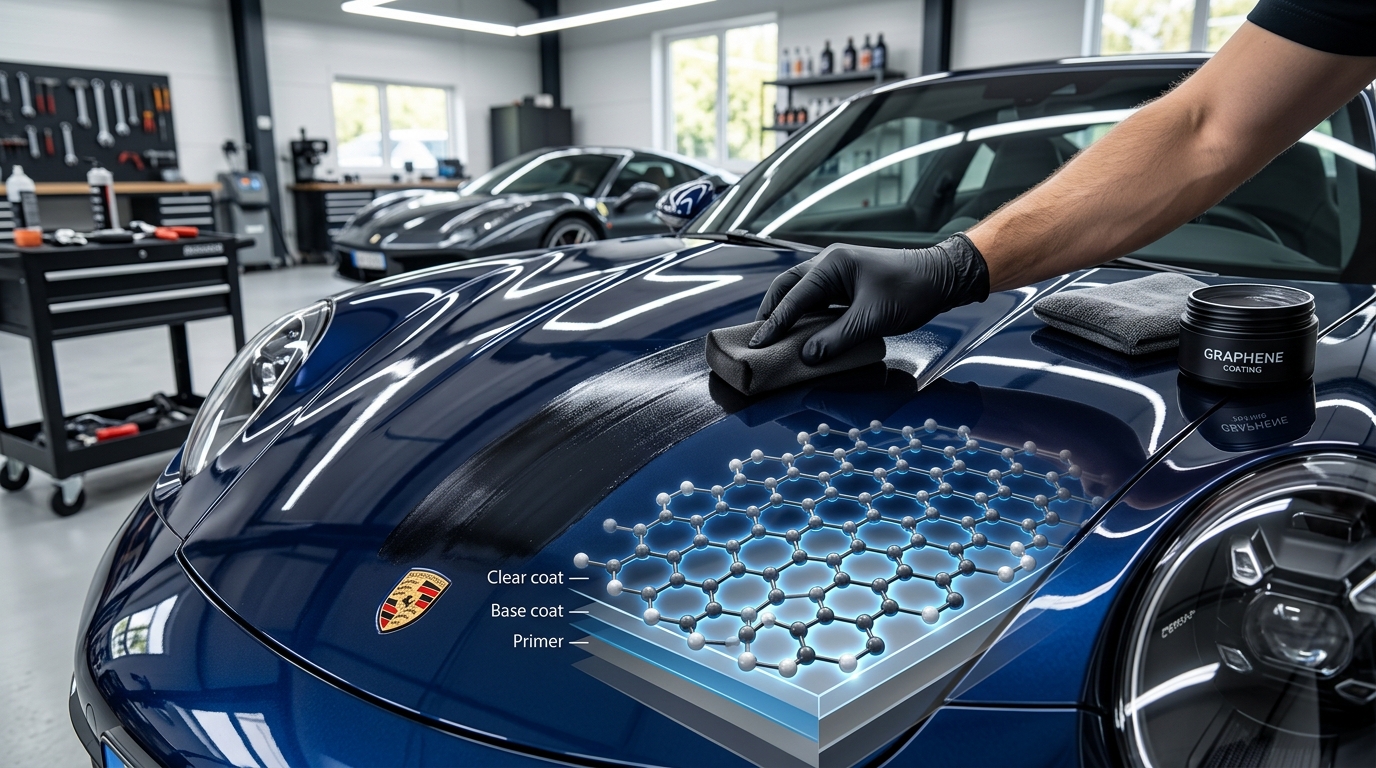
When applied to a vehicle’s painted surface, the liquid carrier evaporates, allowing the polymers and carbon structures to crosslink into a dense, semi-rigid network. The graphene platelets sit within this crosslinked polymer film, creating a tortuous path that prevents water molecules, road salts, bird droppings, and industrial fallout from directly contacting the clear coat.
How Graphene Modifies Surface Dynamics
The addition of carbon nanomaterials introduces distinct physical mechanisms that differentiate graphene-infused products from conventional carnauba pastes and pure synthetic sealants.
High Water Contact Angles and Low Sliding Angles
Automotive protection relies heavily on hydrophobic behavior. Hydrophobicity is measured by the water contact angle, which is the angle formed where a water droplet meets the solid surface. A contact angle above 90 degrees is hydrophobic, while angles exceeding 105 degrees produce tight, spherical water beads.
Graphene wax formulations frequently achieve contact angles between 105 and 115 degrees. More importantly, they optimize the sliding angle—the tilt angle required for a water droplet to roll off the surface. Traditional waxes may bead water effectively, but the droplets often remain stationary on horizontal panels (such as hoods and roofs), evaporating in direct sunlight and depositing dissolved minerals that cause permanent etching. Graphene-modified surfaces reduce surface friction, allowing droplets to roll off at shallow angles before evaporation occurs.
Thermal Dissipation and Reduced Water Spotting
One of the primary failure modes of ceramic (silicon dioxide or SiO2) coatings is their susceptibility to water spotting in hot climates. Because ceramic coatings create a hard, glassy surface that retains heat, standing water beads act as miniature magnifying lenses, baking hard water minerals into the coating.
Carbon structures possess exceptional thermal dissipation capabilities. When suspended in a thin-film wax matrix, graphene platelets help distribute heat evenly across the paint panel rather than concentrating it at localized hot spots. This lowered surface temperature reduces the rapid evaporation rate of resting water droplets, significantly mitigating the severity of calcium carbonate and mineral deposits.
Chemical Resistance and Anti-Static Properties
Automotive clear coats encounter corrosive elements ranging from acidic insect remains (pH 3–4) to alkaline touchless car wash detergents (pH 11–13). Carnauba waxes degrade quickly above pH 9. Graphene structures are chemically inert across virtually the entire pH spectrum. When embedded in a durable synthetic resin, they create a chemically resistant barrier that survives repeated washing cycles.
Furthermore, because graphene exhibits electrical conductivity, it assists in dissipating static electrical charges that build up on clear coats during vehicle travel. By lowering surface static, graphene waxes attract less dry dust, road silt, and pollen between regular washes.
Graphene Wax vs. Carnauba Wax vs. Ceramic Coatings
Graphene waxes occupy an intermediate category between user-friendly organic pastes and permanent chemical coatings. The following matrix illustrates how these formulations compare across core performance categories.
| Attribute | Carnauba Wax | Ceramic Coating (SiO2) | Graphene Car Wax |
|---|---|---|---|
| Primary Composition | Organic palm wax & natural oils | Inorganic silicon dioxide polymers | Polymer matrix + rGO / GNPs |
| Durability | 4 to 8 weeks | 2 to 5 years | 6 to 12 months |
| Application Complexity | Very Low (Wipe on / Wipe off) | High (Requires panel prep & leveling) | Low to Moderate (Spray or paste) |
| Water Spotting Risk | Moderate | High (Requires active maintenance) | Low |
| Chemical Resistance | Low (pH 6–8) | Very High (pH 2–13) | High (pH 3–12) |
| Scratch Resistance | None | Minor swirl resistance (9H hardness) | Slight wash marring reduction |
Addressing Marketing Misconceptions
The introduction of nanotechnology into consumer detailing products has led to widespread technical misunderstandings. Separating realistic material behavior from marketing claims is critical for practical evaluation.
Myth 1: Graphene Wax Creates an Impenetrable Armor
Pure monolayer graphene is recognized for its immense tensile strength at the atomic scale. However, a thin layer of wax containing suspended graphene flakes is not an impenetrable shield. A wax film measures less than one micrometer in thickness. It will not stop high-velocity stone chips, deep keys scratches, or aggressive abrasives. Its primary structural role is to serve as a sacrificial barrier layer that absorbs chemical and environmental attack before the underlying clear coat is damaged.
Myth 2: True Graphene Requires Professional Installation Only
True professional-grade graphene liquid coatings that cure via moisture-catalyzed silazane bonds do require meticulous surface preparation and controlled curing. However, graphene car wax is specifically formulated for consumer accessibility. These products suspend functionalized nanoplatelets inside flexible synthetic waxes or sprayable emulsions that cure through simple solvent evaporation without the risk of permanent high spots or panel hazing.
Myth 3: Clear Graphene Products Contain No Carbon
Graphene oxide and reduced graphene oxide in high concentrations produce an amber, grey, or black liquid. Some consumer spray waxes are completely transparent. A clear product does not necessarily mean an absence of nanomaterials; highly exfoliated functionalized nanosheets can remain translucent in low, dispersed concentrations. However, heavily darkened formulations generally indicate a higher particulate loading of reduced graphene oxide.
Practical Application and Surface Preparation
The longevity and optical clarity of a graphene wax depend fundamentally on the condition of the substrate beneath it. Applying graphene wax over contaminated, oxidized paint prevents the polymers from anchoring securely.
- Decontamination Wash: Wash the vehicle thoroughly using a dedicated automotive shampoo. Follow with an iron-remover spray to dissolve embedded metallic brake dust and an automotive clay bar to remove bonded surface contaminants.
- Paint Correction (Optional but Recommended): Polish the paint using a dual-action polisher to eliminate swirl marks and oxidation. Graphene waxes will seal in whatever optical defects remain on the surface.
- Panel Wipe Down: Wipe every panel with an isopropyl alcohol (IPA) solution or dedicated panel prep spray. This strips polishing oils, silicones, and surfactants, leaving a clean paint surface for chemical bonding.
- Application: Apply the graphene wax using a soft foam or microfiber applicator pad. Work in cross-hatch patterns (up-and-down, then left-to-right) on single panels at a time. If using a spray formula, mist lightly onto the panel or applicator; over-application causes streaking.
- Flashing and Removal: Observe the product as it flashes. Many graphene waxes produce a light haze or an oil-slick sweating effect within one to five minutes. Buff the residue away using a clean, short-pile microfiber towel, followed by a secondary wipe with a plush microfiber towel.
- Curing Period: Keep the vehicle dry and away from direct precipitation for at least 12 to 24 hours to ensure the crosslinked polymer chains fully stabilize.
Product Selection and Evaluation Criteria
When selecting a graphene car wax, prioritize technical performance metrics and formulation stability over brand claims:
- Carrier Mechanism: Spray formulas offer rapid maintenance every 3 to 4 months with minimal physical effort. Paste formulations or liquid cream waxes take longer to apply but generally deliver a thicker protective barrier lasting 6 to 12 months.
- Suspension Stability: Quality products maintain their nanomaterial suspension without permanent phase separation. While some settlement is normal (requiring shaking before use), the product should emulsify readily into a uniform consistency.
- Hydrophobic Longevity: Evaluate how long the product maintains tight, uniform water contact behavior under regular road exposure, rather than judging performance solely on the first wash.
- Ease of Removal: High-quality formulations wipe off effortlessly without leaving oily residues, streaks, or dark smudges on white or light-colored paint finishes.
By combining user-friendly application methods with the structural stability of carbon nanomaterials, graphene car wax delivers a durable, heat-tolerant, and hydrophobic shield that meets the demands of modern vehicle maintenance.