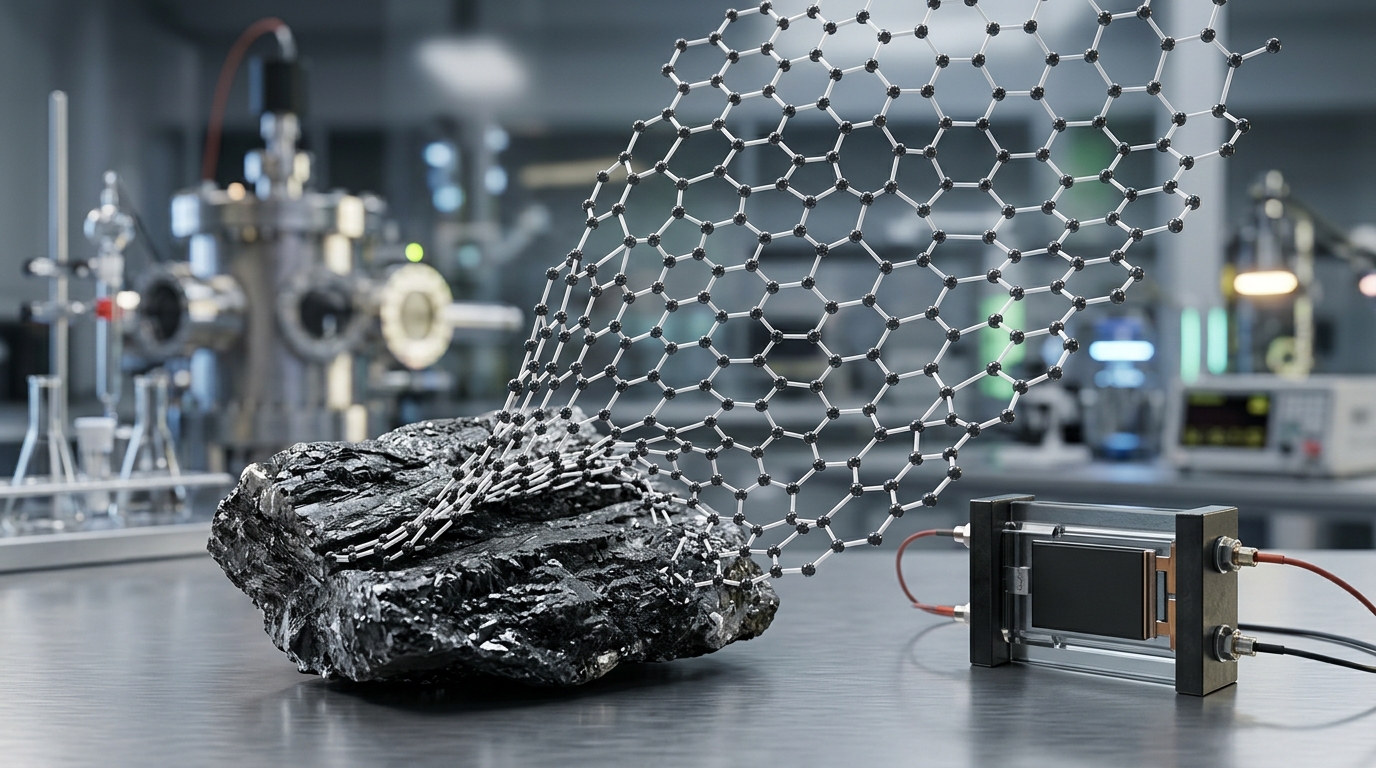

Black Swan Graphene
Black Swan Graphene represents an industrial approach to bulk nanomaterial manufacturing, focusing on high-shear liquid phase exfoliation to produce graphene nanoplatelets at commercial scale. Rather than targeting nanoscale electronic devices or pristine single-atom monolayers for lab-scale physics, the company concentrates on high-volume, cost-sensitive industrial sectors. By optimizing production processes originally established in collaboration with commercial chemical manufacturers, the enterprise supplies graphene additives designed to enhance the mechanical, thermal, and barrier properties of polymers, concrete, and specialized coatings.
The Production Foundation: High-Shear Liquid Exfoliation
Bulk graphene production methods generally fall into two broad categories: bottom-up synthesis, such as chemical vapor deposition (CVD), and top-down mechanical or chemical cleavage of natural graphite. Black Swan Graphene utilizes a top-down, high-shear liquid phase exfoliation method derived from process engineering milestones established in 2014.
In this process, raw natural graphite flakes are suspended in a liquid medium and subjected to precisely controlled hydrodynamic shear forces. These high-velocity fluid flows generate shear stresses that overcome the relatively weak van der Waals forces holding the individual carbon sheets together. As fluid streams collide and pass through tight geometries at high speeds, graphite flakes delaminate along their basal planes without breaking the strong covalent sp² carbon bonds that define graphene’s exceptional strength.
Unlike chemical oxidation routes—such as the classic Hummers method used to make graphene oxide (GO)—shear exfoliation does not heavily oxidize or disrupt the carbon lattice. This preserves the intrinsic crystal structure, maintaining high electrical and thermal conductivity while preventing structural defects that weaken mechanical reinforcement.
Material Profile and Morphological Properties
In commercial engineering, the term “graphene” encompasses a spectrum of material grades. Black Swan Graphene primarily produces graphene nanoplatelets (GNPs), which consist of few-layer to multi-layer graphene stacks rather than isolated single-atom sheets. Industrial classification distinguishes these materials through several key metrics:
- Layer Thickness: Platelets typically range from 2 to 10 carbon layers (often classified as few-layer graphene) up to several dozen layers, with typical thicknesses measuring under 10 nanometers.
- Lateral Dimensions: Particle diameters generally measure between 1 and 20 micrometers, providing a high aspect ratio (the ratio of lateral width to thickness) that is crucial for structural reinforcement and barrier formation.
- Surface Chemistry: Because the material is mechanically cleaved rather than chemically digested, it features low oxygen content and minimal basal-plane functionalization, retaining the natural hydrophobicity and chemical stability of pristine graphite.
- Specific Surface Area: With surface areas significantly higher than standard micronized graphite, the platelets offer extensive interfacial contact area when blended into host matrices.
Primary Application Verticals and Reinforcement Mechanisms
High-volume graphene nanoplatelets are additive materials; their engineering value comes from how efficiently they transfer their microscopic properties into macroscopic host matrices. Black Swan Graphene directs its material toward three primary industrial sectors.
Polymer Compounding and Masterbatches
Thermoplastics and thermosets frequently suffer from trade-offs between stiffness, impact resistance, and weight. When graphene nanoplatelets are blended into polymers like polypropylene, polyethylene, or nylon, several physical mechanisms take effect:
- Stress Transfer: Because of their high aspect ratio, well-dispersed platelets act as microscopic load-bearing bridges. Mechanical stress applied to the bulk polymer transfers across the interface into the rigid graphene sheets, increasing the composite’s overall tensile modulus and yield strength.
- Crystallization Nucleation: In semi-crystalline polymers, graphene platelets serve as heterogeneous nucleation sites, accelerating the crystallization rate and refining the crystalline morphology, which can shorten cycle times during injection molding.
- Barrier Tortuosity: Platelets oriented parallel to a product’s surface force diffusing gas and moisture molecules to navigate an indirect, winding pathway. This tortuous path mechanism substantially reduces permeation rates in packaging and industrial piping.
Cementitious Materials and Concrete Formulations
Concrete is the most widely consumed engineered material in the world, but standard hydration reactions leave microscopic voids and weak microstructures within the matrix. Adding minute concentrations of exfoliated graphene (often fractions of a percent by weight of cement) fundamentally alters the curing chemistry:
- Hydration Acceleration: Graphene surfaces provide nucleation templates for calcium silicate hydrate (C-S-H) gel formation, promoting a denser and more uniform microstructure during the initial hydration stages.
- Microcrack Bridging: As concrete cures and experiences shrinkage or mechanical loading, nanoplatelets bridge microscopic fissures, arresting crack propagation before micro-cracks coalesce into structural failures.
- Pore Refinement: By densifying the C-S-H gel and reducing connected capillary pores, graphene reduces water ingress and chloride penetration, protecting internal steel rebar against corrosion.
Coatings and Protective Finishes
In protective coatings, exfoliated graphene enhances wear resistance and thermal dissipation while providing impermeable barriers against corrosive agents. In liquid and powder coating formulations, the high surface area improves scratch resistance and mitigates ultraviolet degradation by shielding the underlying resin matrix.
Industrial Integration: Dispersion and Interfacial Bonding
While graphene exhibits impressive theoretical numbers, real-world performance depends heavily on processing methods. Nanoplatelets naturally tend to restack into graphite aggregates due to attractive surface energies. Commercial suppliers address this challenge through specialized intermediate product formats.
Rather than providing pure dry powders that create handling risks and agglomerate during dry mixing, industrial adoption relies on stabilized liquid dispersions or pre-compounded polymer masterbatches. Masterbatches encapsulate high concentrations of exfoliated nanoplatelets within a carrier resin using high-torque twin-screw extrusion. When converters dilute this masterbatch into their production lines, the shear generated during standard molding or compounding evenly disperses the platelets throughout the final part.
Another major consideration is interfacial adhesion. Because pristine graphene lacks reactive functional groups on its basal planes, bonding with polar matrices (such as certain engineering resins or water-based systems) can be limited. Process engineers utilize specialized compatibilizers, coupling agents, or mild edge-functionalization to ensure efficient load transfer between the host material and the graphene network without degrading the core carbon lattice.
Technical Evaluation Criteria for Bulk Graphene
Evaluating commercial-grade graphene additives requires analytical testing to verify consistency, quality, and suitability for specific production lines. Standard quality control protocols rely on several core techniques:
| Analytical Method | Property Measured | Significance in Processing |
|---|---|---|
| Raman Spectroscopy | ID/IG and 2D band shape | Quantifies structural defect density and estimates the average number of stacked graphene layers. |
| BET Surface Area Analysis | Nitrogen adsorption surface area (m²/g) | Indicates the degree of exfoliation and available surface for matrix interaction. |
| Laser Diffraction (PSD) | Particle size distribution (D10, D50, D90) | Confirms lateral dimension consistency and detects unwanted secondary agglomeration. |
| Thermogravimetric Analysis (TGA) | Thermal decomposition profile | Measures chemical purity, residual moisture, surfactant content, and thermal stability. |
| Rheological Profiling | Melt flow index and dynamic viscosity | Evaluates how the additive changes compound flow behavior in standard manufacturing equipment. |
Practical Realities and Commercial Outlook
The industrial strategy behind Black Swan Graphene illustrates a practical shift in the nanomaterials sector: transitioning from broad claims about single-atom wonder materials to reliable, cost-effective physical performance enhancements. Graphene nanoplatelets do not need to deliver theoretical single-layer properties to be commercially viable. Instead, they succeed when providing measurable gains in modulus, barrier resistance, or curing efficiency that justify their cost per kilogram.
As standard qualification protocols develop across the concrete, compounding, and packaging sectors, supply consistency, dispersion technology, and bulk material economics remain the key criteria separating lab-scale demonstrations from permanent industrial adoption.