Graphene Armor
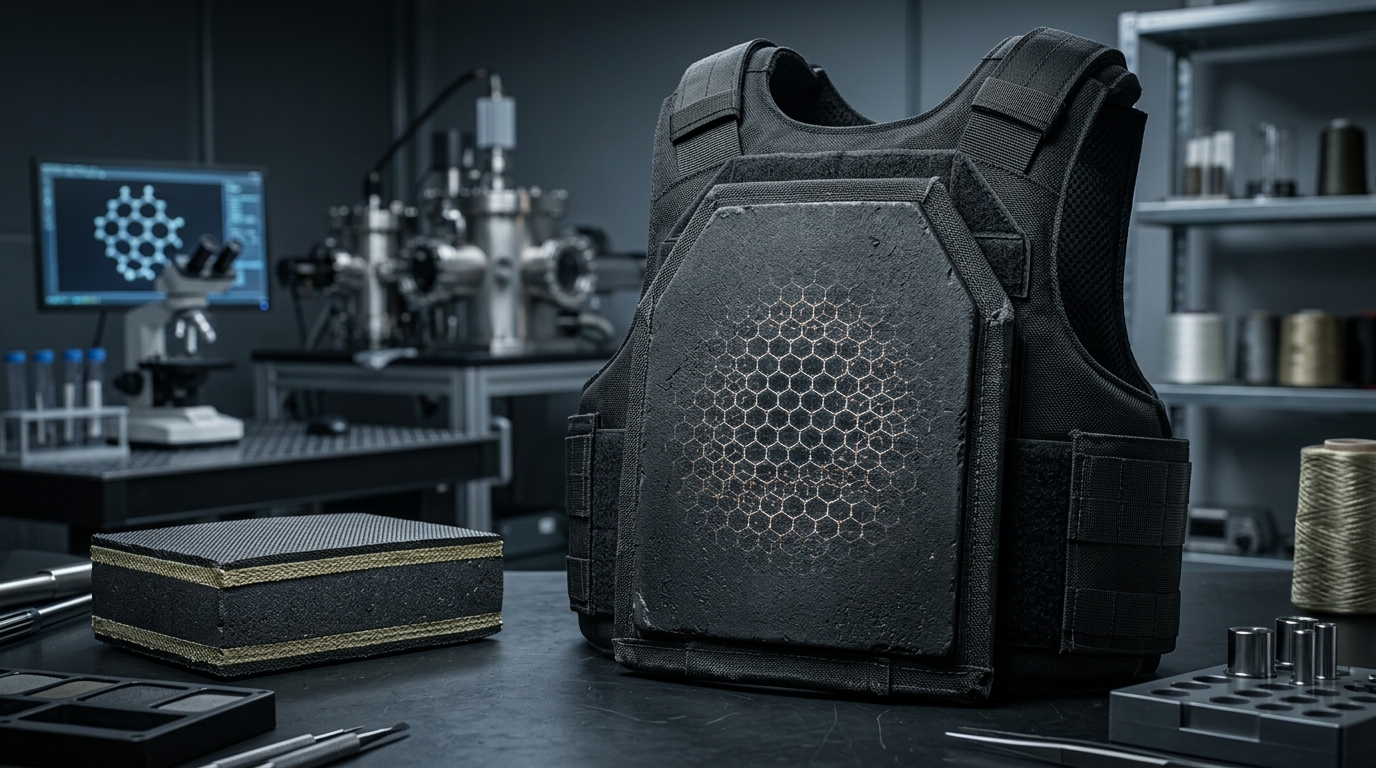
Graphene armor represents a transformative approach to ballistic and impact protection. Rather than relying solely on the mass or thickness of conventional materials, graphene-enhanced defensive systems exploit the exceptional mechanical properties of two-dimensional carbon lattices. At the atomic scale, pristine graphene exhibits an intrinsic tensile strength of approximately 130 gigapascals and an elastic modulus of 1 terapascal, making it theoretically one of the strongest materials known. When integrated into composite structures, these characteristics enable protective systems that absorb and distribute mechanical energy with remarkable speed and efficiency.
However, practical ballistic protection differs sharply from popular science fiction concepts of paper-thin, pure graphene body suits. Real-world armor engineering focuses on utilizing graphene as a nanomaterial additive, a reinforcing phase within polymer matrices, or a multi-layered barrier designed to arrest high-velocity projectiles, fragments, and stab threats without adding prohibitive bulk or weight.
The Physics of Ballistic Protection in Graphene
To stop a high-velocity projectile, an armor material must decelerate the incoming mass while absorbing its kinetic energy over a short distance and time interval. Traditional materials, such as metals and synthetic polymers, achieve this through plastic deformation, fiber stretching, and yarn breakage. Graphene introduces an additional, highly effective mechanism: ultra-fast kinetic energy dissipation via transverse wave propagation.
Acoustic Velocity and Elastic Wave Propagation
When a projectile strikes a barrier, the impact generates stress waves that radiate outward from the point of contact. The speed at which these waves travel depends on the material’s elastic modulus ($E$) and its density ($
ho$), governed by the acoustic wave velocity equation:
v = √(E / ρ)
Because graphene possesses an extraordinarily high stiffness-to-density ratio, sound waves travel through its lattice at speeds exceeding 20,000 meters per second—roughly triple the speed of sound in steel. When an impact occurs, this high acoustic velocity drives a rapid elastic wave propagation outward, forming an expanding dynamic cone. This cone structure transfers energy across a broad surface area long before the projectile can localize stress and shear through the atomic plane.
Specific Penetration Energy
In a landmark 2014 study using miniature ballistic tests, researchers accelerated micron-scale silica spheres into multilayer graphene sheets at supersonic velocities. The tests revealed that nanoscale graphene membranes possess an exceptional specific penetration energy—the energy absorbed per unit mass—substantially outperforming bulk materials like macroscopic steel and aluminum.
Under extreme deformation, graphene absorbs kinetic energy through a combination of elastic stretching, radial crack formation along crystal planes, and structural delamination between layers. This combination allows the material to convert localized impact energy into distributed strain energy and surface energy across multiple microscopic zones.
Material Architectures in Modern Graphene Armor
Pristine monolayer graphene cannot simply be stacked to create a full-scale wearable vest; macro-scale manufacturing defects, atomic layer stacking limits, and shear forces between individual sheets present complex physical hurdles. Instead, armor developers incorporate various forms of graphene into multi-component architectures.
Graphene-Reinforced Polymer Composites
The most commercially viable method for incorporating graphene into defensive gear is through polymer matrix composites. By dispersing graphene nanoplatelets (GNPs) or functionalized graphene oxide (GO) into standard resins, manufacturers reinforce the structural backbone of existing soft and hard armor fabrics.
- Epoxy and Thermoset Enhancement: Adding minute weight percentages (often below 1%) of exfoliated graphene to epoxy matrices improves inter-laminar fracture toughness. This prevents delamination in hard armor plates when subjected to multi-hit ballistic strikes.
- Aramid and UHMWPE Coatings: Traditional ballistic fabrics, such as Kevlar or Ultra-High-Molecular-Weight Polyethylene (UHMWPE), can be coated with graphene suspensions. The nanoparticles fill micro-voids between the fibers, increasing friction between woven yarns and resisting projectile pull-through.
Shear Thickening Fluids with Graphene Additives
Liquid armor systems utilize shear thickening fluids (STFs)—non-Newtonian suspensions containing silica particles in a carrier fluid like polyethylene glycol. Under normal movement, these fluids remain flexible. Upon sudden ballistic or stab impact, the suspended particles instantly lock together, forming a rigid solid barrier.
Integrating graphene into STF-impregnated fabrics enhances this mechanism. The high surface area of graphene flakes increases the hydrodynamic lubrication forces and accelerates the onset of the shear-thickening transition, boosting puncture, knife, and fragment resistance without compromising garment flexibility.
Ceramic Matrix Composites (CMCs)
Hard armor strike faces traditionally rely on technical ceramics such as boron carbide, silicon carbide, or alumina. While these materials are exceptionally hard and shatter incoming armor-piercing bullets, they suffer from inherent brittleness and poor multi-hit endurance.
By incorporating graphene nanoplatelets into ceramic powders prior to sintering, engineers create ceramic matrix composites that arrest micro-crack growth. When a shockwave passes through the ceramic, the embedded graphene sheets bridge propagating cracks and deflect their paths, dissipating energy and preserving the structural integrity of the strike face for subsequent impacts.
Performance Comparison: Graphene Composites vs. Traditional Armor
Evaluating armor materials requires balancing several competing metrics: mass efficiency, structural thickness, durability against multiple impacts, and trauma reduction. The table below illustrates how graphene-enhanced systems compare to conventional ballistic materials.
| Armor Material Type | Primary Deformation Mechanism | Relative Areal Density | Key Advantage | Primary Limitation |
|---|---|---|---|---|
| Aramid Fabric (e.g., Kevlar) | Yarn tensile elongation and friction | Moderate | Proven reliability, high ductility | Susceptible to environmental degradation |
| UHMWPE (Dyneema, Spectra) | High-strength fiber tension, delamination | Low | Extremely lightweight, water resistant | Low thermal resistance (melts under heat) |
| Monolithic Ceramic (Boron Carbide) | Projectile blunting, ceramic pulverization | High (Hard Plates) | Defeats armor-piercing cores | Brittle failure; poor multi-hit capacity |
| Graphene-Ceramic Composite | Crack deflection, bridge-toughening | Moderate to Low | Superior multi-hit survivability | Complex, high-temperature sintering |
| Graphene-Polymer Hybrid | Acoustic wave dispersion, shear thickening | Very Low | Stab and ballistic synergy; thin profile | Strict dispersion and quality control requirements |
Technical Challenges and Engineering Limitations
Despite promising laboratory demonstrations, transitioning graphene armor from specialized research to mass-produced protective gear involves significant physical and chemical hurdles.
Interfacial Bonding and Dispersion
Graphene’s mechanical properties cannot be utilized if the nanomaterial fails to bond with its surrounding matrix. Pristine graphene sheets are chemically inert and naturally agglomerate due to strong van der Waals forces. When graphene clumps together, it creates localized stress concentrators that weaken the host polymer rather than strengthening it.
To solve this, materials scientists apply functional groups (such as hydroxyl, carboxyl, or amine groups) to the graphene surface. While functionalization improves chemical bonding and ensures uniform dispersion, it disrupts the pristine $sp^2$ carbon lattice, slightly reducing the intrinsic tensile strength of the individual sheets. Balancing chemical bonding efficiency with structural purity remains a primary engineering trade-off.
Interfacial Shear Stress and Load Transfer
When a projectile strikes a composite, kinetic energy must transfer rapidly from the matrix material into the reinforcing graphene particles. This load transfer relies on interfacial shear stress. If the interface between the graphene and the surrounding resin or fiber fails prematurely, the graphene flakes will pull out of the matrix without absorbing significant energy.
Macro-Scale Defect Sensitivity
At the nanoscale, pristine graphene displays near-theoretical strength. However, as the area of graphene increases to macroscopic dimensions, the probability of structural defects—such as grain boundaries, vacancies, and Stone-Wales dislocations—rises sharply. According to the Griffith fracture criterion, high stress concentrates at these defect sites, causing brittle failure well below theoretical thresholds. This fundamental physical constraint explains why macroscopic pure-graphene sheets are unsuitable for armor, cementing composite formulations as the dominant development path.
Applications Across Defense Domains
Graphene armor systems serve varied operational roles, with each application customized to counter specific threats and operational environments.
Personal Protective Equipment (PPE)
In soft body armor, graphene-doped textiles reduce the overall layer count required to achieve standard ballistic certifications. This results in lighter, more flexible garments that enhance user mobility and heat dissipation. Furthermore, the combination of high hardness and surface lubricity provides substantial resistance against sharp-edge and spiked puncture threats, resolving a long-standing vulnerability of standard synthetic ballistic fabrics.
Mitigating Blunt Force Trauma
Stopping bullet penetration represents only half the challenge in body armor design; mitigating behind-armor blunt trauma is equally vital. When a bullet strikes a vest, the rear face of the fabric deforms inward, causing severe contusions, fractured ribs, or internal organ damage. This deformation is measured as the backface signature (BFS).
Graphene-enhanced fabrics and backing plates distribute the impact energy over a much wider spatial footprint, flattening the deformation cone and reducing BFS depth. This dampens the localized shock wave transmitted to the wearer’s body.
Vehicle and Aerospace Protection
Beyond personal protection, graphene composites find utility in vehicle armor and aerospace engineering:
- Vehicle Spall Liners: Mounted on the interior of armored vehicles, graphene-reinforced spall liners capture high-velocity fragmentation and interior metal flakes ejected when an external plate is struck by heavy ordnance.
- Hypervelocity Debris Shields: In orbital environments, spacecraft and satellites face continuous threats from micrometeoroids and orbital debris traveling at speeds exceeding 7,000 meters per second. Graphene-layered multi-wall shielding systems absorb hypervelocity impact energy, preventing hull breach without imposing severe payload weight penalties.
Evaluation and Testing Criteria
Standardized ballistic performance metrics are essential for certifying any graphene-enhanced protective system. Engineers rely on several established quantitative parameters:
- $V_{50}$ Ballistic Limit: The velocity at which a specific projectile is expected to penetrate an armor sample 50% of the time. An increase in $V_{50}$ at an equivalent areal density confirms the material benefit of graphene integration.
- Areal Density ($AD$): Expressed in kilograms per square meter ($kg/m^2$), this metric assesses armor weight relative to surface area. Graphene systems aim to decrease areal density while preserving baseline protective thresholds.
- Multi-Hit Durability: The ability of a rigid plate to withstand closely grouped successive projectile strikes without delamination, catastrophic ceramic pulverization, or structural compromise.
By focusing on scalable composite manufacturing, precise surface functionalization, and optimized energy dissipation pathways, materials science continues to translate the theoretical physics of graphene into robust, lightweight armor solutions for extreme conditions.