Scaling Graphene: Why Industry is Pivoting to Continuous Flow Manufacturing
For years, the story of graphene production was defined by the laboratory batch. Researchers and early-stage companies relied on small-scale reactors to synthesize material, perfect for characterizing atomic layers but insufficient for the demands of industrial sectors like automotive or aerospace. As we move through 2026, a critical bottleneck is breaking: the transition to continuous flow manufacturing.
Moving Beyond the Batch
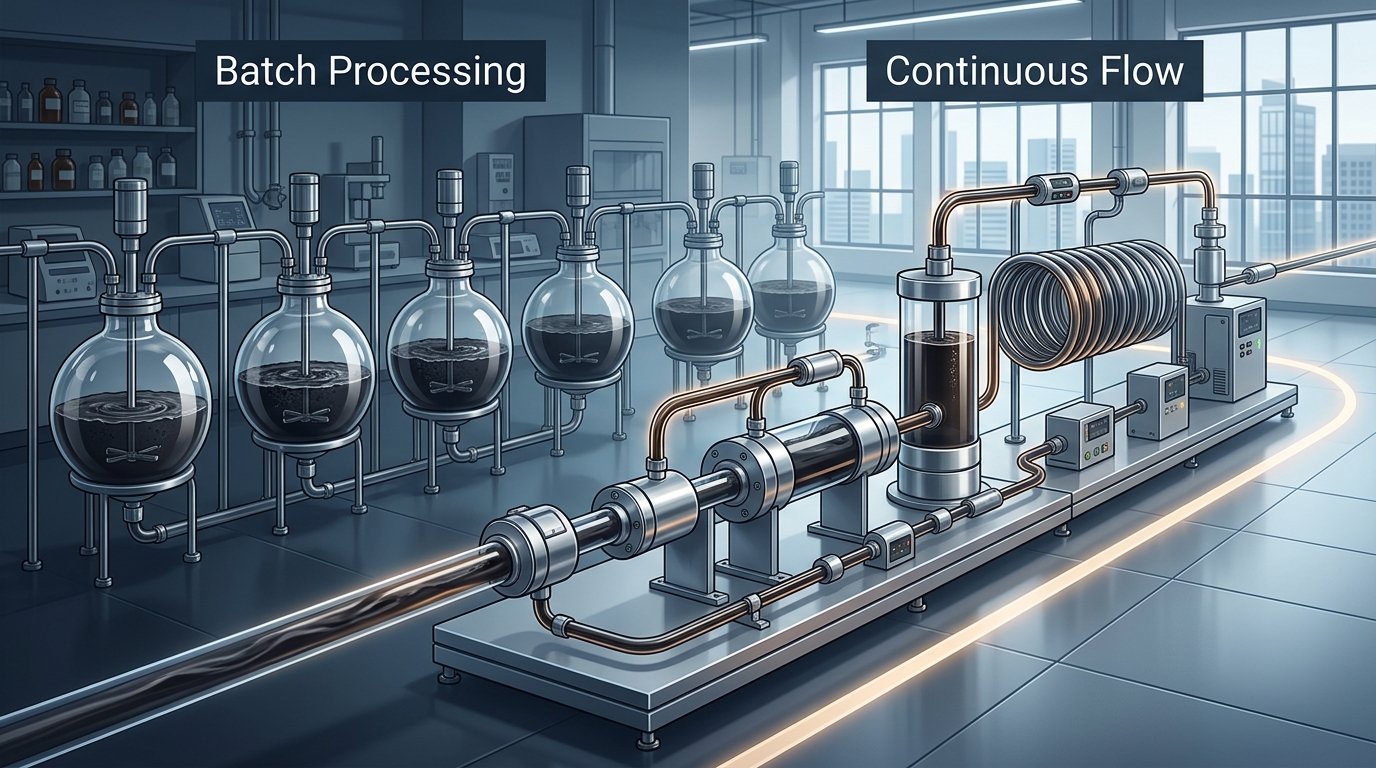
Batch processing acts much like a kitchen stove; you prepare a limited amount of material, process it, and then reset the entire system. While this method allows for high precision and strict quality control, it is fundamentally incompatible with the high-volume requirements of modern supply chains. Manufacturers cannot wait for a cooling cycle or reactor cleaning to produce the next batch of additives for concrete or battery cathodes.
Continuous flow systems change the architecture of production. By using specialized reactors where precursors enter at one end and finished graphene emerges from the other, companies can maintain a steady state of operation. This shift significantly reduces the downtime associated with manual handling and batch-to-batch variations, which have historically plagued the consistency of graphene-enhanced products.
Operational Consistency and Cost
The move toward continuous production is not just about volume; it is about predictability. When a manufacturer integrates graphene into a high-performance coating or a structural composite, they require a material with identical mechanical properties every single time. Continuous flow allows for real-time monitoring and adjustments, ensuring that the structural integrity of the graphene flakes remains stable throughout long production runs.
Furthermore, as output scales, the cost per gram naturally declines. This scaling effect is what many market analysts point to when discussing the “inflection point” of 2D materials. While batch production keeps prices high due to labor intensity and low throughput, continuous manufacturing spreads capital expenditures over a much larger volume of material, helping graphene become a viable commodity for industrial applications rather than a niche research tool.
Engineering Challenges
Transitioning to these systems is far from simple. Maintaining high-quality graphene while increasing throughput requires advanced control systems to prevent the material from re-agglomerating—a common problem when manufacturing at high speeds. Engineers are currently refining liquid-phase exfoliation and chemical vapor deposition (CVD) techniques to operate reliably in these continuous environments. As these production lines hit full capacity throughout 2026 and beyond, we should expect a broader range of graphene-enhanced products hitting the market, backed by more stable and predictable material supplies.