Spanish Research Teams Develop Bidirectional Graphene Interface to Personalize Neurological Therapies
Researchers in Spain have achieved a major milestone in neurotechnology by developing a flexible, bidirectional neural interface capable of simultaneously recording and modulating brain activity. Led by the Institute of Microelectronics of Barcelona (IMB-CNM-CSIC) and the Catalan Institute of Nanoscience and Nanotechnology (ICN2), the study introduces an innovative device that overcomes the long-standing technical barriers of brain-computer interfaces (BCIs).
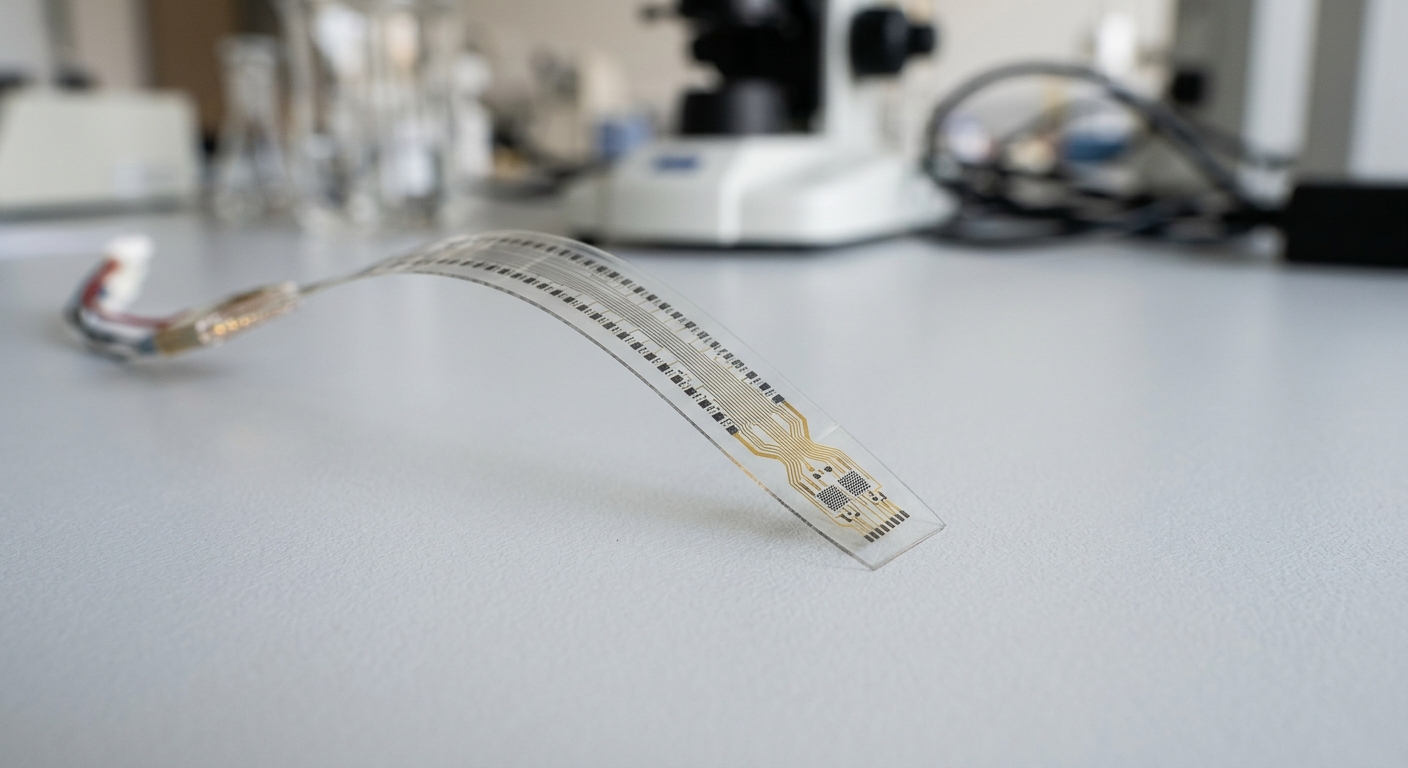
The research, published in the journal Nature Communications, details a monolithic, flexible probe that successfully integrates two distinct graphene-based technologies. By combining active recording components with passive stimulation elements on a single platform, the device can effectively “speak” and “listen” to the brain at the same time without signal interference.
Overcoming the Noise Barrier in Brain Implants
Traditional clinical implants, such as those used to manage Parkinson’s disease or epilepsy, are primarily unidirectional. While they can deliver electrical pulses to stimulate neural tissue, they struggle to simultaneously record the brain’s natural electrical responses. The primary obstacle is the massive electrical noise—known as stimulation artefacts—generated by the pulses, which completely drowns out the delicate, low-amplitude signals of nearby neurons.
This limitation has prevented the development of closed-loop therapies that can read brain activity in real time, interpret the data, and deliver targeted therapeutic stimulation instantly. The new Spanish-led device solves this issue by utilizing the unique physical and electrical properties of graphene, achieving an “artefact-resilient” design that maintains high-fidelity recording during active stimulation.
A Dual-Graphene Monolithic Architecture
To achieve bidirectional communication, the research team integrated two complementary graphene-based technologies onto a single, highly conformable polyimide substrate:
- Monolayer Graphene Transistors: The device utilizes solution-gated field-effect transistors (gSGFETs) made of single-layer graphene. These active sensors are highly sensitive and capable of recording brain activity across an exceptionally wide bandwidth, including ultra-low frequency “infraslow” signals that are typically invisible to conventional metal electrodes.
- Nanoporous Graphene Microelectrodes: For the stimulation component, the researchers incorporated microelectrodes made of nanoporous reduced graphene oxide (rGO). This porous structure allows for high charge injection limits, enabling the delivery of precise electrical pulses to modulate nerve cells without damaging the surrounding tissue.
The integration of these two materials on a microscale level allows the device to record local field potentials and infraslow activity continuously. During validation tests in mouse models, the interface successfully recorded neural signals during active microstimulation, demonstrating that the recording capability of the transistors was not compromised by the electrical pulses.
Path to Commercialization and Clinical Application
This scientific breakthrough has a direct path to commercial markets through INBRAIN Neuroelectronics, a spin-off company founded in 2019 by researchers from ICN2, IMB-CNM, and the Catalan Institution for Research and Advanced Studies (ICREA). INBRAIN has licensed the core graphene transistor and electrode technologies to develop clinical-grade neural interfaces for human use.
The commercial potential of this platform is already being realized. In April 2026, INBRAIN announced the successful completion of patient enrollment in its first-in-human clinical study. Conducted in collaboration with the University of Manchester and the Northern Care Alliance in the UK, the trial evaluated the safety of a graphene-based cortical interface in eight patients undergoing brain tumor resection. The device demonstrated a highly favorable safety profile with zero adverse events, proving the viability of graphene in human neurosurgery.
A New Era for Adaptive Neuromodulation
The ability to establish a real-time, bidirectional dialogue with the brain opens up vast opportunities for medical device manufacturers, biotech startups, and healthcare investors. By enabling closed-loop neuromodulation, this technology paves the way for personalized, adaptive therapies that adjust automatically to a patient’s shifting brain states.
Future clinical systems leveraging this bidirectional interface could offer highly precise, real-time intervention for drug-resistant epilepsy, stroke rehabilitation, and advanced movement disorders, representing a major leap forward for the multi-billion-dollar neurotechnology sector.