FSU Physicists Uncover Graphene Superconductivity to Simplify Quantum Computing
Physicists from Florida State University (FSU), in collaboration with an international team of scientists, have discovered unusual superconducting states in a specialized form of graphene. The breakthrough, published in the journal Nature Physics, reveals that rhombohedral multilayer graphene naturally hosts coexisting superconducting and topological behaviors. This dual characteristic could dramatically simplify the design and scalability of next-generation quantum technologies, including fault-tolerant quantum computers.
The Physics of Staircase-Stacked Carbon Layers
Graphene, a single layer of carbon atoms arranged in a hexagonal lattice, has long been celebrated for its extraordinary strength and conductivity. However, when multiple layers of graphene are stacked in a specific staircase-like sequence—known as chiral stacking—its electronic properties undergo a radical transformation. This configuration is referred to as rhombohedral graphene.
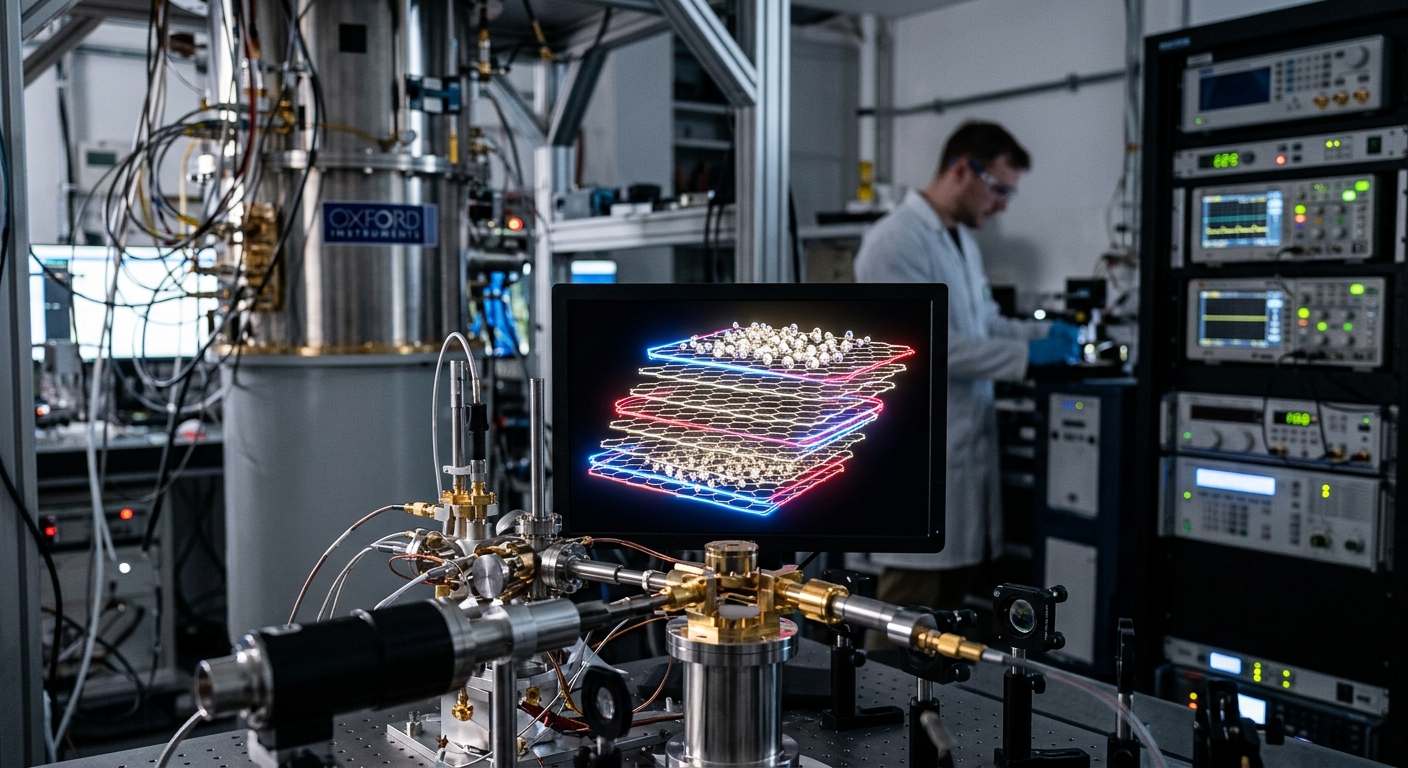
In this staircase structure, low-energy electrons do not distribute evenly. Instead, they localize almost exclusively on the outermost top and bottom surfaces of the material. The research team focused their experiments on medium-thickness rhombohedral structures, specifically examining heptalayer (seven-layer) and octalayer (eight-layer) graphene devices. By applying an external electric field, the researchers were able to manipulate these surface-bound electrons to trigger highly unusual quantum states.
Dual-Surface Carriers and the Quantum Anomalous Hall Effect
The international collaboration demonstrated that superconductivity—the ability to conduct electricity with zero resistance—originates directly from these dual-surface carriers. In the octalayer graphene device, superconductivity appeared in five distinct regions of the electronic phase diagram, depending on the polarity and strength of the applied electric displacement field.
In the heptalayer device, which was aligned with hexagonal boron nitride to form a moiré superlattice, the researchers observed another major milestone. At higher electric fields, the material exhibited a quantum anomalous Hall effect. This is a rare topological state where electrical current flows entirely without resistance along the very edges of the material, even in the absence of an external magnetic field.
The coexistence of superconductivity and topological edge states within a single, continuous material is highly sought after in condensed matter physics. This specific combination is considered the ideal environment for hosting exotic quasiparticles known as Majorana modes, which are key to building stable quantum bits (qubits) that are immune to environmental noise.
Eliminating the Complexity of Quantum Device Engineering
Historically, scientists attempting to study the intersection of superconductivity and topology had to engineer incredibly complex, multi-layered “sandwich” structures. These devices required placing different materials—such as conventional superconductors and topological insulators—in microscopic proximity. These hybrid structures are notoriously difficult to fabricate, highly sensitive to defects, and suffer from poor replicability.
Rhombohedral multilayer graphene bypasses these engineering bottlenecks by hosting both phenomena naturally within a single, atomically clean carbon platform. Because the material is highly tunable via simple electrostatic gating, researchers can switch between states or optimize them on the fly without needing to physically alter the device.
This discovery provides a clean, highly reliable sandbox for physicists to explore correlated quantum phases. By distilling these complex interactions into their most essential form, the scientific community is now better positioned to design and scale up practical quantum components.
A Multi-Institutional Collaboration
The research was led by FSU Assistant Professor of Physics Cyprian Lewandowski and postdoctoral researcher Phong Võ Tiến, alongside lead authors from the University of Washington and other global institutions. Crucial material synthesis was provided by the National Institute for Materials Science in Tsukuba, Japan.
The team leveraged the advanced computational power of the FSU Research Computing Center and experimental facilities at the National High Magnetic Field Laboratory. The project received financial support from several major agencies, including the U.S. Army Research Office, the U.S. Department of Energy, and the National Science Foundation (NSF).