Graphene Filters: Can Atom-Thin Membranes Solve Global Water Scarcity?
Graphene-enhanced membranes are emerging as a breakthrough technology in water treatment, specifically in the energy-intensive field of desalination. By leveraging graphene’s unique atomic structure, researchers are developing filters capable of removing salt and contaminants with significantly higher efficiency and lower energy requirements than traditional polymer-based reverse osmosis systems.
While the technology is currently moving from laboratory success to pilot-scale testing, it represents a major shift in how we approach water purification. It is important to note that while the science is promising, widespread commercial adoption is still navigating hurdles related to large-scale manufacturing consistency and long-term durability in harsh, high-pressure industrial environments.
Key Takeaways
- High Permeability: Graphene’s atom-thin structure allows water to pass through rapidly while blocking ions and pollutants.
- Energy Efficiency: Potential to reduce the high electrical demand associated with current seawater desalination plants.
- Material Versatility: Graphene oxide (GO) is the most common form used due to its ability to be processed into stable, porous membranes.
- Scaling Challenges: Moving from small-scale lab results to uniform, defect-free industrial membranes remains the primary engineering focus.
How Graphene Filtration Works
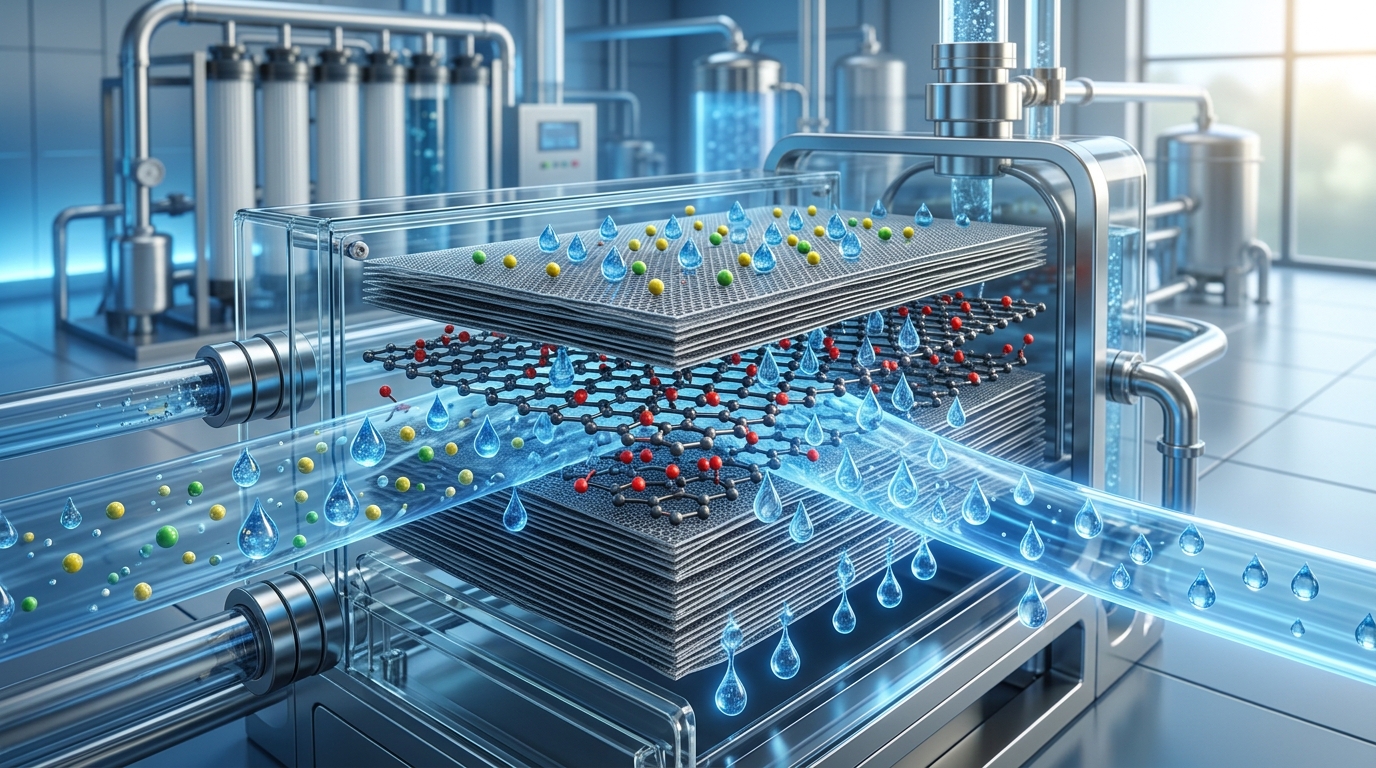
At its core, a graphene-based filter utilizes the material’s two-dimensional structure. Graphene oxide, a derivative of graphene, can be arranged to create precise nano-channels. These channels are small enough to allow water molecules to pass through while physically sieving out larger molecules, salts, and even certain biological contaminants.
Unlike standard polymer membranes that rely on solution-diffusion mechanisms, graphene membranes can act as a more direct physical sieve, which theoretically allows for much higher water flux—the speed at which water passes through the filter—without sacrificing the quality of the filtered output.
The Potential for Desalination
Desalination is the process of removing salt from seawater to make it potable. Currently, reverse osmosis (RO) dominates the market but is notoriously energy-heavy. The potential for graphene lies in its ability to decrease the pressure required to force water through the membrane.
| Feature | Traditional RO Membranes | Graphene-Enhanced Membranes |
|---|---|---|
| Permeability | Moderate | High (Ultra-thin) |
| Energy Usage | High | Potentially Low |
| Durability | High (Proven) | Developing |
Benefits and Limitations
The primary benefit of graphene-based filtration is efficiency. By improving flux, plants could potentially process more water with less electricity, lowering the overall cost of producing fresh water. Furthermore, graphene’s chemical resistance makes it a candidate for environments where traditional membranes might degrade quickly.
However, the industry faces significant hurdles. Producing graphene sheets that are free of microscopic tears is difficult. If a membrane has defects, the filtration effectiveness drops. Additionally, industrial-scale manufacturing methods that keep costs competitive with existing technology are still being refined by researchers and private companies.
Frequently Asked Questions
Is graphene filtration currently used in tap water filters?
While experimental, high-end, or niche research-grade filters exist, traditional multi-stage filtration (including activated carbon and standard RO) remains the standard for residential tap water.
Why is graphene better than current membranes?
Graphene is theoretically superior due to its extreme thinness and strength, which allows for faster water flow rates compared to the thicker, denser polymers used in conventional RO filters.
When will we see industrial-scale graphene desalination plants?
There is no set date for full-scale commercial deployment. The technology is currently moving through pilot programs and optimization phases as companies work to ensure membrane longevity and cost-effectiveness at scale.
Editorial Disclaimer
This article is provided for educational and informational purposes only. Details can change over time, so readers should verify important information with official sources, qualified professionals, manufacturers, publishers, or relevant authorities before making decisions.