How Graphene is Transforming Power Storage for Military and Aerospace Applications
Graphene is increasingly becoming a critical material for the defense and aerospace sectors, specifically for advanced energy storage solutions. By integrating this atom-thin carbon lattice into battery and supercapacitor architectures, engineers are addressing the persistent challenge of improving power density without increasing total system weight.
As of 2026, the adoption of graphene in these high-stakes environments is moving from laboratory-scale testing into more rugged, real-world development phases. While the potential for faster charging and higher capacity is significant, practical deployment depends on achieving consistent manufacturing scalability and meeting the rigorous safety certification standards required for aerospace operations.
Key Takeaways
- Weight Reduction: Graphene-enhanced materials help reduce the physical footprint of energy systems, directly supporting SWaP (Size, Weight, and Power) optimization goals.
- Thermal Management: The material’s inherent thermal conductivity helps dissipate heat in tightly packed battery modules, enhancing safety.
- Operational Durability: Graphene structures offer increased mechanical strength, essential for equipment subjected to extreme vibrations and G-forces.
- Development Stage: Current progress focuses on scaling production and proving long-term reliability under extreme environmental conditions.
The Role of SWaP Optimization
In both military and aerospace, every gram of additional weight incurs a performance penalty. Whether it is a drone, an orbital satellite, or field-deployed tactical gear, energy storage systems must be as light as possible while delivering maximum power. Graphene-based electrodes are being investigated for their ability to increase the energy density of traditional lithium-ion batteries by providing a more efficient conductive pathway for ions.
Enhancing Safety and Thermal Stability
One of the primary failure modes for high-density energy systems in aerospace is thermal runaway. Graphene’s exceptional thermal properties allow it to act as an effective heat spreader within battery cells. By distributing heat away from localized hot spots, these enhanced materials can help maintain structural integrity during rapid charging cycles or under the high-temperature conditions common in aerospace environments.
Applications in Defense and Space
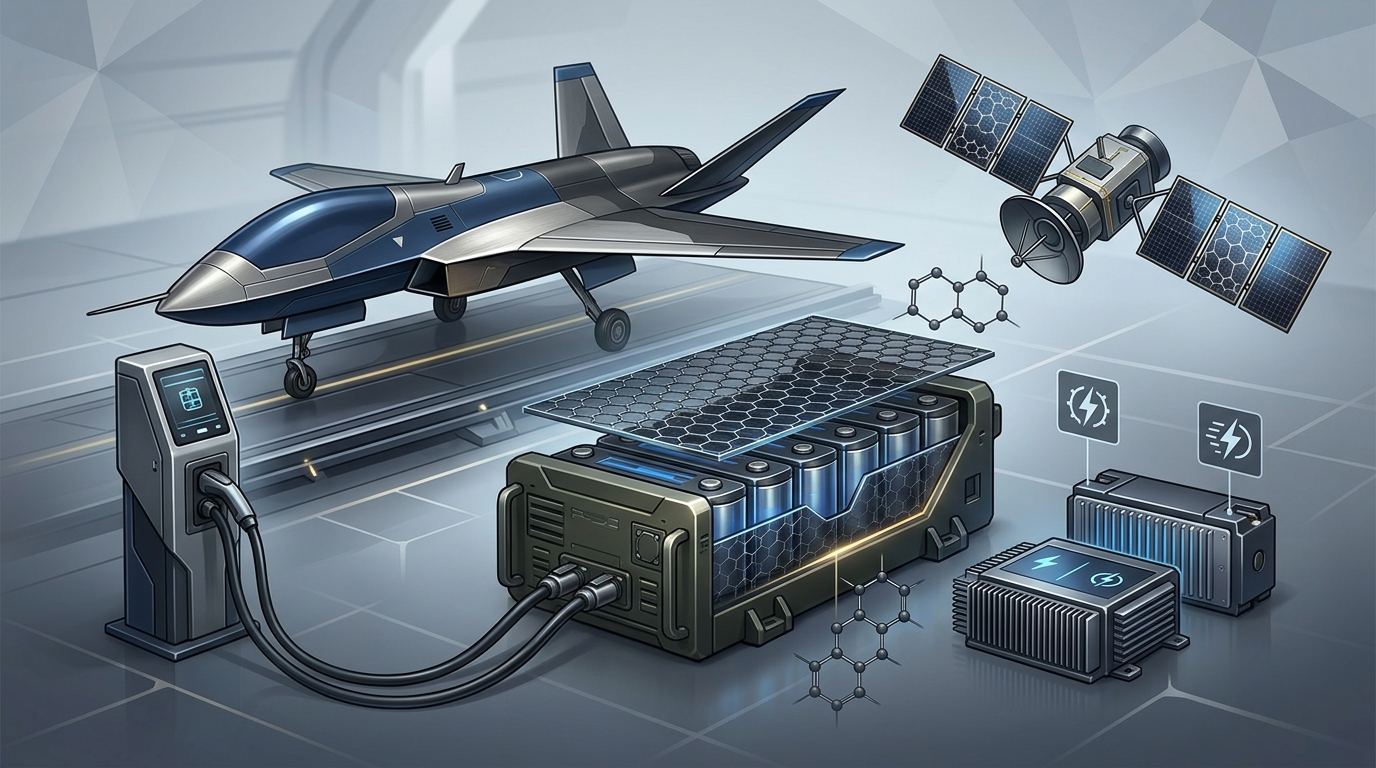
| Application | Primary Benefit |
|---|---|
| UAVs / Drones | Increased flight time through higher energy density. |
| Orbital Satellites | Improved cycle life and resistance to space radiation. |
| Tactical Gear | Lighter, more durable power sources for soldiers. |
What Readers Should Know
While industry news often highlights breakthroughs, the path to widespread commercial or defense implementation remains rigorous. Current research is focused on the transition from high-purity, small-batch graphene to industrial-grade material that maintains its structural benefits. Potential adopters should watch for developments in third-party testing and standard-setting for graphene-enhanced energy components in aerospace-grade supply chains.
Frequently Asked Questions
Why is graphene better for space batteries?
Graphene offers a high surface-to-volume ratio and excellent conductivity, which allows for faster charging and the potential to store more energy in a lighter form factor compared to conventional materials.
Is graphene currently used in military hardware?
Graphene is currently in active testing and early integration phases for various defense applications, including protective coatings and power storage, but widespread adoption is still scaling up.
What are the biggest challenges for these applications?
The primary challenges include achieving cost-effective, large-scale manufacturing and ensuring the materials can survive extreme environmental cycles for the long durations required in aerospace missions.
Editorial Disclaimer
This article is provided for educational and informational purposes only. Details can change over time, so readers should verify important information with official sources, qualified professionals, manufacturers, publishers, or relevant authorities before making decisions.