Argonne maps skyrmion behavior in atom-thin magnets, sharpening the case for spintronic memory
Argonne National Laboratory researchers reported on April 9, 2026, that they have identified how thickness and applied magnetic field control skyrmions inside an atom-thin ferromagnet, a result that could make future spintronic devices easier to engineer. The work centers on Fe3GeTe2, a van der Waals magnet that the team imaged directly at cryogenic temperatures as it switched magnetic states.
Argonne’s cryo-LTEM images show skyrmions changing with thickness
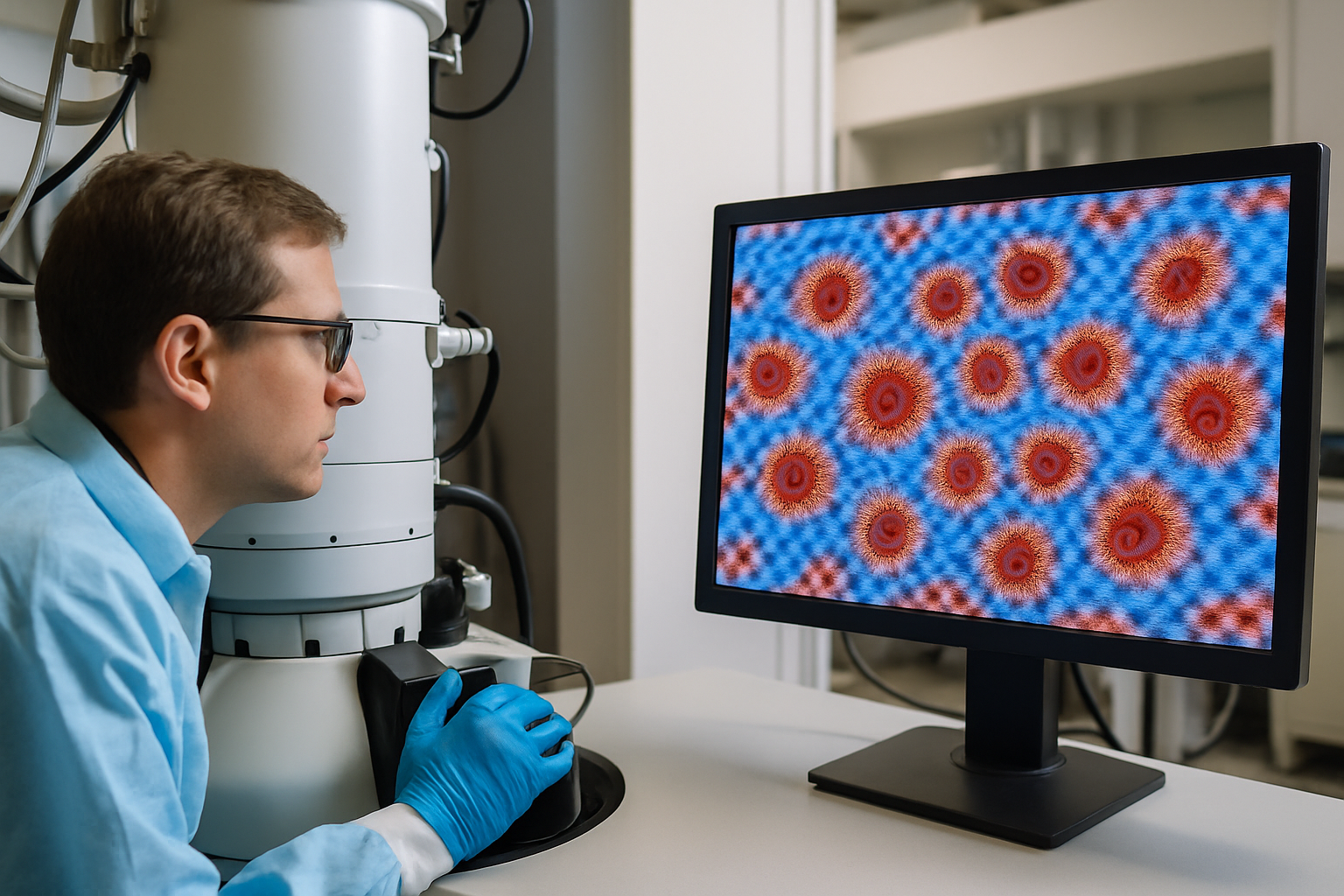
The study used cryogenic Lorentz transmission electron microscopy at Argonne’s Center for Nanoscale Materials to watch a single flake of Fe3GeTe2 during magnetization reversal. Rather than inferring the magnetic structure from bulk measurements, the researchers directly tracked how magnetic domains and skyrmions formed and evolved as the sample thickness changed.
According to the Argonne report, the team also combined the imaging with micromagnetic simulations from the University of Edinburgh, which closely matched the experimental behavior. That combination gave the researchers a thickness-dependent map for how the magnetic structures respond under different cooling and field conditions.
Why the magnetic control matters for spintronics
Skyrmions are nanoscale whirlpools of electron spin that can be moved with very little energy, which makes them attractive for memory and logic devices that could consume less power than charge-based microelectronics. The challenge has been making them predictable enough to design around at practical dimensions.
Argonne’s results push in that direction by showing which parameters most strongly affect skyrmion size and density. In the lab’s framing, that is a step toward using atomically thin magnets as building blocks for dense storage and low-power processors, not just as an interesting magnetic system.
From lab image to device design rules
The research is still fundamental, and the material in question only shows the relevant magnetic behavior at very low temperatures. Even so, the study gives engineers something unusually concrete: a way to think about how to tune domain patterns in ultrathin magnets instead of treating them as uncontrollable side effects.
For materials science, that is the practical value of the paper. It turns a visually striking class of nanoscale magnetism into a more usable design problem, one that may help determine whether skyrmion-based devices remain a laboratory curiosity or move closer to hardware.
Source: Argonne National Laboratory via Phys.org
Date: 2026-04-09