
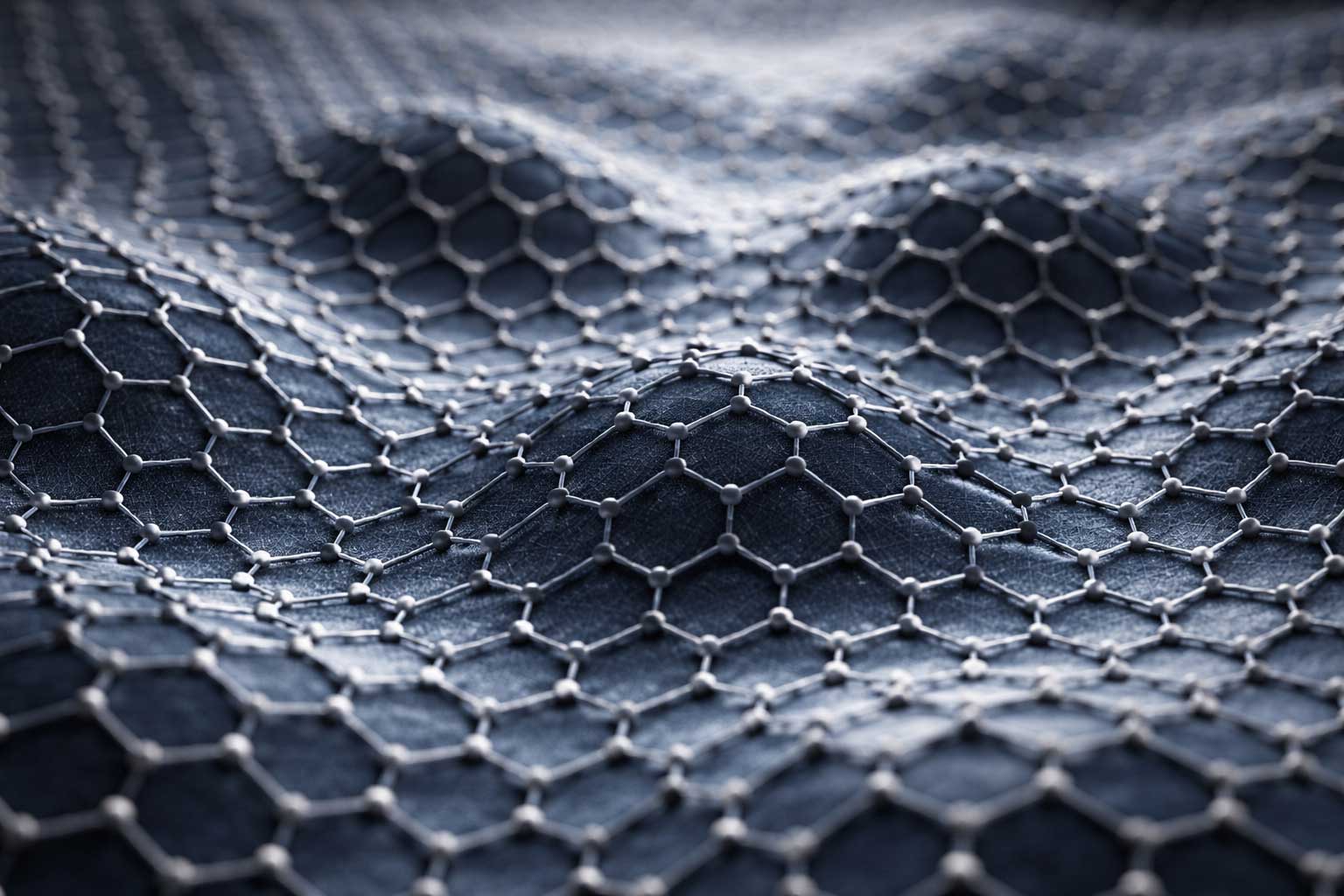
What Is Rippling in Graphene?
Rippling in graphene refers to the tiny wave-like bends, wrinkles or out-of-plane distortions that appear across a graphene sheet at the nanoscale. Although graphene is often described as a one-atom-thick layer of carbon arranged in a hexagonal lattice, it is not perfectly flat under real-world conditions.
Instead, graphene naturally develops slight undulations that can form because of thermal motion, mechanical strain, defects or interactions with the surface beneath it. These structural variations are small, but they play an important role in how graphene behaves.
Why rippling happens in graphene
Graphene is an extremely thin two-dimensional material, which makes it highly sensitive to external forces and atomic-level motion. At normal temperatures, carbon atoms vibrate continuously, and those vibrations can create subtle out-of-plane deformations.
Rippling can also appear when graphene is placed on a substrate, stretched during fabrication, transferred between surfaces or affected by imperfections in its crystal lattice. Even small environmental changes can influence the shape of the sheet.
What rippling looks like
Rather than resembling a perfectly flat atomic film, rippled graphene looks more like an ultrathin flexible membrane with tiny nanoscale waves. These variations are not usually visible to the naked eye, but they can be observed using advanced microscopy and surface analysis techniques.
In research settings, ripples are often described as local height fluctuations or nanoscale corrugations across the graphene surface.
Why rippling matters
Rippling is important because it can influence several of graphene’s key properties. Changes in local curvature may affect how electrons move through the material, which can alter conductivity and other electronic behavior.
Mechanical properties can also be affected. Ripples may help graphene absorb stress, bend more easily and respond differently under tension compared with an idealized flat sheet.
In addition, curved or distorted regions can become more chemically active than flatter areas, which is relevant for sensors, coatings, catalysis research and other applied technologies.
Rippling is a natural feature, not just a flaw
Although the word “rippling” may sound like a defect, it is often considered a natural structural feature of graphene rather than simply a problem. In many cases, understanding and controlling rippling is part of improving graphene performance for electronics, energy storage, composites and advanced materials research.
For scientists and engineers, rippling is one of the reasons graphene remains both promising and complex. Its atomic thinness gives it remarkable properties, but that same thinness also makes its surface behavior highly dynamic.
Simple definition
In simple terms, rippling in graphene means the material forms tiny waves or wrinkles instead of staying perfectly flat. Those nanoscale bends can affect how graphene performs in practical applications.