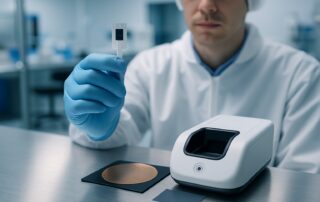
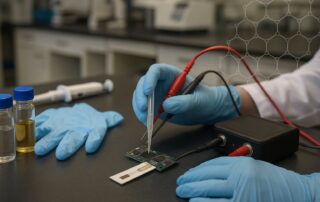
Oregon State team pairs reduced graphene oxide with oxide chemistry for faster food testing

Oregon State University researchers reported an electrochemical sensor that uses reduced graphene oxide in a nanocomposite designed to speed up food-quality testing. The device was built to detect theobromine in drinks and chocolate milk, pointing to a practical route for lower-cost screening outside conventional labs.


By |2026-04-26T03:16:50+00:00April 26th, 2026|News|

Northwestern team scales high-entropy alloy nanoparticle design to millions of particles

A Northwestern University-led team has reported a synthesis method that can tune both the composition and surface structure of high-entropy alloy nanoparticles, then scale the process to millions of particles on a chip. The advance could make it easier to identify catalysts for clean hydrogen, energy storage and other chemical processes.

By |2026-04-26T02:16:24+00:00April 26th, 2026|News|

MIT.nano backs startup using nanomaterial-based ion detectors to make lab instruments smaller and more sensitive

MIT.nano’s 2026 START.nano cohort includes a startup developing nanomaterial-based ion detectors for analytical, chemical and radiation instruments, a sign that a niche sensing platform is moving closer to commercial use.

By |2026-04-26T00:17:18+00:00April 26th, 2026|News|
Go to Top