Graphene X Women's Heated Jacket
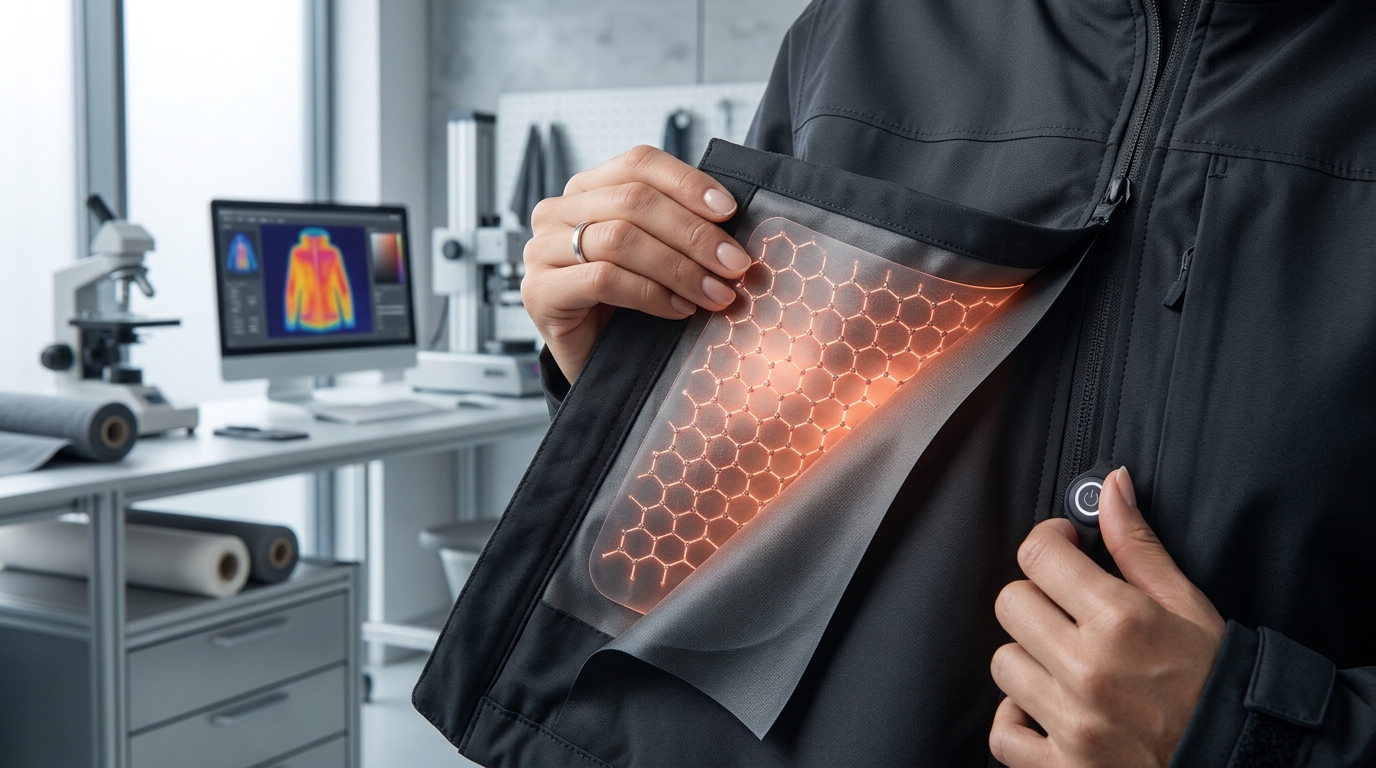
The graphene x women’s heated jacket represents a convergence of advanced nanomaterial science and technical apparel engineering. Designed to solve the traditional tradeoff between bulky insulation and active warmth, this garment integrates electrothermal graphene heating elements directly into a weather-resistant shell tailored to female ergonomics. Rather than relying solely on thick layers of trapped air, the jacket uses an external power bank to run low-voltage electrical current through flexible, atom-thick carbon sheets, generating rapid and uniform warmth across targeted physiological zones.
Understanding how this jacket performs requires examining both the nanoscale properties of graphene and the macroscale challenges of apparel manufacturing. Graphene enhances outerwear through two distinct mechanisms: active heat generation via electrothermal resistive heating and passive heat distribution enabled by the material’s extraordinary thermal conductivity. Together, these mechanisms create an adaptable microclimate that responds dynamically to extreme environmental conditions.
The Thermal Physics of Graphene Heating
Active heating garments traditionally used fine metal wires or coiled carbon fiber bundles. While functional, these conventional systems suffer from concentrated hot spots, mechanical stiffness, and vulnerability to fatigue failure from repeated folding. Graphene alters this dynamic through its unique structural and electronic properties.
Resistive Joule Heating
At the heart of the jacket’s active system is Joule heating, the process by which electrical energy converts into thermal energy as electrons flow through a resistive medium. When connected to a standard lithium-polymer battery pack, voltage applied across the flexible graphene film forces charge carriers through a two-dimensional hexagonal lattice. Because graphene provides a continuous, highly uniform conductive plane rather than isolated strands, the electrical current distributes evenly across the entire surface area of the heating pad.
This uniform sheet resistance eliminates the localized overheating common in wire-based garments. The result is rapid thermal ramp-up, allowing the garment to reach target operating temperatures within seconds of activation while operating at safe, low direct-current voltages (typically 5V to 12V).
Far-Infrared Emission
Unlike heating coils that primarily warm adjacent air through conduction and convection, graphene heating films emit substantial thermal energy in the form of far-infrared radiation (FIR), typically within the 4 to 16-micrometer wavelength band. Far-infrared energy matches the absorption spectrum of human skin tissue, allowing radiant heat to penetrate subcutaneous layers more effectively than ambient surface warming alone. This radiant transfer promotes local microcirculation and provides a deeper sensation of warmth at lower actual air temperatures inside the jacket lining.
Material Architecture and Garment Construction
A technical heated jacket must withstand severe weather, continuous flexing, moisture accumulation, and periodic laundering. Achieving this requires a layered composite architecture where nanomaterials reinforce both structural and functional layers.
The Heating Element Matrix
Pure monolayer graphene, first isolated mechanically in 2004, is too delicate and costly for bulk textile production. Commercial heated garments utilize advanced composite formulations, such as liquid-phase exfoliated graphene nanoplatelets suspended in a flexible polymer binder, or continuous chemical vapor deposition (CVD) films laminated between protective dielectric membranes. This flexible carbon lattice resists tens of thousands of flex cycles without micro-cracking or losing electrical continuity.
Graphene-Integrated Membrane Shell
Beyond the active heating pads, the outer textile layers often incorporate graphene directly into the polyurethane or PTFE waterproof-breathable membrane. When infused into synthetic polymer matrices, graphene nanoplatelets enhance several baseline attributes:
- Abrasion Resistance: The exceptional tensile strength of sp² carbon-carbon bonds reinforces polymer fibers, significantly increasing tear and abrasion resistance without adding fabric weight.
- Thermal Distribution: Graphene’s in-plane thermal conductivity helps pull excess heat away from body zones that naturally run hot and redistribute it toward cooler peripheries.
- Antimicrobial and Antistatic Properties: The physical structure of graphene disrupts bacterial cell membranes, reducing odor retention over extended backcountry use, while its moderate electrical conductivity dissipates static charges.
- Hydrophobic Weatherproofing: Imparting nano-scale surface roughness enhances the durable water repellent (DWR) performance of the outer face fabric.
Anatomical and Ergonomic Tailoring for Women
Thermal management in outerwear is not gender-neutral. Biological variations in surface-area-to-mass ratio, peripheral blood circulation rates, and localized subcutaneous fat distribution mean that female bodies regulate temperature differently than male bodies under cold exposure.
Women generally experience faster heat loss from extremities and lower back regions due to vasoconstriction mechanisms prioritizing core reproductive organs. The women’s specific patterning in the Graphene X heated jacket addresses these physiological factors through zoned thermal placement:
- Targeted Core Panels: Heating elements are positioned across the mid-back, lumbar region, and chest pockets to warm blood circulating back toward the vital organs and extremities.
- Contoured Form Factor: Active heating relies heavily on close proximity to the body. If a garment hangs loosely, thermal energy is lost to dead air convection. An anatomically tailored cut ensures that heating elements maintain consistent, comfortable contact with base layers without restricting shoulder or torso articulation.
- Balanced Weight Distribution: Battery mass can cause garment sagging or chafing if positioned improperly. Dedicated battery pockets are balanced low against the hip or inside internal chest recesses to preserve natural balance during dynamic movement.
Comparison: Heating Technologies in Technical Apparel
Evaluating the performance of graphene against traditional heating methods reveals clear distinctions in weight, efficiency, and longevity.
| Feature | Graphene Film Elements | Carbon Fiber Filaments | Copper / Metal Wire |
|---|---|---|---|
| Heat Uniformity | Planar, continuous heat distribution with zero hot spots | Moderate uniformity; slight ribbed patterning | Localized wire lines; distinct hot spots |
| Flexibility & Hand-Feel | Ultra-thin, soft, imperceptible within lining | Semi-flexible; noticeable fiber bundle texture | Rigid; prone to kink and structural fatigue |
| Thermal Response Time | Instantaneous (seconds to full output) | Moderate (10 to 30 seconds) | Slow (requires prolonged coil warm-up) |
| Far-Infrared Emission | High emissivity across therapeutic FIR band | Moderate emissivity | Low emissivity; primarily convective |
| Durability Under Wash | High when encapsulated in waterproof polymers | Moderate; prone to wire breakage over time | Low; fragile solder joints and connection points |
Power Management and Battery Dynamics
Active heating systems depend entirely on electrical storage. The jacket utilizes high-density lithium-ion or lithium-polymer power banks connected through sealed, water-resistant USB or proprietary barrel-jack connectors. Operational duration depends on heat output settings, ambient air temperatures, and battery capacity.
Most technical heating systems operate across multi-tiered output modes:
- Low Setting (Eco Mode): Delivers baseline warmth (roughly 38°C to 40°C) with low power draw, extending battery life up to 8 to 10 hours on a standard 10,000 mAh pack.
- Medium Setting (Balancing Mode): Maintains comfortable core temperature (around 45°C) for moderate outdoor activities, lasting 4 to 6 hours.
- High Setting (Boost Mode): Pushes elements to maximum output (up to 50°C to 55°C) to rapidly counteract severe freezing conditions, depleting power reserves in 2 to 3 hours.
An essential design virtue of graphene-based apparel is passive thermal regulation. Even when the battery is completely exhausted, the composite insulation and graphene-enhanced membrane continue to retain body heat far better than an uninsulated single-layer shell, preventing catastrophic warmth loss in remote environments.
Care, Maintenance, and Longevity Considerations
The electronic nature of heated garments introduces specific maintenance requirements. While the encapsulated graphene elements are impervious to water damage, the wiring harness, control switches, and connection ports require proper handling.
To maintain garment integrity over seasons of hard use, users should follow key maintenance protocols:
- Battery Removal: Always disconnect and remove the power bank before storage or cleaning.
- Washing Conditions: Hand washing or gentle machine cycling in cold water inside a mesh laundry bag prevents excessive mechanical agitation. Harsh industrial detergents and bleach should be avoided to preserve the waterproof membrane.
- Drying Protocol: Air drying is standard. High-temperature commercial tumble dryers can melt inner adhesive seams and degrade the dielectric coatings encapsulating the heating elements.
- Connector Maintenance: Ensure the USB power lead is completely dry before reconnecting the power source to avoid short-circuits.
Key Evaluation Criteria for Heated Technical Outerwear
When assessing a high-performance jacket featuring graphene heating technology, technical enthusiasts should evaluate several critical benchmarks:
- True Nanomaterial Integration: Distinguish between garments using authentic electrothermal graphene films versus standard carbon-fiber pads marketed with loose terminology. True graphene elements provide ultra-flat, continuous warmth across large surface areas.
- Breathability vs. Weatherproofing: Active heating accelerates perspiration during high-output activities. The garment must feature a high moisture vapor transmission rate (MVTR) to vent sweat while blocking external wind and precipitation.
- Controller Design and Safety: Look for multi-stage thermal regulators with automatic safety shut-offs to prevent over-voltage, short circuits, or burns during extended contact.
- Unpowered Thermal Performance: A robust technical jacket must function reliably as a standalone mountain shell even when the electronic components are switched off.
By blending the microscopic strength and thermal efficiency of graphene with functional tailoring, the graphene x women’s heated jacket provides a reliable, adaptable defense against extreme cold without compromising mobility or packability.