
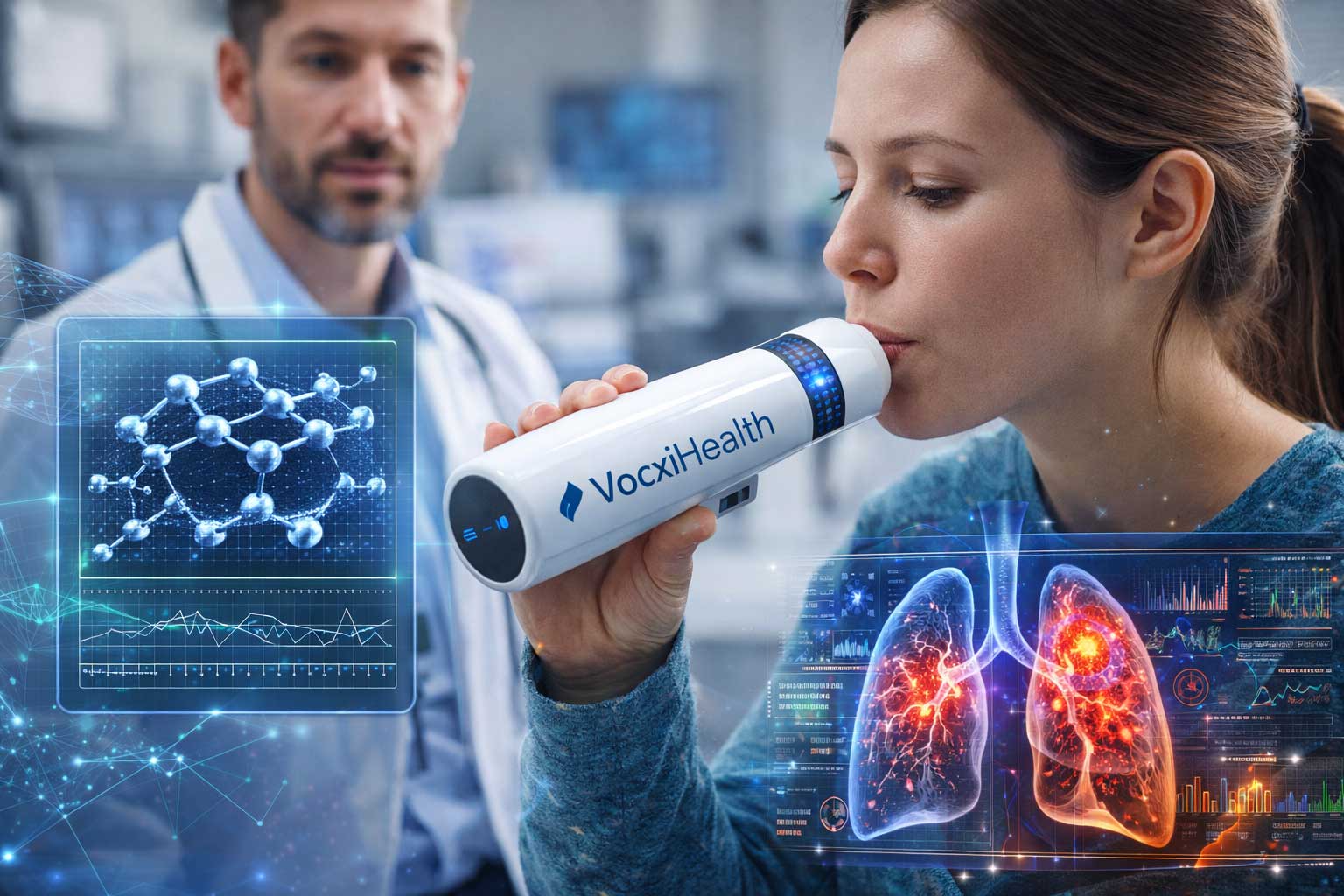
How Vocxi Health Used Graphene to Build a Cancer-Smelling Breath Diagnostic Device
In 2026, Vocxi Health has emerged as one of the most watched innovators in the medical diagnostics industry, thanks to its breakthrough handheld breath-testing technology called MyBreathPrint®. The device is designed to detect lung cancer by analyzing chemical biomarkers in a patient’s breath, using a graphene-based sensor array that functions like a high-tech “electronic nose.”
Instead of relying on radiation-based imaging or invasive biopsies, Vocxi Health’s approach aims to deliver rapid and non-invasive early detection. By combining graphene nanotechnology with machine learning, MyBreathPrint® represents a major step toward a future where cancer screening can be done in under a minute during a routine doctor visit.
What Is Vocxi Health’s MyBreathPrint® Device?
MyBreathPrint® is a portable diagnostic tool developed by Vocxi Health that uses a breath sample to detect early-stage lung cancer signals. The device is often described as part of the modern “liquid biopsy” movement, where cancer detection is performed through biological signatures instead of imaging scans or tissue removal.
Unlike blood-based liquid biopsies, MyBreathPrint® focuses on volatile organic compounds (VOCs), which are chemical molecules released into human breath as byproducts of metabolic processes. Certain cancers are believed to produce distinct VOC patterns, meaning the breath itself can contain a detectable “chemical fingerprint.”
How Graphene Helps Vocxi Health “Smell” Cancer
The core of Vocxi Health’s innovation is its graphene-based sensor technology. Graphene is a one-atom-thick sheet of carbon arranged in a honeycomb structure. Because it is extremely thin, highly conductive, and has an enormous surface area relative to its size, graphene is considered one of the most sensitive sensor materials ever discovered.
Vocxi Health uses graphene not as a structural component, but as the active sensing surface that reacts to chemical molecules in breath.
The Graphene Sensor Array
Vocxi’s system reportedly uses a single monolayer of graphene that is functionalized with specialized chemical receptors. These receptors are engineered to interact with certain VOC compounds that may be linked to lung cancer metabolism.
Because graphene is so reactive at the molecular level, even a small interaction can cause measurable electrical changes. This is what makes the technology far more sensitive than conventional breath sensors.
Vocxi Health’s graphene-based design is described as being up to 1,000 times more sensitive than many traditional electronic sensing materials, which is a key reason the device can detect biomarkers at extremely low concentrations.
Quantum Capacitance and Electrical Pattern Detection
When a patient breathes into the device, VOC molecules come into contact with the graphene surface. This interaction causes shifts in the graphene’s electrical behavior, including changes in quantum capacitance.
In simple terms, the breath chemicals trigger a measurable electrical “signal change” in the graphene sensor. The device then converts these chemical reactions into unique electrical patterns.
Instead of identifying one molecule at a time, the system detects a combination of signals, forming a recognizable “signature” that can be compared against known disease profiles.
What Is a “BreathPrint” and How Does AI Analyze It?
Vocxi Health refers to its diagnostic output as a BreathPrint, meaning a distinct pattern of electrical signals produced when a patient breathes into the sensor array.
This BreathPrint is analyzed by artificial intelligence, which compares the signal pattern to a trained database of disease biomarkers. The concept is often compared to cancer-sniffing dogs, which can detect cancer-related chemical signatures through smell. Vocxi’s system attempts to replicate that detection ability, but with semiconductor-level precision.
Using machine learning, the AI system can classify breathprints and flag patterns that match early lung cancer signatures, potentially identifying disease before it becomes visible through imaging.
Why This Technology Matters for Lung Cancer Screening
Lung cancer remains one of the deadliest cancers in the world largely because it is often diagnosed too late. Most patients are not diagnosed until the disease has already progressed to advanced stages, when survival rates are significantly lower.
Vocxi Health’s MyBreathPrint® aims to shift screening earlier, when cancer is most treatable.
Fast, Non-Invasive Testing
One of the most compelling advantages of breath-based diagnostics is speed. MyBreathPrint® requires only about one minute of normal breathing, and results are delivered almost instantly through a physician-connected system.
Unlike CT scans, biopsies, or lab-based blood tests, the breath test does not require:
- Radiation exposure
- Needles or blood collection
- Hospital imaging rooms
- Multiple-day lab processing
This makes the system highly scalable for everyday healthcare settings.
Early Detection Potential
Vocxi Health’s approach is designed to detect cancer-related chemical biomarkers at extremely low concentrations, potentially at the parts-per-billion level.
If validated at scale, this could enable detection at Stage 0 or Stage 1, where survivability is dramatically higher compared to late-stage diagnosis.
Vocxi Health vs Traditional Lung Cancer Screening Methods
In the United States, the most common screening method for high-risk patients is the low-dose CT (LDCT) scan. While LDCT scans can detect suspicious nodules, they also create a common problem: uncertainty.
Many patients are told they have a small nodule, but must wait months for follow-up scans to confirm whether it is cancerous.
Vocxi’s BreathPrint approach aims to provide a more immediate chemical-level signal, potentially reducing long-term monitoring anxiety and repeated imaging costs.
Clinical Progress and 2026 Status
As of February 2026, Vocxi Health is transitioning from clinical trials toward broader healthcare integration. The device is moving closer to real-world deployment as observational studies expand and AI breathprint databases grow.
One of the most scalable features of the platform is that the hardware remains the same. To detect additional diseases, the company mainly needs to expand its AI training database and validate new VOC patterns.
Vocxi is reportedly exploring observational studies for other solid tumors and viral infections, positioning the platform as a future multi-disease diagnostic tool.
Why Graphene Was the Missing Link in Breath Diagnostics
Breath diagnostics is not a new concept. For decades, scientists have known that breath contains chemical clues about health. The problem has always been sensitivity. Many traditional breath tests require bulky lab equipment such as mass spectrometers to detect small chemical concentrations.
Vocxi’s graphene sensor approach could be the missing link because it delivers extreme sensitivity in a compact handheld device.
By combining graphene’s molecular responsiveness with machine learning classification, Vocxi Health is building a technology platform that could transform routine screening into a fast, accessible procedure.
Final Takeaway
Vocxi Health’s MyBreathPrint® device represents a major breakthrough in how graphene is being applied in real-world healthcare. By using a graphene-based nanosensor array, the device can detect chemical lung cancer biomarkers through breath, translating VOC interactions into electrical signals that AI can classify within seconds.
If large-scale clinical trials confirm its accuracy, this technology could redefine early cancer screening and reduce reliance on invasive biopsies and repeated CT scans, making the future of cancer detection as simple as breathing into a handheld device.
Frequently Asked Questions (FAQ)
What is Vocxi Health’s MyBreathPrint®?
MyBreathPrint® is a handheld diagnostic device developed by Vocxi Health that detects lung cancer biomarkers through chemical analysis of a patient’s breath.
How does graphene help detect cancer in breath?
Graphene is highly sensitive to chemical molecules. When VOC biomarkers in breath interact with the graphene sensor, it creates measurable electrical signal changes that can be analyzed for cancer patterns.
What does “cancer-smelling device” mean?
It refers to a sensor technology that detects cancer-related VOC chemical signatures in breath, similar to how trained dogs can detect cancer through smell.
How fast is the MyBreathPrint® test?
The test requires about one minute of normal breathing and can deliver results to a connected physician platform within seconds.
Is MyBreathPrint® a replacement for CT scans?
As of 2026, it is still being evaluated in clinical trials and is positioned as a screening or supplementary tool rather than a full replacement for CT scans.
Can Vocxi’s graphene device detect cancers besides lung cancer?
The technology is designed to be expandable. The hardware can remain the same while the AI database is updated to detect additional cancers or diseases.