
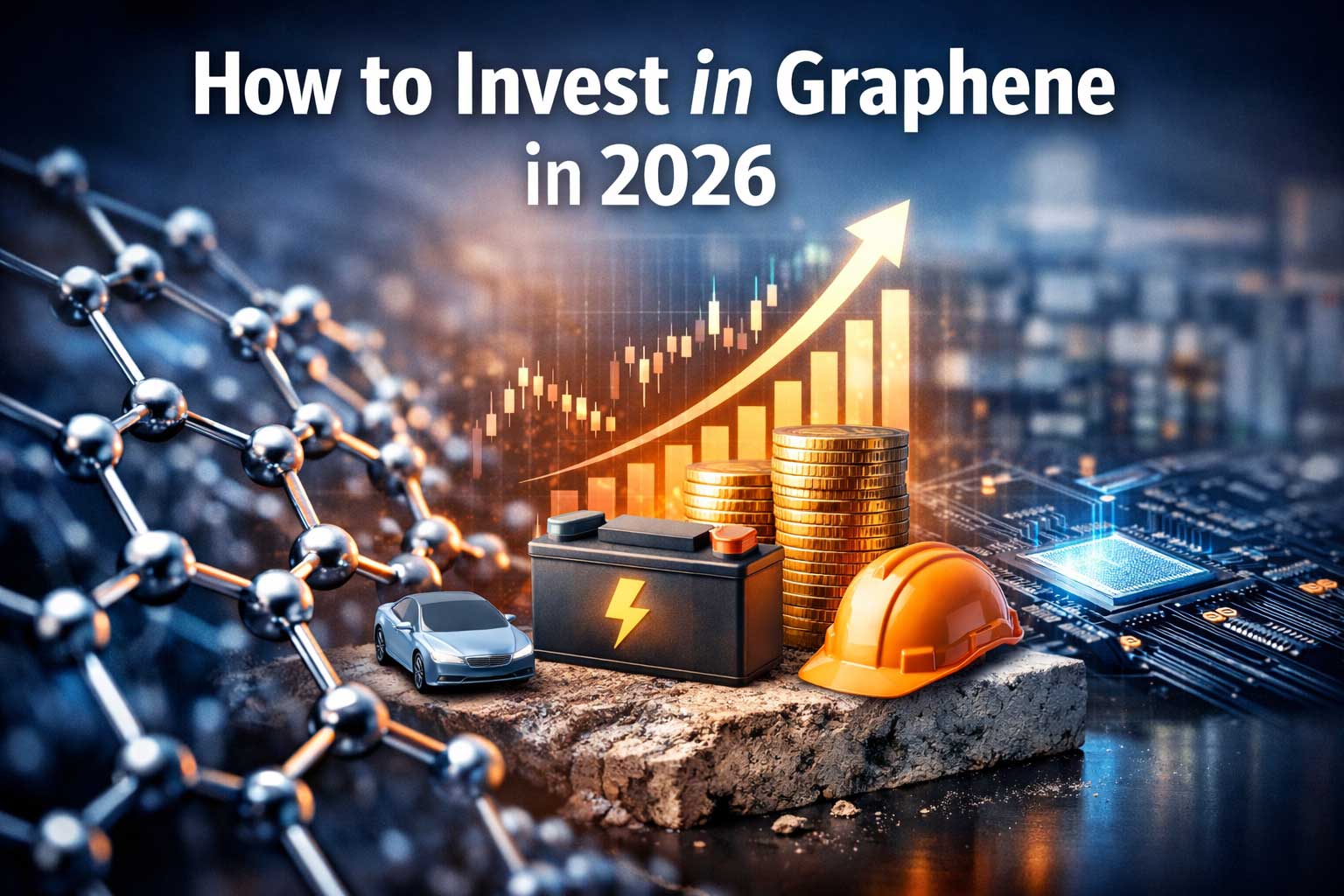
How to Invest in Graphene in 2026 Without Taking Unnecessary Risk
Graphene has long been described as a “miracle material” — stronger than steel, lighter than aluminum, and more conductive than copper. But for investors, graphene is not simply a scientific breakthrough. It is a high-volatility, early-stage industrial theme positioned at the intersection of electric vehicles, semiconductors, aerospace engineering, and advanced construction materials.
In 2026, the graphene industry is transitioning from research-driven innovation to commercial deployment. This “lab-to-fab” shift creates asymmetric opportunity — but it also exposes investors to dilution risk, commercialization delays, and uneven revenue scaling. Capital allocation discipline is critical.
Why Graphene Matters Now
Graphene is a single layer of carbon atoms arranged in a two-dimensional hexagonal lattice. Ongoing materials science research and semiconductor initiatives continue to explore its exceptional properties.
- Exceptional tensile strength (stronger than steel by weight)
- High electrical conductivity
- Superior thermal dissipation
- Lightweight flexibility for composite materials
- Barrier properties for coatings and corrosion resistance
Industry analysts estimate the global graphene market could exceed $1–3 billion in 2026, with long-term compound annual growth rates potentially above 30%. However, widespread industrial standardization is still developing — and revenue concentration remains limited.
The gap between scientific promise and consistent earnings is what defines graphene investing today.
The Graphene Investment Pyramid
Tier 1: Infrastructure & Equipment Suppliers (Lower Risk)
Companies supplying advanced manufacturing equipment often provide more stable exposure. For example, equipment manufacturers that produce chemical vapor deposition (CVD) systems support graphene and semiconductor fabrication without relying on a single material breakthrough.
This “picks and shovels” strategy mirrors historical resource cycles — where infrastructure suppliers frequently deliver steadier returns than early-stage producers.
Tier 2: Commercial-Scale Graphene Producers (Moderate to High Risk)
These firms focus directly on graphene production and application integration, including companies expanding into automotive plastics, EV battery materials, aluminum-ion battery development, industrial additives, and advanced coatings.
Most remain small-cap or micro-cap equities, meaning liquidity risk and share dilution must be carefully evaluated.
Tier 3: Indirect Corporate Exposure (Lower Volatility)
Major global corporations are integrating graphene into batteries, thermal systems, and composite materials. Investors can gain exposure indirectly through diversified materials, electronics, or EV suppliers rather than through pure-play graphene firms.
This strategy reduces volatility while preserving exposure to long-term adoption trends.
Financial Strength Snapshot (2026)
Balance sheet durability often matters more than innovation headlines. Recent filings show significant variation across the sector.
| Company Type | Liquidity | Debt Profile | Profitability | Risk Profile |
|---|---|---|---|---|
| Equipment Supplier | Strong cash position | Minimal debt | Profitable | Lower |
| Large Pure-Play Producer | Large cash reserve | Moderate debt | Net loss, improving margins | Moderate |
| Lean Industrial Producer | Debt-free | None | Near break-even | Moderate |
| Battery-Focused Innovator | Healthy liquidity | Low debt | Pre-profit stage | Speculative |
| Early-Stage Coating Developer | Limited liquidity | Comparable debt | Pre-revenue | High |
Financial survivability separates investment-grade candidates from experimental stories.
Primary Growth Catalysts in 2026
EV Battery Enhancement
Graphene-enhanced anodes may improve charging efficiency and thermal stability, supporting faster charging cycles and longer battery life.
Semiconductor Development
Research initiatives continue exploring graphene’s potential as a complement or alternative to silicon in advanced electronics.
Green Infrastructure
Graphene-infused concrete additives are being evaluated to increase durability and reduce cement-related emissions.
Each catalyst remains in scaling phase rather than mass adoption.
Core Investment Risks
Commercialization Lag
Prototype success does not guarantee large-scale purchase orders.
Equity Dilution
Small-cap firms often issue new shares to finance expansion.
Liquidity Constraints
Micro-cap stocks may experience wide bid-ask spreads and execution risk.
Cost Competition
Graphene must compete economically with established industrial additives.
Capital Allocation Framework for 2026
- Core allocation to financially stable infrastructure suppliers
- Selective exposure to commercial-scale producers with improving fundamentals
- Long-term time horizon with volatility tolerance
Graphene remains a frontier materials theme. It is not yet a mature industrial sector with predictable earnings cycles.
The Bottom Line
Graphene investing in 2026 requires disciplined analysis, balance sheet evaluation, and patience. The material’s scientific promise is significant — but capital markets reward execution and scalability, not theoretical advantage.
The opportunity is real. The volatility is equally real. In this sector, risk management is not optional — it is the strategy.