
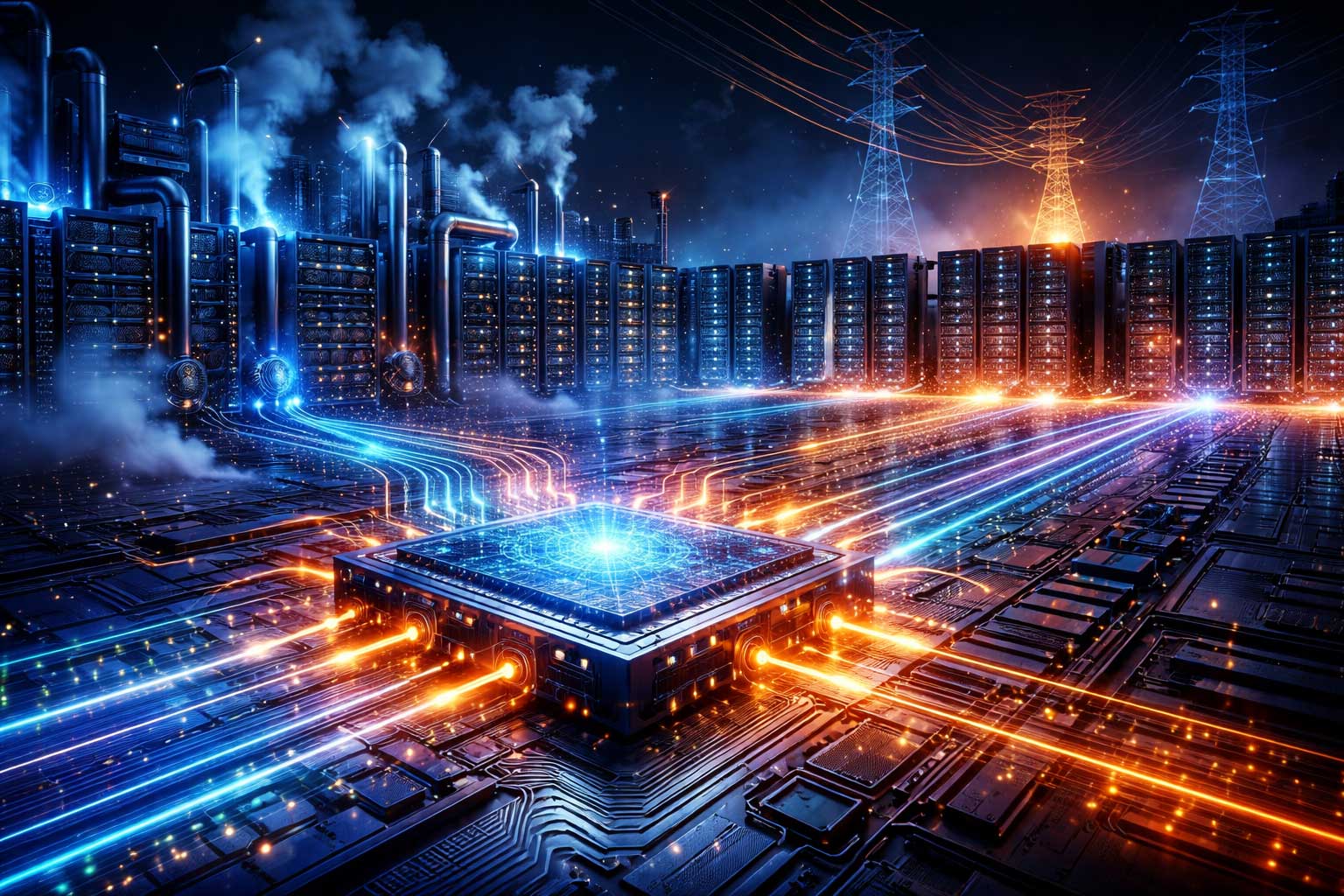
How Is Energy Used for AI? What Powers Training, Inference and Cooling
Artificial intelligence may feel invisible on the user side, but behind every chatbot reply, image generation request, and coding suggestion is a very physical system powered by electricity. The biggest energy demands come from training large models, running them for users in real time, and cooling the dense hardware inside modern data centers. The International Energy Agency says data center electricity use is set to more than double to around 945 terawatt-hours by 2030, with AI identified as the main driver of that growth.
That shift is changing how the industry talks about AI. The discussion is no longer only about model capability. It is also about how electricity is consumed, where the largest energy loads sit, and how companies can keep AI systems efficient as demand rises.
How AI uses energy
AI uses energy across three main layers: computation, cooling, and supporting infrastructure. Computation is the direct power used by processors such as GPUs, CPUs, and accelerators to perform large volumes of mathematical operations. Cooling is required because AI chips generate intense heat under sustained high loads. Supporting infrastructure includes power conversion, networking, storage, and standby capacity designed to handle spikes in demand.
The training phase: the learning cost
Training is the phase where an AI model learns patterns from massive datasets. This process can run across thousands of specialized chips for days, weeks, or months. During training, systems are typically pushed at very high utilization for extended periods, which makes this one of the most electricity-intensive steps in the AI lifecycle.
Training also drives secondary energy use. The more power that goes into densely packed processors, the more cooling is needed to keep them operating within safe thermal limits. This is one reason AI infrastructure is different from ordinary office or consumer computing.
The inference phase: the usage cost
Inference is what happens after training, when a user asks an AI system a question and the model generates a response. One request may seem small on its own, but inference happens continuously and at enormous scale. That is why many analysts now treat inference as a major long-term source of AI electricity demand. EPRI said in February 2026 that AI workloads currently account for only part of data center electricity use, but that share is rising as adoption expands.
For ChatGPT specifically, Sam Altman said in June 2025 that the average query uses about 0.34 watt-hours of electricity. That figure is widely cited, but it should still be treated as model- and workload-specific rather than a universal number for all AI systems, since energy use varies by model size, task complexity, hardware, and data center design.
Where the electricity actually goes inside an AI data center
The electricity used by AI is not spent on “thinking” alone. A large share also goes to keeping the facility stable and cool enough to operate. In practical terms, energy in AI data centers is spread across processor workloads, thermal management, power delivery systems, networking, and storage. As rack densities increase, these non-compute demands become more important.
| Area | How energy is used |
|---|---|
| Compute | Running GPUs, CPUs, and accelerators for training and inference workloads |
| Cooling | Removing heat from high-density racks through air, direct-to-chip liquid cooling, or immersion systems |
| Power infrastructure | Converting and distributing electricity across servers, networking gear, and backup systems |
| Support systems | Networking, storage, idle readiness, and facility-level operations |
Why AI needs more power than traditional computing
The main difference is power density. AI servers concentrate far more compute into each rack than conventional enterprise systems. EPRI and NVIDIA both point to rising rack-level power needs as AI deployment scales, with newer systems increasingly requiring advanced liquid cooling and redesigned power architecture.
That means AI growth is not just about adding more servers. It often requires rethinking the building itself: electrical upgrades, cooling redesign, and stronger grid connections. The IEA said the United States alone is expected to account for the largest share of projected data center electricity growth through 2030.
Cooling is now central to the AI energy story
Cooling has become one of the most important pieces of AI infrastructure because the latest chips produce concentrated heat loads that traditional air cooling struggles to manage efficiently. That is why direct-to-chip liquid cooling and immersion systems are moving from niche deployments into mainstream data center planning.
NVIDIA says its Blackwell platform is designed around liquid-cooled, high-density deployment and claims major gains in throughput, water efficiency, and energy efficiency compared with traditional air-cooled approaches. Those figures come from the company itself, but they still illustrate the direction the sector is moving: denser racks, more advanced cooling, and tighter coupling between chip design and facility engineering.
What this means for the power grid
AI energy use is now large enough to matter beyond the data center industry. The IEA projects that global data center electricity consumption will rise sharply by 2030, while EPRI projects U.S. data centers could account for 9% to 17% of national electricity use by that point, depending on how demand evolves.
That does not mean all of that demand comes from AI alone, but AI is a central driver. The practical result is growing pressure on utilities, transmission systems, and regional planners to prepare for much larger and more concentrated loads.
The bigger takeaway
So, how is energy used for AI? It is used to train models, serve live responses, cool high-density hardware, and keep data center systems ready at scale. The answer is not just “AI uses electricity.” The more complete answer is that AI depends on an entire industrial stack of chips, cooling systems, power electronics, and grid infrastructure.
As AI adoption spreads, efficiency is becoming a competitive issue, not just an environmental one. The next major advances may come not only from smarter models, but from systems that deliver more useful output with less energy per task.