
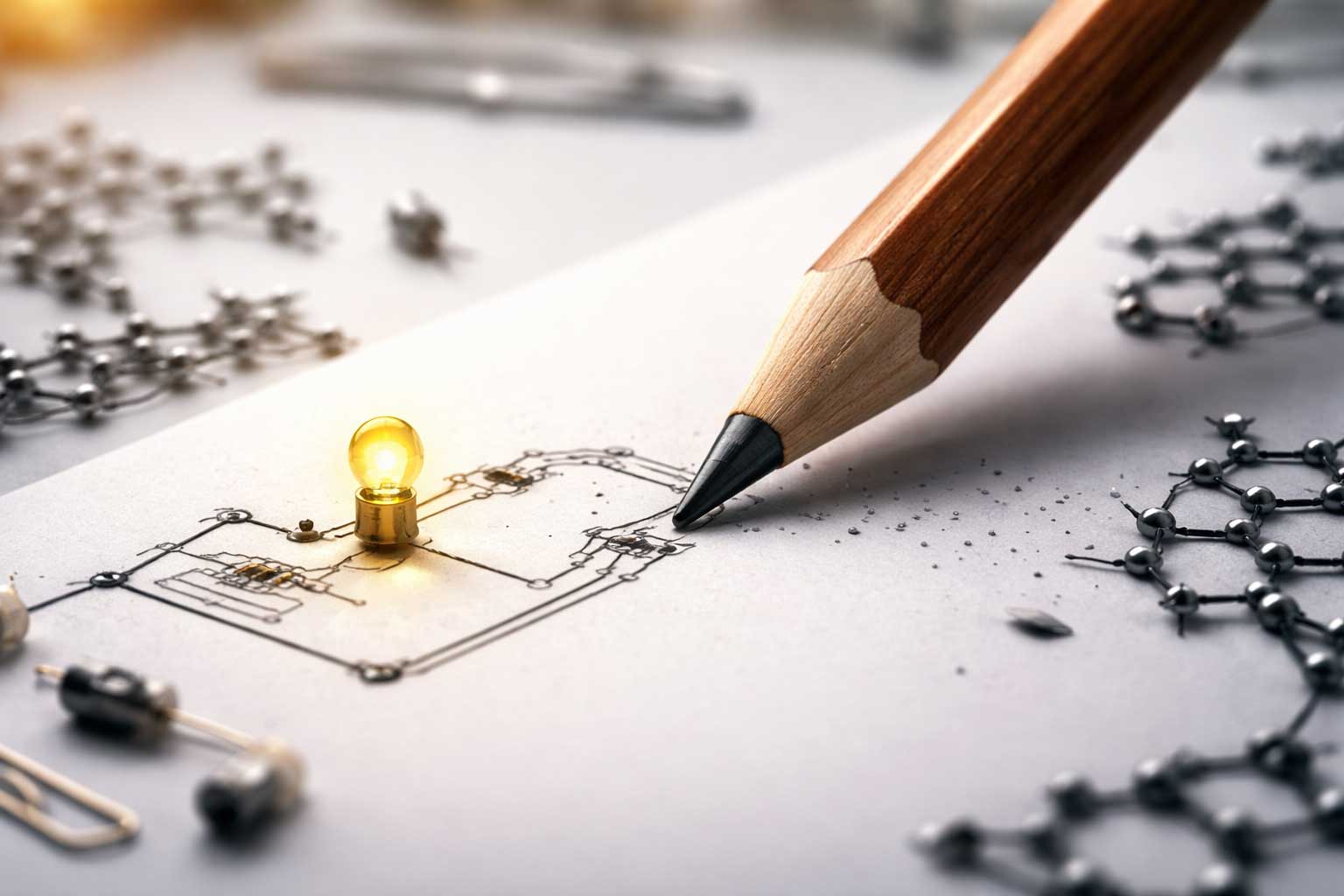
How Does a Graphene Pencil Work
A graphene pencil is a next-generation writing instrument that replaces traditional graphite with graphene-based material. While it looks and feels similar to a normal pencil, its behavior on paper reveals a far more advanced mechanism rooted in nanoscale physics.
Beyond writing, a graphene pencil can lay down electrically conductive traces, enabling simple circuits, sensors, and smart-paper applications. It transforms an everyday tool into a bridge between analog creativity and digital technology.
Definition
A graphene pencil is a writing device that uses graphene or graphene-enhanced carbon instead of conventional graphite. Graphene is a single-atom-thick sheet of carbon arranged in a hexagonal lattice. Unlike graphite, which consists of millions of stacked graphene layers, a graphene pencil aims to deposit much thinner, more uniform carbon layers onto a surface.
Functionally, it still works by abrasion: material transfers from the pencil to the paper. The difference lies in scale and structure. Instead of thick, irregular flakes, a graphene pencil deposits ultra-thin carbon sheets, producing smoother lines, greater precision, and in some cases, electrically conductive marks.
Composition and Structure
Traditional pencils contain graphite mixed with clay and binders. Graphite itself is a bulk material composed of many graphene layers weakly bonded together. In a graphene pencil, the “lead” is engineered using:
- Few-layer graphene flakes
- Graphene-oxide or reduced graphene composites
- Carbon matrices enriched with graphene sheets
These materials are compressed into a rod similar in form to standard pencil cores. The internal structure is optimized so that graphene layers shear off easily under light pressure while remaining mechanically stable. This balance allows consistent transfer without rapid wear.
Key Properties
- Atomic Thinness: Graphene is one atom thick, enabling extremely fine deposition.
- Low Friction: Sheets slide over one another smoothly, producing effortless writing.
- High Strength: Graphene is stronger than steel at equal thickness, extending pencil lifespan.
- Electrical Conductivity: Deposited lines can conduct electricity.
- Uniformity: Marks are consistent and sharply defined.
Production and Processing Methods
Manufacturing a graphene pencil begins with graphene synthesis. Methods include chemical exfoliation, thermal reduction of graphene oxide, and mechanical delamination. The resulting graphene flakes are blended with controlled binders and carbon fillers.
The mixture is extruded into rods and cured under heat and pressure. Unlike graphite pencils, the ratio of graphene to binder is carefully tuned to maintain both conductivity and mechanical cohesion. The rod is then encased in wood or polymer just like a conventional pencil.
Some experimental versions use near-pure graphene pellets sintered into solid cores, maximizing electrical performance for research applications.
Applications and Use Cases
- Precision Writing and Drawing: Artists benefit from smooth strokes and consistent shading.
- Paper-Based Electronics: Users can draw circuits, resistors, and antennas.
- Educational Tools: Demonstrates conductivity and nanomaterials in classrooms.
- Rapid Prototyping: Engineers sketch functional components without tools.
- Smart Packaging and Labels: Conductive traces can trigger sensors or indicators.
Advantages
Graphene pencils outperform traditional pencils in multiple dimensions:
- Longer usable lifespan
- Cleaner, darker, more uniform lines
- Minimal pressure required
- Ability to create conductive paths
- Resistance to breakage
They unify writing, drawing, and electronics in a single, intuitive tool.
Limitations and Challenges
Despite their promise, graphene pencils face hurdles:
- Higher production cost
- Inconsistent conductivity on rough paper
- Limited mass-market availability
- Variability between manufacturers
Graphene synthesis at scale remains expensive, and maintaining purity while preserving usability is technically demanding.
Safety, Ethical, and Environmental Notes
Graphene is carbon-based and non-toxic in solid form. However, fine graphene dust may pose respiratory risks in industrial settings. Responsible manufacturing includes dust control and protective equipment.
Environmentally, graphene pencils reduce reliance on mining natural graphite and can be produced using recycled carbon. This positions them as a more sustainable writing technology.
Future Outlook
As graphene production becomes cheaper and more consistent, graphene pencils may become mainstream. Future versions could integrate sensing capabilities, interact with digital devices, or function as hybrid stylus-tools.
They represent a philosophical shift: ordinary objects evolving into intelligent interfaces. A pencil that once only recorded thoughts may soon transmit data, power circuits, and connect paper to the digital world.
Frequently Asked Questions
Is a graphene pencil the same as a normal pencil?
No. A normal pencil uses graphite, which is many stacked layers of graphene. A graphene pencil uses graphene-based material that deposits thinner, more uniform layers with additional properties such as electrical conductivity.
Can a graphene pencil really conduct electricity?
Yes. The lines drawn by a graphene pencil can conduct current, enabling simple circuits, switches, and sensors on paper.
Does a graphene pencil last longer?
In most designs, yes. Graphene’s strength reduces wear, allowing the core to last longer than standard graphite leads.
Is it safe for children to use?
For normal use, it is safe. The material is solid carbon. Industrial exposure to graphene dust requires precautions, but consumer pencils pose no known risk.
Are graphene pencils commercially available?
Some experimental and niche products exist, primarily for education and research. Widespread consumer versions are still emerging.