
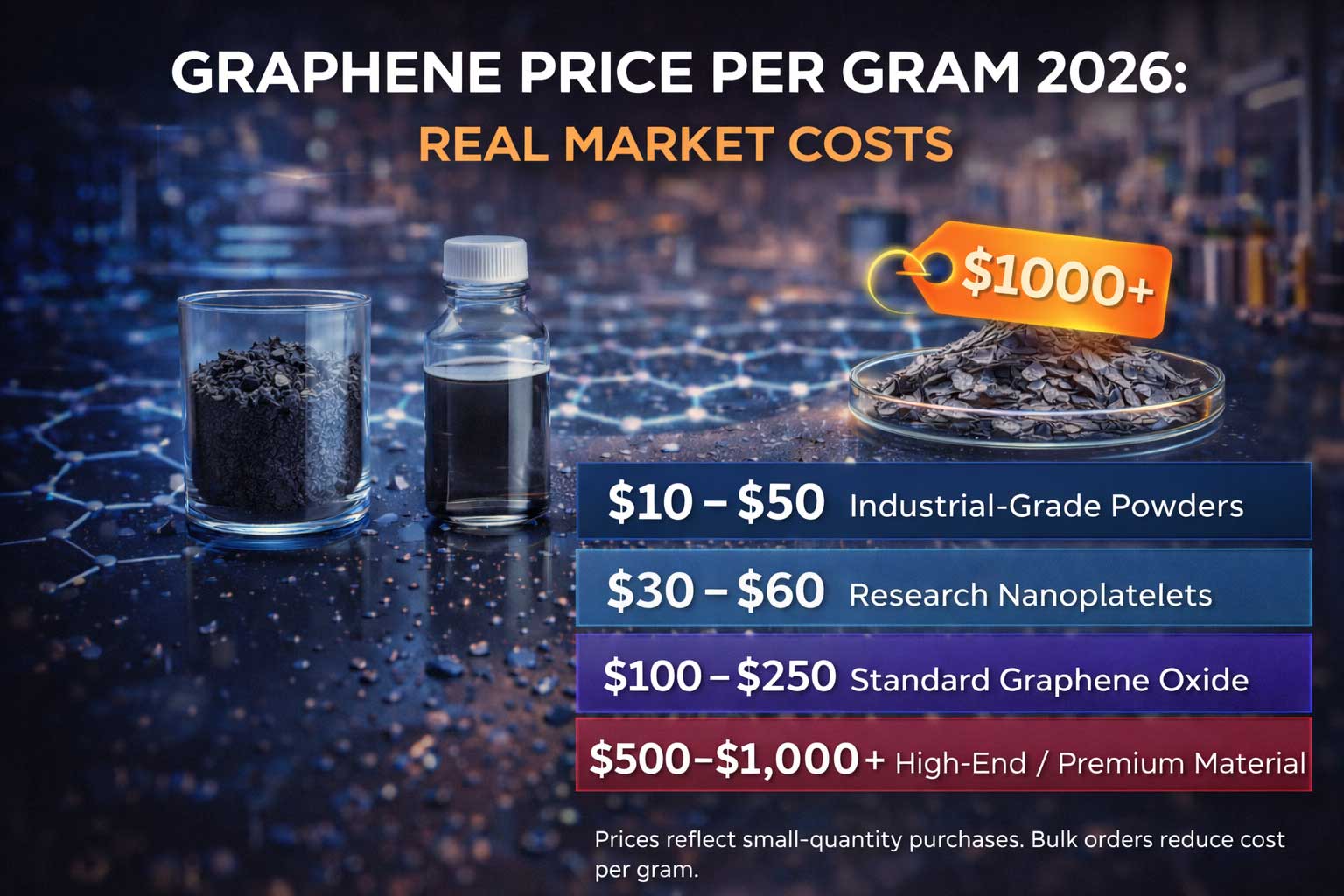
Graphene Price per Gram in 2026
Graphene is often described as a “wonder material,” but its price still surprises many people. Unlike metals such as copper or silver, graphene does not have a single global market price.
In 2026, the cost of graphene varies widely depending on its form, purity, and production method. A gram of graphene can cost anywhere from a few dollars to more than a thousand.
Typical Graphene Prices in 2026
Here are realistic market ranges for graphene materials sold in small quantities:
- Industrial-grade graphene powders: $10–$50 per gram
- Research-grade graphene nanoplatelets: $30–$60 per gram
- Graphene oxide (standard lab grade): $100–$250 per gram
- High-purity or CVD graphene: $500–$1,000+ per gram
These prices reflect retail and laboratory-scale purchases. In bulk orders, the cost per gram drops dramatically.
Why Graphene Prices Vary So Much
Graphene is not a single uniform product. Price depends on:
- Number of layers (single-layer vs. multi-layer)
- Purity and defect levels
- Production method (exfoliation, chemical synthesis, CVD)
- Form (powder, film, dispersion, oxide)
- Order volume
A gram of ultra-pure single-layer graphene used for electronics research is far more expensive than a gram of bulk graphene powder used in plastics.
Bulk Pricing Changes Everything
When graphene is purchased by the kilogram, the effective cost per gram can fall below $1. Industrial suppliers often sell:
- Graphene nanoplatelets for composites at scale
- Masterbatches for plastics and rubber
- Dispersions for coatings and inks
At these volumes, graphene becomes economically viable for mass-market products such as car parts, tires, coatings, and textiles.
How Prices Are Trending
Graphene prices have steadily fallen over the past decade due to:
- Improved production techniques
- Higher manufacturing yields
- Growing industrial demand
- Competition among suppliers
In 2026, graphene remains expensive at the research level, but increasingly affordable for industrial use. This trend is what enables graphene to move from laboratories into everyday products.
What “Expensive” Really Means
Although graphene may cost hundreds of dollars per gram in lab form, real-world products use extremely small amounts. A coating, battery additive, or composite may contain only milligrams.
In practice, graphene often adds just cents to the cost of a finished product while delivering significant performance gains.
The Big Picture
Graphene does not behave like a commodity metal with a fixed spot price. It is a family of advanced materials, each with its own market value.
In 2026, graphene pricing reflects a transition:
- High-cost research material
- Mid-cost specialty additive
- Low-cost industrial enhancer at scale
This range is what makes graphene both a premium research material and a practical industrial component at the same time.
Frequently Asked Questions
Why is graphene so expensive?
High-purity graphene requires complex production and quality control.
Is graphene getting cheaper?
Yes. Industrial graphene costs have dropped significantly over the past decade.
Can graphene ever be cheap?
At scale, graphene already costs less than $1 per gram in some industrial uses.
Does product cost reflect gram price?
No. Products use tiny amounts, so graphene often adds only cents to cost.
Is there a global graphene price?
No. Each type of graphene has its own market and pricing structure.