
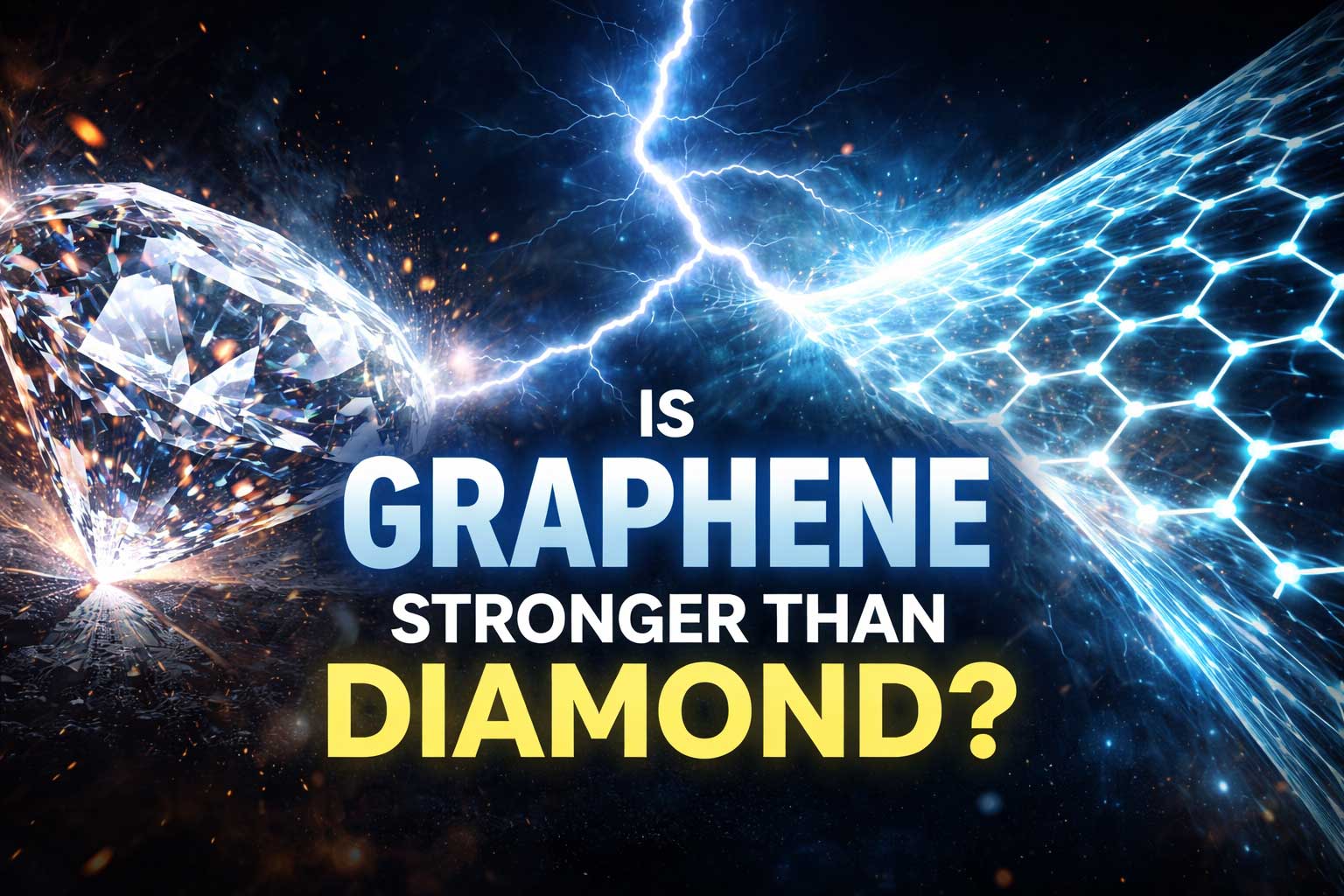
Is Graphene Stronger Than Diamond?
For centuries, diamond has symbolized ultimate strength—an unbreakable material forged under immense pressure deep within the Earth.
But science has now revealed a rival: graphene. Made from the same element as diamond, this one-atom-thick material challenges everything we thought we knew about strength.
What Does “Stronger” Really Mean?
Strength is not a single property. In materials science, it is measured in different ways:
- Hardness – resistance to scratching or indentation
- Compressive strength – resistance to being crushed
- Tensile strength – resistance to being pulled apart
- Flexibility – ability to bend without breaking
Diamond is famous for its hardness. It resists scratches better than any natural material. But hardness is not the same as overall strength.
Graphene, by contrast, excels in tensile strength. It can be stretched far more than diamond without breaking, making it extraordinarily resilient under tension.
Diamond: Hard but Brittle
Diamond’s carbon atoms are locked into a rigid three-dimensional crystal lattice. This structure makes it incredibly hard, but also brittle.
When diamond is struck at the right angle, its crystal planes can fracture. This is why diamonds can be cut and shaped. Their strength is directional.
Diamond resists compression exceptionally well, but under tension it fails much sooner than graphene.
Graphene: Flexible and Unbreakable in Tension
Graphene arranges carbon atoms into a flat, two-dimensional honeycomb lattice. This geometry distributes force evenly across the entire sheet.
As a result, graphene can:
- Stretch without tearing
- Bend without cracking
- Absorb enormous force relative to its weight
Pound for pound, graphene is more than 200 times stronger than steel and far surpasses diamond in tensile strength.
Where diamond snaps, graphene flexes.
Why Graphene Wins in Real-World Applications
Most real-world materials fail under tension, not compression. Bridges, cables, aircraft frames, body armor, and medical implants are all stressed by pulling forces.
Graphene’s ability to endure stretching makes it ideal for:
- Ultra-light armor
- Reinforced construction materials
- Flexible electronics
- Medical scaffolds for tissue repair
Diamond remains valuable for cutting, drilling, and abrasion-resistant tools. But it cannot bend, flex, or conform to shapes.
Graphene can do all of that—while remaining nearly weightless.
The Carbon Connection
Both diamond and graphene are pure carbon. The difference lies entirely in atomic arrangement.
Diamond stacks carbon atoms in a rigid three-dimensional lattice.
Graphene spreads them in a flat, two-dimensional grid.
This tiny change produces radically different physical behavior.
It is a powerful reminder that the future of materials is not about discovering new elements—but about rearranging the ones we already have.
The Future of Strength
Diamond once defined what it meant to be strong. Its reputation shaped culture, industry, and imagination.
Graphene now challenges that legacy.
It represents a new class of materials—strong not because they resist change, but because they adapt.
In a world that demands lighter, faster, and more resilient technologies, flexibility is the new strength.
Diamond may still shine.
But the future belongs to graphene.
Frequently Asked Questions
Is graphene harder than diamond?
No. Diamond remains the hardest known natural material. Graphene is stronger in tensile strength, not hardness.
Can graphene replace diamond?
Graphene will not replace diamond in cutting tools or jewelry. It will dominate applications where flexibility and tensile strength matter.
Why is graphene so strong?
Its two-dimensional honeycomb lattice distributes force evenly, preventing weak points where fractures begin.
Is graphene unbreakable?
No material is truly unbreakable. But graphene requires extraordinary force to tear relative to its thickness and weight.
Will graphene change construction?
Yes. Graphene-enhanced composites could produce lighter, stronger buildings, vehicles, and infrastructure.